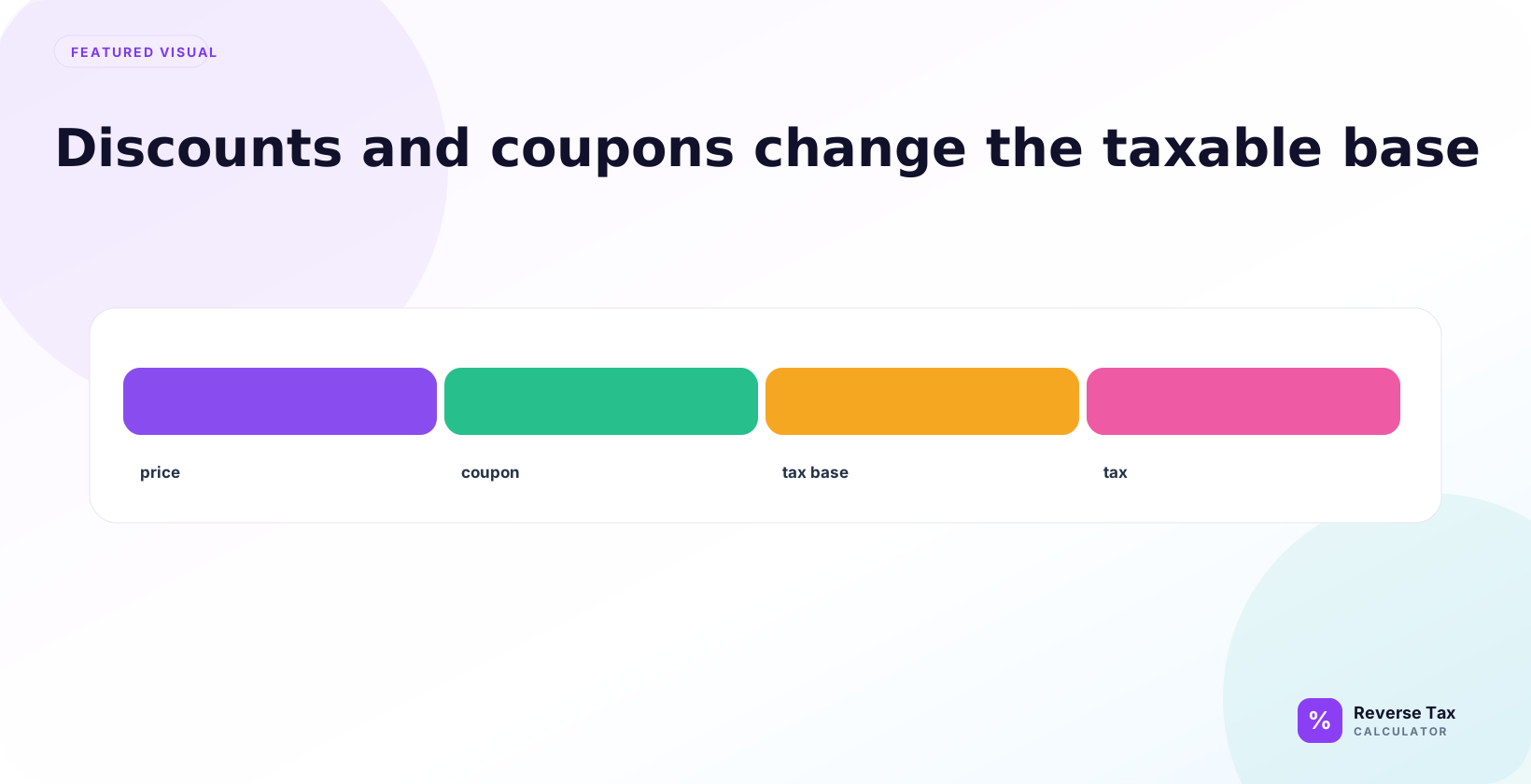
Discounted receipts need reverse tax based on the taxable amount after the coupon or discount has changed the selling price. A tax-inclusive receipt should be reversed from the discounted taxable total, not from the original list price, because the tax is usually calculated on the reduced base. Manufacturer coupons, store coupons, exempt items, and jurisdiction rules can change whether the discount lowers taxable value before the reverse formula is used.
The core question is: did the discount reduce the selling price before tax, or did someone else reimburse the seller for the discount?
Do You Reverse Tax Before or After a Discount?
Reverse tax after the discount if the discount reduced the taxable selling price before tax was charged.
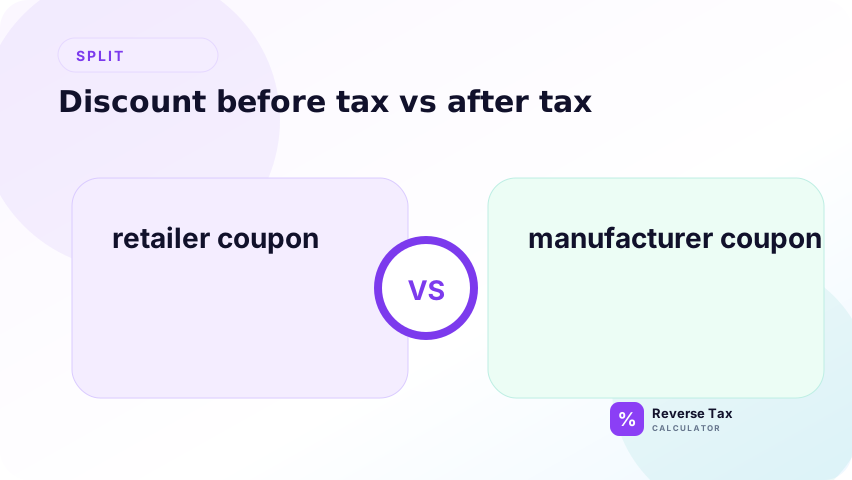
Reverse tax before the discount if the receipt tax was calculated on the original price and the discount did not reduce the taxable base.
In practice, read the receipt lines. A coupon can reduce the tax base, leave the tax base unchanged, or create a mixed result.
Why Do Discounts Change Reverse Tax?
Reverse tax depends on the tax-inclusive amount and the rate. Discounts change which amount should be treated as tax-inclusive.
If a $100 item is reduced to $80 before tax, the tax should be tested against $80. If the seller is reimbursed by a manufacturer for a $20 coupon, some jurisdictions may still treat the reimbursed amount as part of taxable sales.
That is why a coupon is not just a price label. It can be a tax-base event.
What Is the Taxable Base After a Discount?
The taxable base is the amount subject to tax after applying the rule for the discount type.
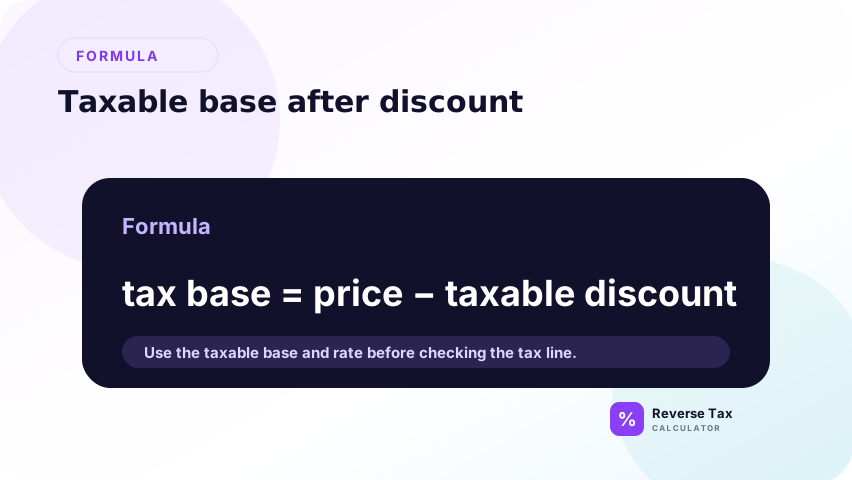
This section is the hinge for the whole article. Reverse tax does not start with the amount the customer feels they paid. It starts with the amount the tax system treated as taxable. A retailer discount, manufacturer coupon, gift card, and post-sale rebate can all change that answer differently.
Retailer Discount
A retailer discount usually reduces what the customer pays to the retailer. If no third party reimburses the seller, the discounted amount is commonly the better base to test first.
Manufacturer Coupon
A manufacturer coupon may involve third-party reimbursement. CDTFA Publication 113 says manufacturer coupon reimbursements are included in total taxable sales when the sale is subject to tax. That means the receipt can tax a larger base than the customer paid in cash.
Prompt Payment Discount
A prompt payment discount can reduce taxable sales if the customer qualifies and pays on time. CDTFA Publication 113 gives an example where a $100 sale with a 2% prompt payment discount is taxed on $98, not $100.
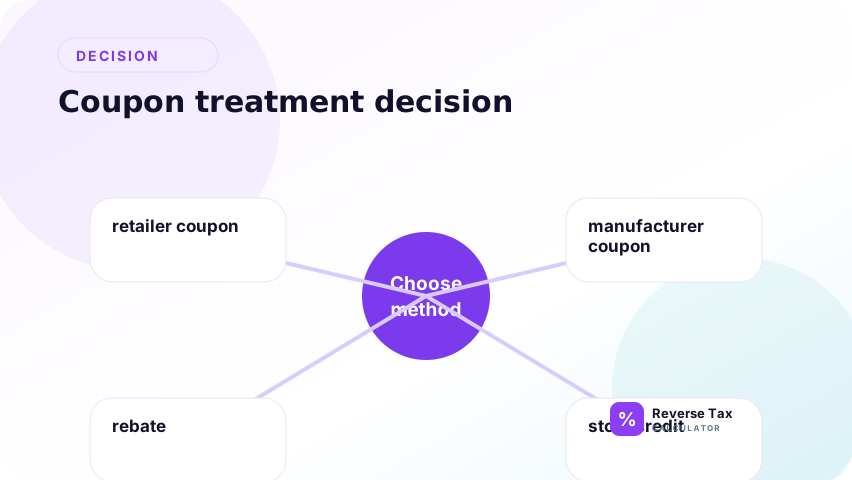
How Do Retailer Coupons Affect Reverse Tax?
Retailer coupons are issued by the seller. If the customer receives a price reduction and the seller is not reimbursed by a third party, the taxable base may be the reduced price.
Example:
Original price: $100.00
Retailer coupon: $20.00
Discounted taxable base: $80.00
Rate: 8%
Tax: $6.40
Total: $86.40
Reverse tax should use $86.40 as the tax-inclusive amount for the $80 taxable base.
How Do Manufacturer Coupons Affect Reverse Tax?
Manufacturer coupons can be different because the seller may receive reimbursement from the manufacturer. The customer pays less, but the seller receives value from another party.
Example:
Shelf price: $100.00
Manufacturer coupon: $20.00
Customer pays before tax: $80.00
Taxable base in some rules: $100.00
Rate: 8%
Tax: $8.00
Customer total: $88.00
If you reverse the $88.00 total at 8%, you get $81.48, which looks strange. The reason is that the total does not contain the full taxable base in the same way as a normal tax-inclusive price.
How Do Rebates Affect Reverse Tax?
Rebates can happen before or after the sale. A point-of-sale rebate may reduce what the customer pays at checkout. A mail-in or post-sale rebate may not reduce the taxable base at the time of sale.
Reverse tax must follow the receipt structure. If the rebate appears after tax, remove it from the payment analysis but not necessarily from the taxable base.
How Do Loyalty Points and Store Credits Affect Reverse Tax?
Loyalty points and store credits can act like discounts, payment methods, or third-party value depending on program design.
For reverse tax, classify them before calculating:
| Program type | Treat as | Reverse tax impact |
|---|---|---|
| Store-funded discount | Price reduction | Lower taxable base |
| Gift card redemption | Payment | Does not reduce taxable base |
| Manufacturer-funded reward | Third-party consideration | May keep base higher |
| Loyalty points with no reimbursement | Possible discount | Check receipt and rules |
How Do Discounts Affect Tax-Inclusive Prices?
If a price is tax-inclusive after discount, use:
Pre-tax discounted base = Discounted total divided by (1 plus rate)
If the discount was applied after tax, first reconstruct the pre-discount taxable base from the tax line or subtotal.
The sequence matters more than the formula.
This is why the calculation order should be checked before using a calculator. A discount before tax changes the base that should be reversed. A discount after tax changes the payment amount but may not change the tax-inclusive taxable amount.
Worked Example: Discount Before Tax
Receipt:
Item price: $50.00
Store coupon: $10.00
Taxable base: $40.00
Rate: 7.5%
Tax: $3.00
Total: $43.00
Reverse check:
$43.00 divided by 1.075 = $40.00
The coupon reduced the taxable base.
This example is the clean case. The discounted total contains exactly one taxable base plus tax. Because the tax base is $40.00 and the rate is 7.5%, a normal reverse tax formula can reconstruct the base without extra coupon adjustments.
Worked Example: Coupon Does Not Reduce the Full Base
Receipt:
Item price: $50.00
Manufacturer coupon: $10.00
Tax at 7.5% on $50.00: $3.75
Customer total: $43.75
If you reverse $43.75 at 7.5%, you get $40.70. That is not the shelf price or the discounted price. The receipt total includes tax on value that the customer did not pay directly.
This is why coupon pages need more than a basic calculator.
Decision Matrix: Which Amount Should You Reverse?
| Receipt clue | Likely treatment | Amount to test first |
|---|---|---|
| Store coupon before tax | Discount reduces base | Discounted subtotal |
| Manufacturer coupon | Possible third-party reimbursement | Original selling price |
| Gift card | Payment method | Price before gift card |
| Rebate after purchase | Post-sale adjustment | Original taxable sale |
| Prompt payment discount | May reduce base if earned | Discounted amount |
| Loyalty credit | Depends on program | Receipt-defined base |
Operational Workflow for Discounted Receipts
| Step | Action | Why it matters |
|---|---|---|
| 1 | Identify original item price | Finds starting value |
| 2 | Identify discount type | Separates seller discount from third-party value |
| 3 | Check discount timing | Before-tax and after-tax discounts differ |
| 4 | Calculate taxable base | Finds the amount tax should apply to |
| 5 | Recalculate tax | Confirms arithmetic |
| 6 | Document assumption | Keeps result auditable |
Common Reverse Tax Errors with Coupons
| Error | Result | Fix |
|---|---|---|
| Treating every coupon as a base reduction | Understates taxable base | Classify coupon source |
| Treating gift cards as discounts | Understates tax | Treat gift card as payment |
| Reversing final payment only | Produces odd base | Add back payment credits when needed |
| Ignoring tax line | Misses actual base | Use tax amount to infer base |
| Using one rule nationally | Overgeneralizes | Verify jurisdiction |
How Can You Tell If the Discount Was Before Tax?
You can tell a discount was before tax by checking whether the taxable subtotal was reduced before the tax line was calculated. If the receipt shows item price, discount, lower taxable subtotal, then tax, the discount likely reduced the tax base. If the discount appears after tax or as payment, gift card, loyalty credit, or reimbursement, it may not reduce tax in the same way.
Look for the order of lines on the receipt.
Receipt order is not perfect legal proof, but it is useful calculation evidence. A discount above the tax line usually suggests the discount affected the taxable base. A discount below the tax line may suggest a payment adjustment, credit, or after-tax reduction.
Discount Appears Above Tax
This often means the discount reduced the taxable base.
Discount Appears Below Tax
This may mean the discount was a payment adjustment, credit, or post-tax reduction.
Tax Looks Too High for the Discounted Price
This can indicate a manufacturer coupon, taxable fee, or another base adjustment.
Example: Using the Tax Line to Identify Coupon Treatment
Assume a receipt shows a $100 item, a $20 coupon, 8% tax, and an $88 total.
Test one:
Tax on discounted price = $80 multiplied by 8% = $6.40
Test two:
Tax on original price = $100 multiplied by 8% = $8.00
The receipt tax is $8.00 because $88 total minus $80 customer price equals $8.00 tax. That means the coupon did not reduce the full taxable base. A reverse tax page that only divides $88 by 1.08 would miss the real structure.
How Should You Handle Stacked Promotions?
Stacked promotions need a line-by-line approach. A store coupon, manufacturer coupon, loyalty credit, and gift card can appear on one receipt but affect different parts of the transaction.
Do not combine all promotions into one discount number before calculating. First classify each promotion by source and timing. Then decide whether it changes price, payment, reimbursement, or taxable base. This prevents gift cards and manufacturer coupons from being treated like ordinary seller discounts.
Separate Price Reductions
These reduce the selling price before tax when the rule allows.
Separate Payment Credits
Gift cards and store credits usually reduce the amount due, not the taxable base.
Separate Third-Party Reimbursement
Manufacturer-funded value may keep the taxable base higher than customer cash paid.
Information Gain: Customer Payment Is Not Always the Tax Base
Many reverse tax explanations assume the amount paid by the customer equals the taxable base plus tax. Coupons break that assumption.
When a third party reimburses the retailer, the seller may have taxable value that is larger than the customer cash price. The reverse tax result can look wrong unless the article explains coupon source, timing, and reimbursement.
That distinction is the main information gain of this page. A basic calculator answer can be mathematically correct for a clean tax-inclusive total, but coupon receipts may not contain a clean total. The source of the discount determines whether the customer's cash payment is the same as the taxable base.
Trust Boundary for Discount and Coupon Calculations
A reverse tax calculator can test the arithmetic shown on a discounted receipt. It cannot decide every coupon rule without jurisdiction, coupon source, program terms, item category, and transaction date.
Use official tax authority guidance for compliance. CDTFA Publication 113 is one example of official guidance showing that manufacturer coupons, retailer coupons, prompt payment discounts, and deal instruments can have different tax consequences.
If the coupon receipt also has missing rate evidence, use the guide on calculating receipt tax when the rate is missing.
If the same receipt includes shipping, review shipping charges in reverse tax before choosing the taxable base.
If a restaurant receipt includes gratuity, check tips before or after tax before reversing the final paid amount.
Frequently Asked Questions
Do coupons reduce sales tax?
Sometimes. Retailer discounts often reduce the taxable base, while reimbursed manufacturer coupons may not.
Should I reverse tax from the discounted total?
Only if the discount reduced the taxable base before tax was calculated.
Why is tax higher than expected after a coupon?
The coupon may be manufacturer-funded, or the receipt may include taxable fees or other taxable items.
Is a gift card a discount?
Usually no. A gift card is generally a payment method, not a reduction in selling price.
What is the safest way to calculate?
Use the tax line and taxable base shown or implied by the receipt, then verify the coupon rule with the relevant authority.
Sources and Notes
- Formula source: arithmetic relationship between taxable base, rate, tax, and total.
- CDTFA Publication 113, Coupons, Discounts, and Rebates
- Accuracy note: coupon tax treatment varies by jurisdiction and program terms.