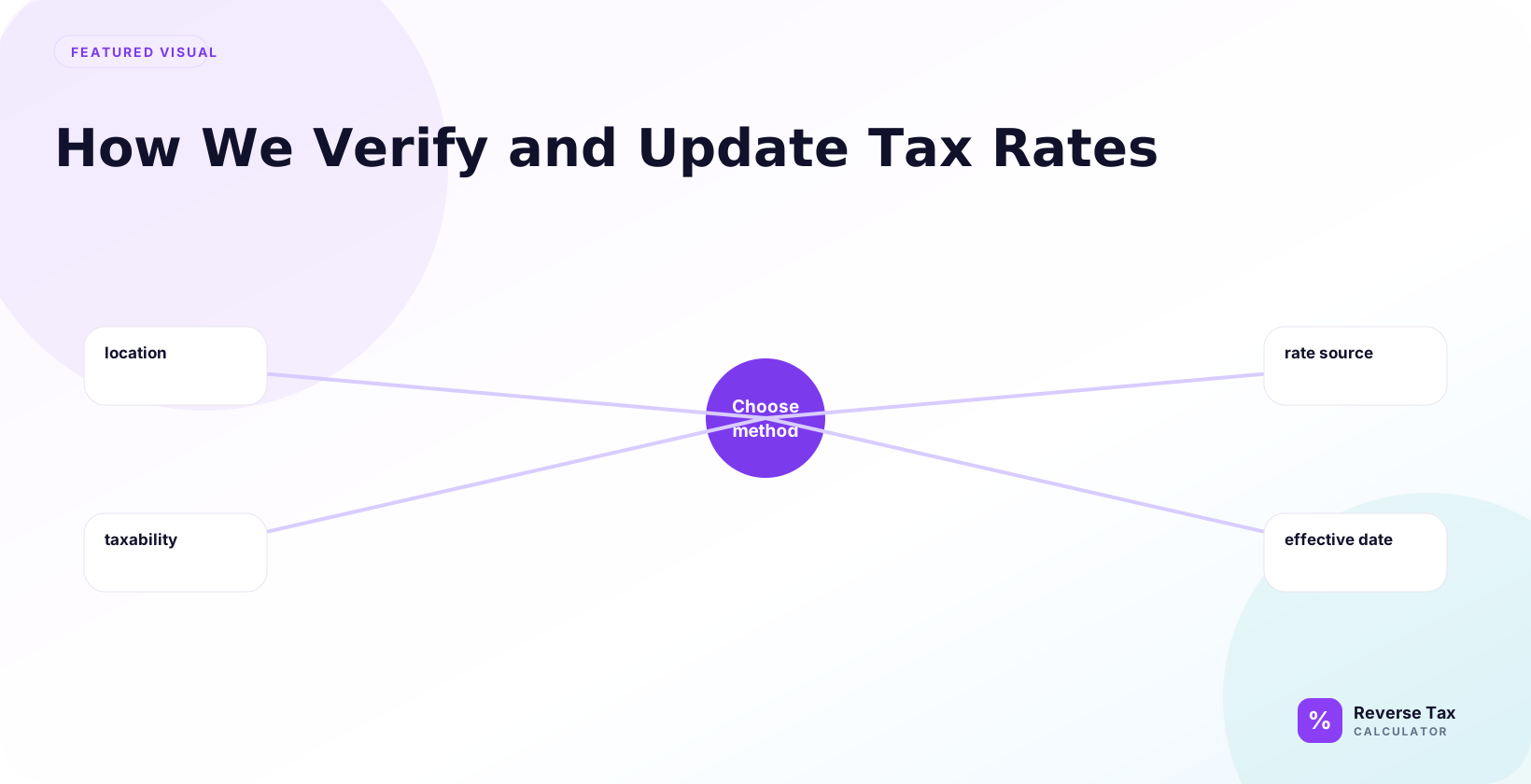
Tax rate verification means checking rates against official or primary rate sources before using them in reverse tax calculations. A rate update changes the multiplier, so stale tax data can produce the wrong before-tax price and included tax even when the formula is correct. Verification needs jurisdiction, effective date, tax type, product category, local rate layer, and exemption status because rate tables do not always match every receipt.
Why Rate Provenance Matters
Reverse tax uses the rate as a core input:
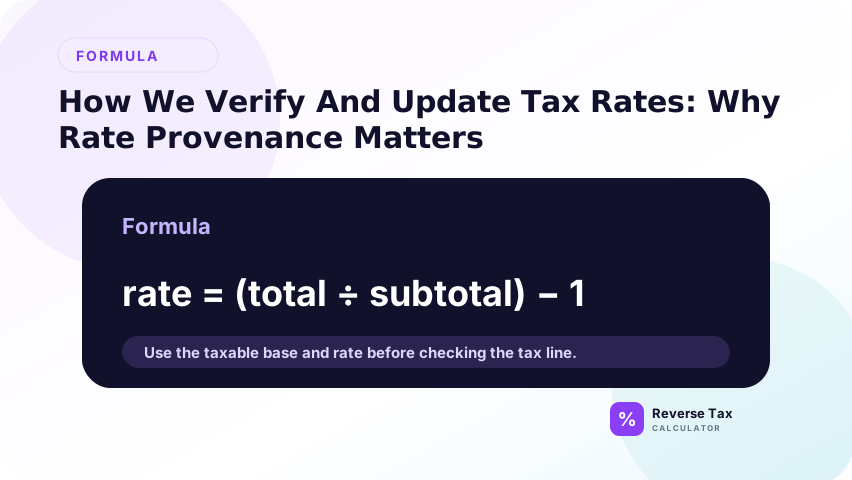
Pre-tax amount = Total / (1 + rate / 100)
If the rate is wrong, the result is wrong. Rate provenance answers:
| Question | Why it matters |
|---|---|
| Where did the rate come from? | Source trust |
| When was the rate effective? | Date accuracy |
| What location does it cover? | Jurisdiction accuracy |
| What product does it apply to? | Taxability accuracy |
| Is it current or historical? | Use-case accuracy |
Source Hierarchy
Use this hierarchy when choosing or checking tax rates:
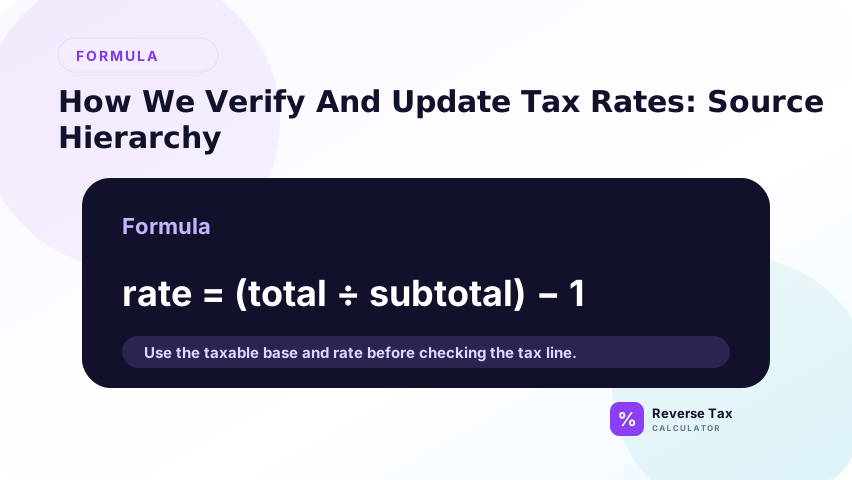
| Priority | Source type | Use |
|---|---|---|
| 1 | Official tax authority page | Best source for rates and rules |
| 2 | Official rate table or lookup tool | Best source for location-specific rates |
| 3 | Official legislation or regulation | Strong but harder to interpret |
| 4 | Official guidance publication | Useful for examples and special cases |
| 5 | Accounting professional or internal record | Useful for business context |
| 6 | Third-party tax database | Helpful if it cites official sources |
| 7 | Search snippet or blog | Not enough by itself |
This hierarchy reduces hallucination risk and helps users understand why a rate was chosen.
How We Verify Rates
Rate verification has five checks:
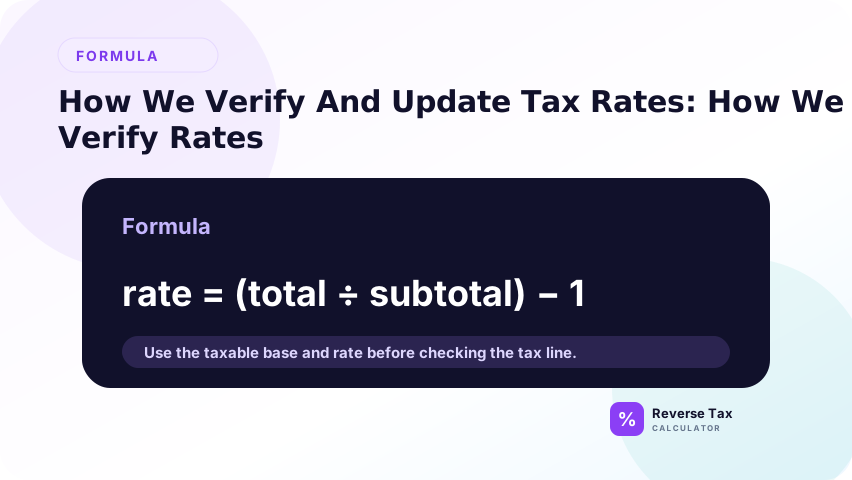
- Jurisdiction check.
- Effective-date check.
- Taxability check.
- Combined-rate check.
- Receipt or invoice consistency check.
| Check | Example |
|---|---|
| Jurisdiction | State, province, city, county, district |
| Effective date | Rate in force on receipt date |
| Taxability | Clothing, food, shipping, services |
| Combined rate | State plus local or GST plus provincial tax |
| Document consistency | Receipt tax divided by taxable subtotal |
When the user is choosing a rate for calculation, the correct tax rate workflow should be used before entering a number into the calculator. When local rates are involved, the state rate vs local combined rate guide explains why a state headline rate may not match a receipt.
How We Handle Updates
Tax rates can change. We handle rate updates by:
- checking official pages for current effective dates;
- citing source URLs in article drafts when rates are stated;
- avoiding stale rate claims without an effective date;
- adding accuracy notes where rules are jurisdiction-specific;
- separating example arithmetic from legal rate claims.
If a page uses a rate only for a math example, the article should say so. If a page states an official rate, the article should cite an official source.
Update Triggers
Rate-sensitive pages should be reviewed when:
| Trigger | Why it matters |
|---|---|
| Official tax authority announces a rate change | Current rates may become outdated |
| A page cites a rate with a specific effective date | The claim may need a new date |
| A user reports a mismatch | Receipt evidence may reveal a local or historical issue |
| A jurisdiction changes product taxability | Rate may still be right but taxable base may change |
| A calculator page targets a location | Local rates and sources need closer review |
| A source URL changes | Citation may break or point to stale material |
This update system is designed to reduce silent drift. Tax content can become wrong without looking obviously wrong.
Current Rates vs Historical Rates
Current rates are not always correct for old receipts. A receipt from 2024 should use the rate that applied in 2024, not necessarily the rate visible today.
| Use case | Rate needed |
|---|---|
| Today’s purchase | Current rate |
| Old receipt | Historical rate |
| Refund | Usually original sale rate |
| Audit | Rate effective on transaction date |
| Price estimate | Current expected rate |
If a receipt has city, county, ZIP, or district components, the city, county, and ZIP sales tax rate workflow gives the local-rate context that a general rate table can miss.
Historical Rate Handling
Historical rates need stricter labeling than current rates. If a page says “current,” it should not be used as proof for an old transaction.
| Historical evidence | Strength |
|---|---|
| Official prior-rate table | Strong |
| Archived official publication | Strong |
| Receipt showing subtotal and tax | Strong for that transaction |
| Third-party historical table | Medium if sourced |
| Search snippet | Weak |
If a historical source is not available, the article should explain how to verify the rate rather than invent one.
What We Do Not Guess
We do not guess:
| Unknown | Why not guess |
|---|---|
| Local district rate | Address boundaries can differ |
| Product taxability | Item rules vary |
| Historical rate | Rates can change |
| Shipping taxability | Transaction facts matter |
| Tip or service charge treatment | Optional and mandatory charges can differ |
| Exemption status | Documentation may be required |
When a rate is unknown, the safer content pattern is to explain how to verify it.
Rate Claim Types
Different claims need different evidence.
| Claim type | Example | Evidence needed |
|---|---|---|
| Formula claim | Divide by 1.08 for 8 percent | Math only |
| Current rate claim | Statewide rate is 7.25 percent | Official current source |
| Local rate claim | Address has 8.25 percent | Official lookup or receipt |
| Product taxability claim | Basic groceries are zero-rated | Official rule source |
| Historical rate claim | Rate changed on a date | Official dated source |
This protects content from sounding more certain than the evidence allows.
Example: Official Rate With Effective Date
California CDTFA’s rate page lists current California city and county sales and use tax resources and shows tax rates effective April 1, 2026. It also states that California’s statewide tax rate is 7.25 percent and local district taxes can increase tax owed.
For a reverse tax article, that supports a statement like:
| Claim type | Safe use |
|---|---|
| Statewide rate | Cite official source |
| Local rate | Use address lookup or table |
| Historical rate | Use prior-rate source |
| Generic example | Mark as example only |
Example: Official Rule With Product Taxability
An official rate is only one part of verification. Product taxability can change whether the rate applies at all. For example, a jurisdiction may have a general rate but different treatment for food, clothing, medicine, shipping, or digital goods. A rate update workflow should therefore verify both the numeric rate and the category rule that controls the taxable base.
Canada Revenue Agency guidance says the rate to charge depends on place of supply and supply type. It also states that zero-rated supplies have a 0 percent GST/HST rate throughout Canada, with basic groceries given as an example.
That supports a product-taxability caution: a rate is not enough if the item itself is zero-rated or exempt.
User Verification Checklist
Before relying on a reverse tax result, check:
| Check | Done |
|---|---|
| Correct location | |
| Correct transaction date | |
| Correct taxable amount | |
| Correct combined rate | |
| Official source used | |
| Exempt items separated | |
| Shipping and tips classified | |
| Rounding checked |
Internal QA Checklist for Rate Content
Every rate-sensitive article should pass these checks:
| QA check | Pass condition |
|---|---|
| H1 matches topical map | Exact article title used |
| Rate claim sourced | Official or clearly labeled example |
| Effective date considered | Current or historical context stated |
| Product taxability caveat present | No universal overclaim |
| Combined rate explained | State-only rates not overused |
| No forbidden dash characters | Automated check passes |
| Internal links are scoped | Page links to correct sibling intent |
Handling Uncertainty
If uncertainty remains, the article should say what is unknown and what source would resolve it.
| Unknown | Best next source |
|---|---|
| Exact local rate | Official address lookup |
| Old transaction rate | Historical official table |
| Shipping taxability | Official shipping guidance |
| Food classification | Official product taxability rule |
| Exempt buyer status | Exemption certificate or accountant |
Clear uncertainty is better than confident wrongness.
Error Reporting Workflow
If a rate appears wrong:
- Capture the URL and article title.
- Capture the source used in the article.
- Compare with the official tax authority source.
- Check effective date.
- Check whether the article used the rate as an example or as an official claim.
- Update the content and source note.
- Re-run dash, heading, and source QA.
Accuracy Policy for Examples
Example numbers are arithmetic demonstrations unless the article says they are official rates. A 100.00 example at 8 percent teaches the formula. It does not claim that 8 percent applies everywhere.
| Example type | Source requirement |
|---|---|
| Pure formula example | No official rate source needed |
| Official rate example | Official source required |
| Taxability example | Source or clear caveat required |
| Historical rate example | Effective-date source required |
Frequently Asked Questions
Why not list every rate directly?
Rates can change, and local boundaries can be precise. Official lookups are safer for exact transaction rates.
Can third-party tax rate sites be used?
They can help, but official tax authority sources are preferred when accuracy matters.
How often should tax rates be checked?
Check whenever a page states a current official rate, especially before publishing or updating a rate-sensitive article.
What if official sources disagree?
Use the source with legal authority for the jurisdiction and transaction type, and document the conflict.
Does a calculator result prove tax compliance?
No. It proves arithmetic from the inputs. It does not prove the legal rate or taxability.
Sources
Sources for tax-rate verification should be official whenever possible, such as tax authority pages, rate lookup tools, bulletins, statutes, or official notices. Secondary sources can help discover changes, but they should not be the final authority for compliance-sensitive rate data. Record source URL, date checked, effective date, jurisdiction, tax type, and any product taxability limitation.
- California Department of Tax and Fee Administration, California City and County Sales and Use Tax Rate Information
- Canada Revenue Agency, Charge and collect the GST/HST