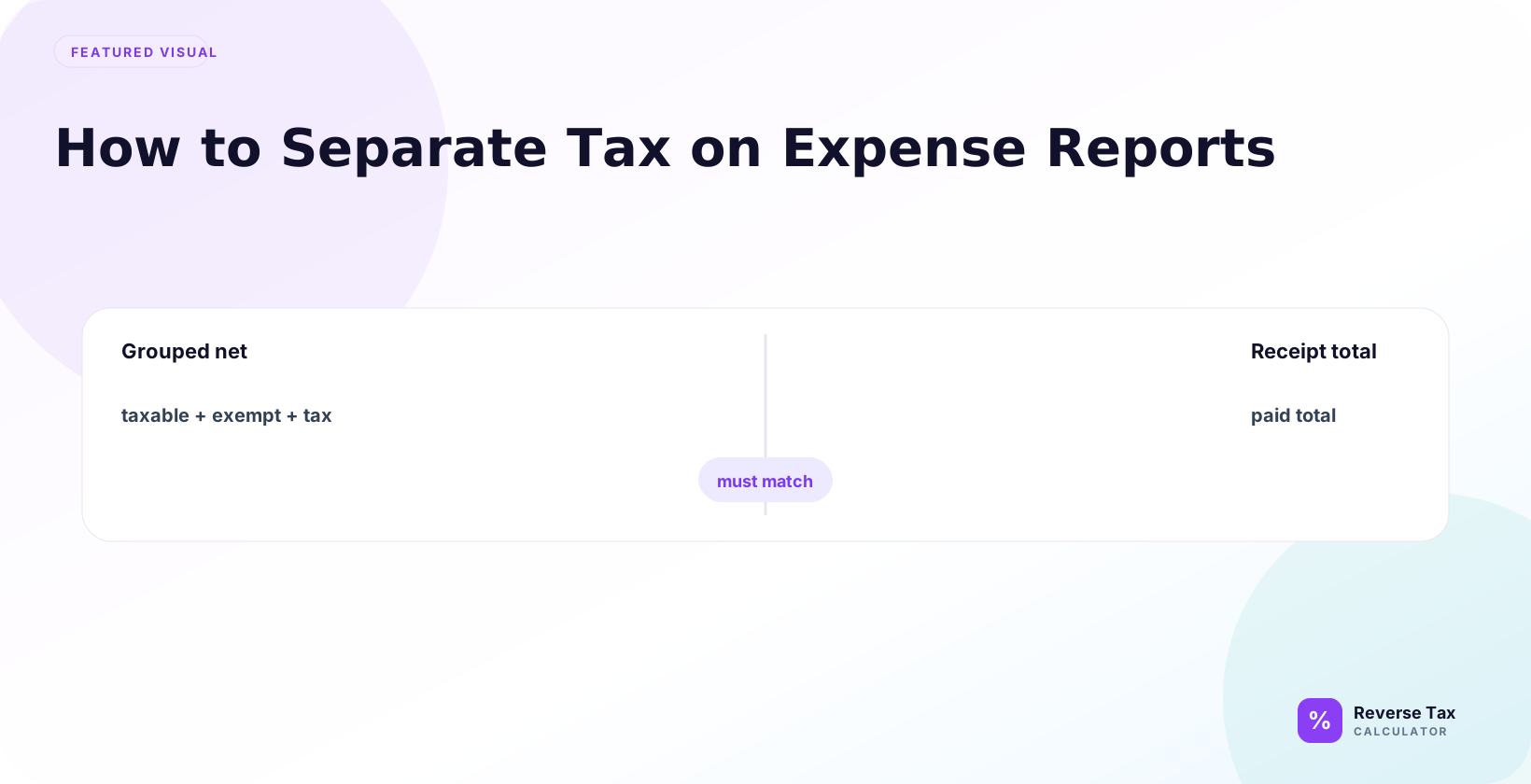
Expense reports use reverse tax when a tax-inclusive receipt must be split into reimbursable net cost and tax amount. The calculation divides the taxable receipt amount by the correct rate multiplier, then records included tax separately where accounting rules require it. Expense report accuracy depends on receipt tax lines, business purpose, VAT or sales tax recovery rules, exempt items, tips, shipping, currency conversion, and rounding.
Expense reports need evidence more than clever arithmetic. A clean receipt beats an estimate.
How Do You Separate Tax on an Expense Report?
Separate tax on an expense report by identifying the total, shown tax amount or tax rate, pre-tax expense amount, and any non-tax items such as tips, delivery fees, or credits. The goal is to document the reimbursable or deductible expense clearly, not just to force a calculator result.
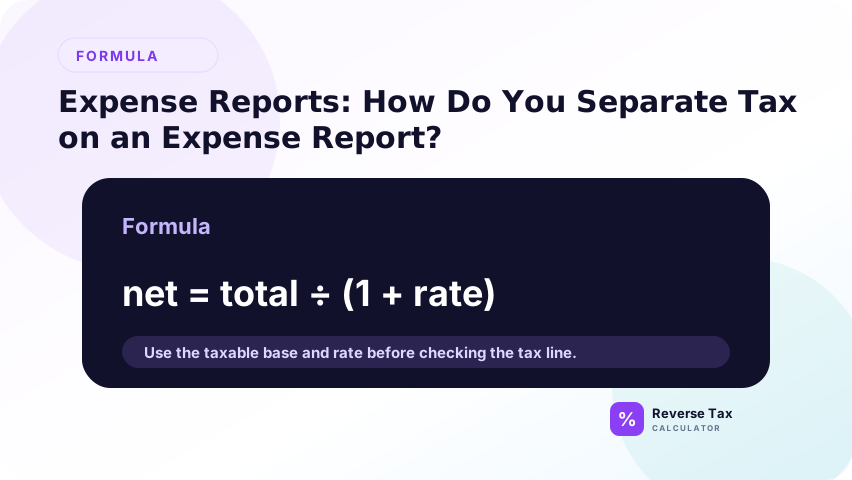
Use the receipt tax line first.
If the receipt shows subtotal and tax:
Expense before tax = subtotal
Tax = tax line
Total = subtotal plus tax
If the receipt shows only a tax-inclusive total:
Expense before tax = total divided by (1 plus tax rate)
Tax = total minus expense before tax
Why Does Expense Report Tax Separation Matter?
Expense reports are used for reimbursement, bookkeeping, budgeting, project costing, and sometimes tax support. If tax is included inside the expense amount without being identified, reports can become harder to audit.
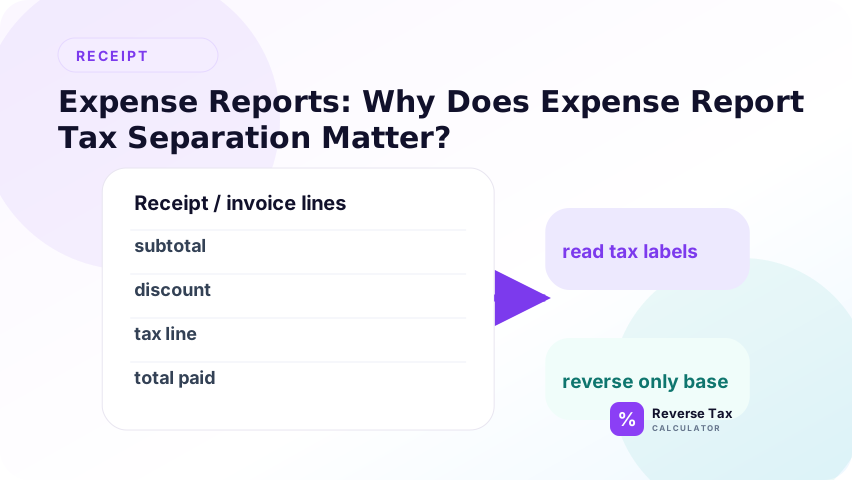
For businesses that track recoverable VAT, GST, HST, PST, QST, or sales tax, separating tax may also affect accounting treatment. For ordinary employee reimbursement, the company may simply reimburse the full amount but still want tax separated for records.
What Receipt Fields Should You Capture?
Capture the fields that prove the expense.
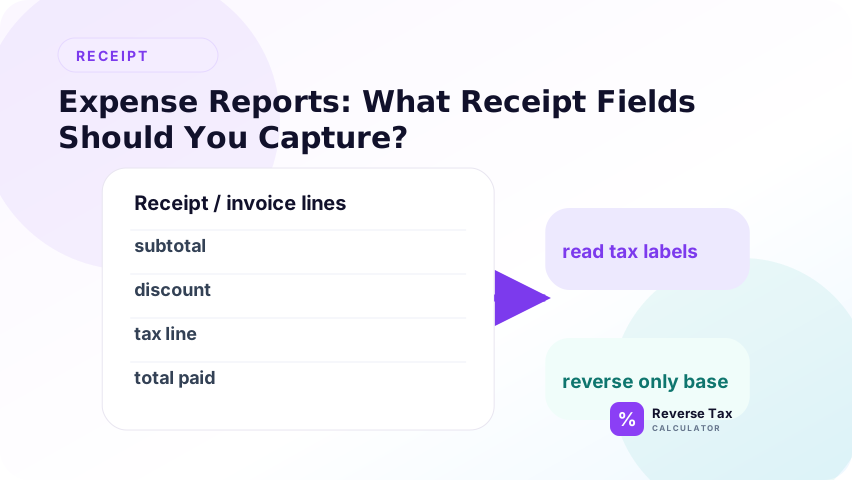
| Field | Why it matters |
|---|---|
| Vendor name | Identifies seller |
| Date | Supports period and policy |
| Location | Helps identify tax jurisdiction |
| Subtotal | Shows pre-tax expense |
| Tax line | Shows tax charged |
| Tip or gratuity | Separates optional payments |
| Final total | Reconciles payment |
| Payment method | Confirms paid amount |
IRS Publication 463 explains that documentary evidence such as receipts, canceled checks, or bills is generally needed to support expenses, and adequate evidence ordinarily shows amount, date, place, and essential character.
How Do You Separate Tax When the Receipt Shows Subtotal?
When the receipt shows subtotal and tax separately, use those values directly. The subtotal is the pre-tax expense amount and the tax line is the tax amount. Reverse tax is mostly useful as a check, not as the primary evidence.
Use the receipt directly.
Example:
Meal subtotal: $40.00
Tax: $3.20
Tip: $8.00
Total paid: $51.20
Expense before tip and tax is $40.00. Tax is $3.20. Optional tip is $8.00. Do not reverse the full $51.20 because it includes a tip.
How Do You Separate Tax When Only the Total Is Visible?
When only the total is visible, use the tax rate only if the total is tax-inclusive and the rate is known. Divide the total by 1 plus the rate to estimate the pre-tax amount, then subtract that amount from the total to estimate tax.
Use reverse tax only if the rate is known.
Example:
Receipt total: $108.00
Rate: 8%
Pre-tax expense = $108.00 divided by 1.08 = $100.00
Tax = $8.00
This works only if the full $108.00 is tax-inclusive and taxable at 8%.
What If the Tax Rate Is Missing?
If the tax rate is missing, do not guess from the total alone. Look for subtotal, tax amount, location, item category, invoice labels, or official rate evidence. A total by itself does not contain enough information to identify the tax rate reliably.
Do not guess silently. Use the receipt location, transaction date, and official rate source if the expense policy requires a tax split.
If you cannot verify the rate, record the total as paid and mark the tax split as unknown or estimated according to company policy.
What If the Receipt Has a Tip?
If the receipt has an optional tip, separate the tip before reverse tax. The tip may be part of the reimbursed payment, but it may not be part of the taxable expense base. Mandatory service charges need separate review because they can behave differently.
Remove optional tips before reverse tax.
Example:
Final card charge: $64.00
Optional tip: $10.00
Rate: 8%
Tax-inclusive meal amount = $54.00
Pre-tax meal = $54.00 divided by 1.08 = $50.00
Tax = $4.00
The tip is not part of the reverse tax base.
What If the Expense Has Shipping or Delivery?
Shipping and delivery charges should be classified before tax is separated. If shipping was taxed, it may belong inside the taxable base. If it was not taxed, remove it before applying the reverse formula. Receipt lines and invoice wording matter.
Separate shipping, delivery, service fees, and handling before reverse tax. Some charges may be taxable and others may not.
If shipping is non-taxable, subtract it before reversing tax. If it is taxable, include it in the taxable base. If uncertain, flag the assumption.
Example: Hotel Folio with Several Taxes
A hotel folio can include room charge, lodging tax, occupancy tax, resort fee, parking, meals, and tips. Do not reverse the full folio total at one rate.
Example:
Room charge: $200.00
Lodging tax: $24.00
Parking: $30.00
Meal with tax: $54.00
Tip: $10.00
Total: $318.00
The room tax, meal tax, parking, and tip should be separated by line. If the expense report needs only reimbursement, the paid total matters. If accounting needs tax categories, the itemized folio matters.
Example: Software Invoice with VAT or GST
A software invoice may show gross amount, VAT or GST amount, net amount, and country-specific tax details. If the tax is shown, use the shown tax line. If only the gross amount and rate are shown, reverse the gross amount by dividing by 1 plus the rate.
Software invoices often show a tax registration number, customer country, tax rate, taxable subscription amount, tax, and total.
If the invoice shows:
Subscription: $100.00
VAT: $20.00
Total: $120.00
Use the invoice fields directly. If the invoice only shows $120.00 tax-inclusive at 20%, reverse tax to $100.00 and $20.00, then attach the invoice as support.
What If the Receipt Has Discounts or Coupons?
Discounts and coupons can reduce the taxable base or act as payment adjustments. For expense reports, record the amount actually reimbursed and the tax amount supported by the receipt. Do not treat every coupon as a simple reduction without checking receipt structure.
Discounts can reduce the taxable base, or they can act as third-party consideration. Use the receipt tax line if available. If the receipt only shows a total, a discount can make reverse tax unreliable unless you know whether it was applied before tax.
Expense Category Table
| Category | Tax separation issue | Best practice |
|---|---|---|
| Meals | Tips and service charges | Separate subtotal, tax, tip |
| Hotel | Lodging taxes and fees | Keep itemized folio |
| Office supplies | Usually itemized sales tax | Use receipt tax line |
| Rideshare | Fees and tips | Separate fare, tax, tip |
| Software | VAT or sales tax | Save invoice with tax ID if available |
| Shipping | Taxability varies | Keep charge line separate |
Decision Matrix: Can You Separate Tax Reliably?
| Evidence | Reliability | Action |
|---|---|---|
| Receipt shows subtotal and tax | High | Use receipt fields |
| Receipt shows total and tax | High | Total minus tax gives pre-tax |
| Receipt shows total and verified rate | Medium to high | Use reverse tax |
| Receipt shows total only | Low | Do not calculate exact tax |
| Receipt includes tip or fees | Medium | Separate lines first |
| Receipt is missing | Low | Follow company substantiation policy |
Operational Workflow for Expense Reports
| Step | Action | Output |
|---|---|---|
| 1 | Upload receipt | Evidence |
| 2 | Capture vendor, date, and total | Basic support |
| 3 | Identify subtotal, tax, tip, and fees | Correct fields |
| 4 | Use reverse tax only when needed | Calculated split |
| 5 | Mark estimates | Transparency |
| 6 | Submit policy notes | Reviewer support |
Common Expense Report Tax Errors
| Error | Result | Fix |
|---|---|---|
| Reversing final restaurant total | Includes tip in tax base | Remove tip first |
| Guessing the rate | False precision | Verify or mark unknown |
| Treating every fee as taxable | Overstates tax | Classify fee |
| Ignoring tax-inclusive invoices | Overstates expense before tax | Reverse only taxable amount |
| Losing receipt evidence | Weak support | Attach original receipt |
How Should Reimbursements Handle Tax?
Reimbursements should follow the organization's policy and the receipt evidence. Some reports reimburse the full paid amount, while accounting may separately identify tax for reporting or recovery. The expense report should preserve both payment amount and tax detail when available.
Many employers reimburse the full paid amount if the expense is allowable. The tax split may be used internally for accounting, project costing, or recoverable tax reporting.
The employee should not change the paid total to make the tax math look cleaner. The reimbursable amount should reconcile to the actual receipt and policy.
How Should Bookkeeping Handle Expense Tax?
Bookkeeping should handle expense tax according to whether the tax is recoverable, reimbursable, capitalized, or part of the expense cost. For ordinary expense reports, the safest workflow is to preserve gross amount, tax amount, net expense, merchant, date, and tax label separately. If the tax is recoverable VAT or GST, it may need a different account than nonrecoverable sales tax.
Bookkeeping treatment depends on the tax system and whether the business can recover input tax or must include tax in the expense. The reverse calculation can separate the values, but accounting policy decides where they are posted.
Bookkeeping treatment depends on whether the tax is recoverable.
Non-Recoverable Tax
If tax is not recoverable, it may be part of the expense cost.
Recoverable Tax
If VAT, GST, or similar tax is recoverable, the tax portion may go to a receivable or input tax account.
Mixed Treatment
Some expenses are partially recoverable. Separate by line and rule.
Information Gain: Expense Tax Split Is a Documentation Problem
The main information gain is that expense tax separation is a documentation problem as much as a formula problem. A good expense report shows source receipt, rate or tax line, pre-tax amount, tax amount, tip or fee handling, and reviewer notes.
Most calculators focus only on formula. Expense reports need a documentation workflow. The tax split must connect to vendor, date, location, category, receipt image, and reimbursement policy.
That is why the safest rule is receipt first, formula second, estimate last.
Reviewer Checklist for Expense Tax Splits
| Review question | Good answer |
|---|---|
| Does the total match the receipt? | Yes |
| Was the tax line copied when visible? | Yes |
| Was reverse tax used only when needed? | Yes |
| Were tips removed before tax reversal? | Yes |
| Were fees classified separately? | Yes |
| Are estimates labeled? | Yes |
When Should You Not Separate the Tax?
Do not separate tax when the tax amount is irrelevant to the reporting process, when policy requires gross expense reporting, when the rate cannot be verified, or when the receipt does not provide enough evidence. Mark the amount as gross when separation would be speculative.
Do not force a tax split when the receipt does not support it and the policy does not require it. For small, non-recoverable expenses, a company may prefer recording the full reimbursed amount as one expense. The key is consistency with policy and support.
Trust Boundary
Expense report tax separation is arithmetic and documentation support. It does not decide deductibility, input tax recovery, VAT reclaim, GST credits, or employer reimbursement policy. Use official guidance and company policy for compliance-sensitive treatment.
A reverse tax calculator can split a tax-inclusive amount when the rate and taxable base are known. It cannot decide whether an expense is deductible, reimbursable, recoverable, or compliant under every company policy or tax law.
Use company policy, official tax guidance, and accounting review for high-value or audit-sensitive expenses.
For receipt cleanup, use removing tax from a receipt.
If the expense includes gratuity, review tips before or after tax.
If the expense includes delivery, review shipping charges in reverse tax.
Frequently Asked Questions
Should tax be separated on an expense report?
Yes, if the company policy or accounting workflow asks for it. Use receipt fields first.
Can I calculate tax from a receipt total?
Yes, but only if you know the correct rate and the whole amount is taxable at that rate.
Should tips be included in reverse tax?
No. Remove optional tips before calculating tax backwards.
What if the tax amount is missing?
Use subtotal and total if available. If only total is visible, verify the rate before estimating.
What source supports receipt evidence?
IRS Publication 463 explains documentary evidence expectations for expense records.
Sources and Notes
- Formula source: arithmetic relationship between tax-inclusive total, pre-tax amount, tax, and rate.
- IRS Publication 463, Travel, Gift, and Car Expenses
- Accuracy note: company policy and local tax rules control reimbursement and recoverable tax treatment.