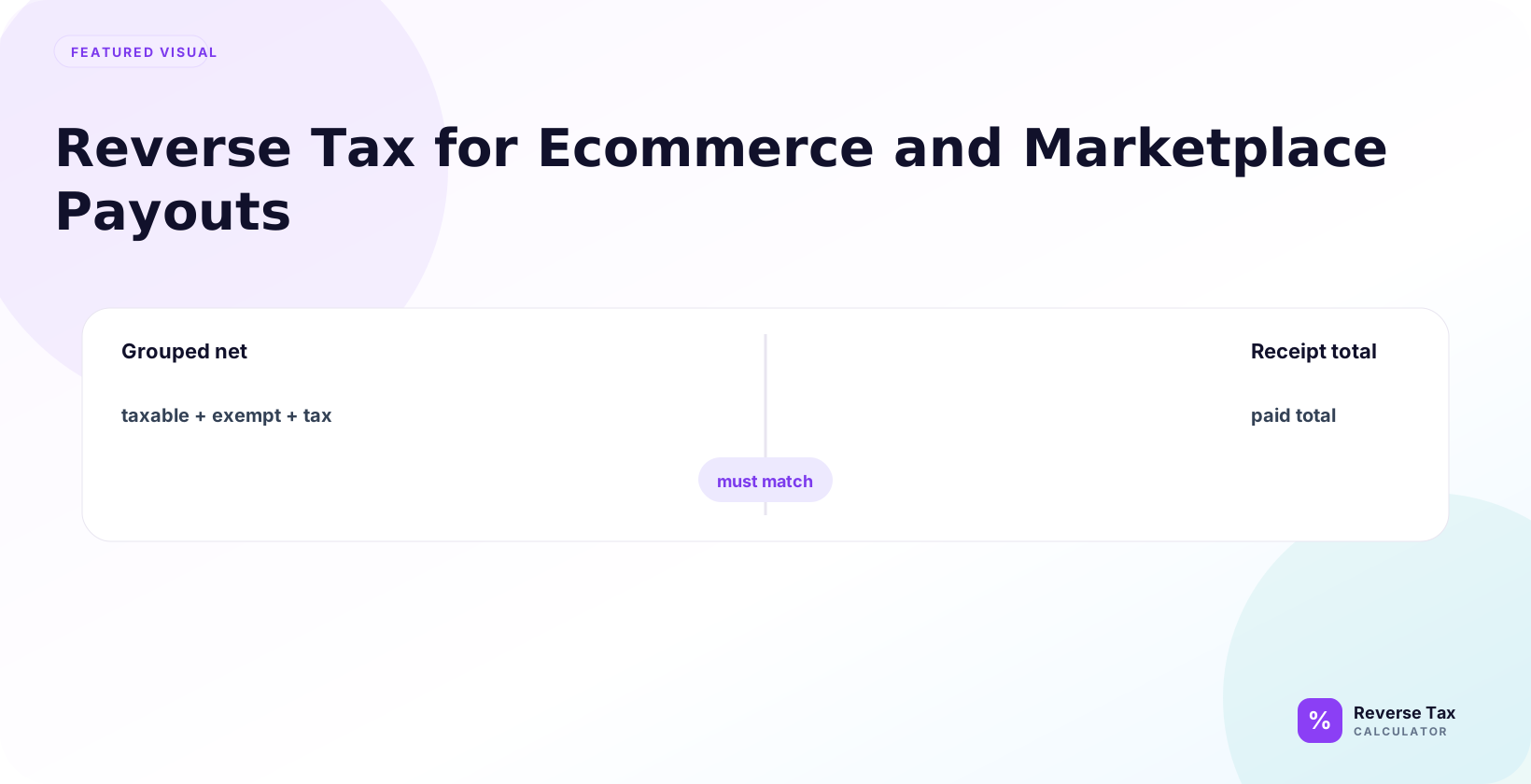
Ecommerce marketplace payouts need reverse tax when gross customer payments, tax collected, fees, refunds, and seller revenue are bundled in the payout report. Tax reconciliation separates the sales amount from tax liabilities so revenue is not overstated and tax collected is not treated as income. Marketplace reports can vary by platform, jurisdiction, tax collection responsibility, refunds, shipping, discounts, payment fees, and whether the marketplace remits tax directly.
A payout is settlement cash after the platform has processed tax, fees, refunds, reserves, ads, and other adjustments.
How Do You Use Reverse Tax on Marketplace Payouts?
Use reverse tax on marketplace payouts only after tracing the payout back to order-level tax data. A payout is often net of fees, refunds, reserves, chargebacks, ads, and shipping labels. The tax-inclusive order amount, not the net deposit, is usually the safer calculation base.
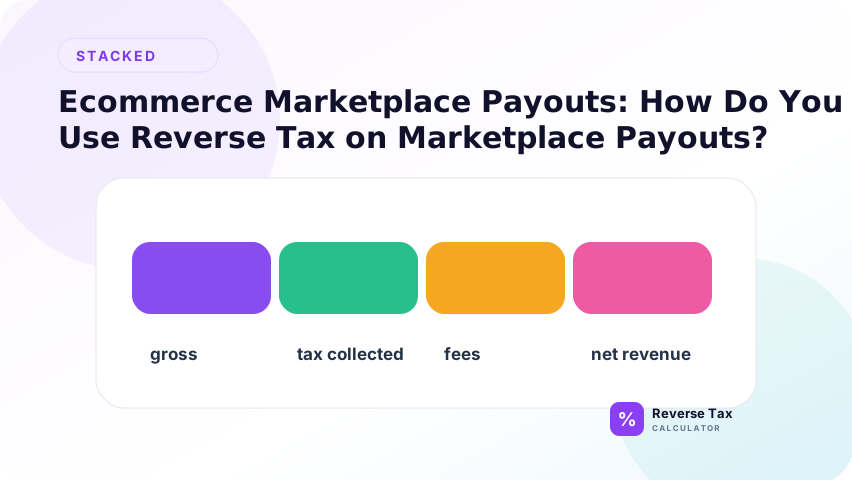
Start with order-level data, not the bank deposit.
Use reverse tax only on tax-inclusive order amounts where the rate and taxable base are known.
Then separate:
- Product revenue
- Shipping or delivery charges
- Sales tax charged to buyer
- Tax remitted by marketplace
- Seller fees
- Refunds and returns
- Net payout
Why Marketplace Payouts Are Confusing
Marketplace payouts are confusing because they combine sales activity and cash settlement activity. The payout may include orders from several days, fees deducted by the platform, tax collected by the marketplace, refunds, reserves, and adjustments that do not belong in the taxable base.
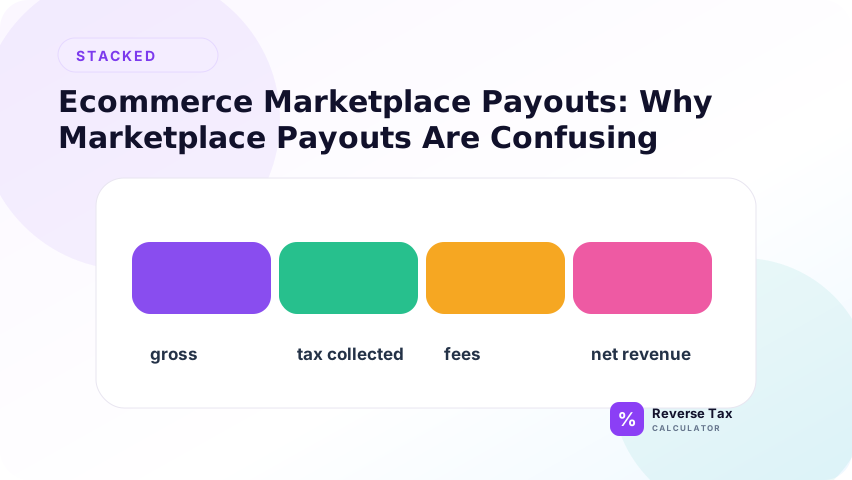
Marketplace reports combine ecommerce, tax, accounting, and settlement concepts. One payout can include many orders and many adjustments.
The customer may pay $108.00, but the seller may receive $85.00. That does not mean revenue is $85.00. It may mean the platform withheld tax, fees, and reserves.
Customer Order vs Seller Payout
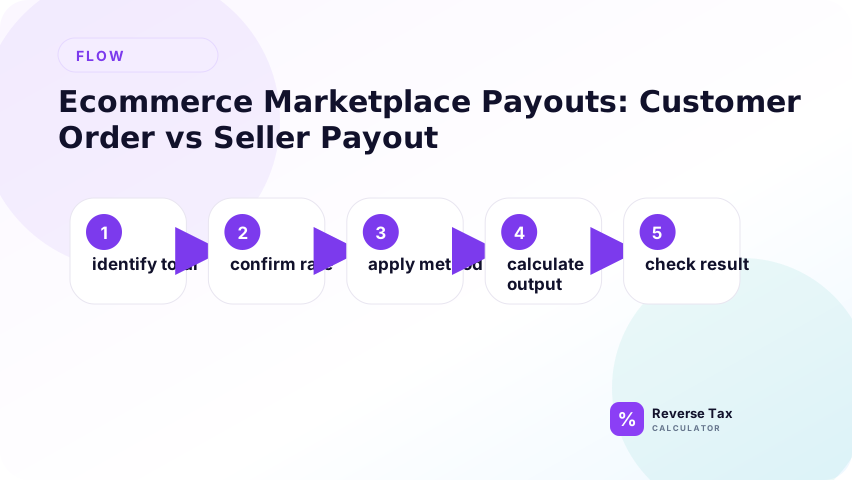
These two numbers answer different questions.
| Number | Meaning |
|---|---|
| Customer order total | What the buyer paid or was charged |
| Tax collected | Tax charged to buyer |
| Marketplace-remitted tax | Tax the platform may handle |
| Seller fees | Platform charges |
| Refunds | Customer reversals |
| Net payout | Cash deposited to seller |
Reverse tax belongs at the order level. Payout reconciliation belongs at the settlement level.
The customer order explains the taxable event. The seller payout explains cash settlement after the platform finishes its deductions and remittance workflow. If you reverse tax from the payout, you may accidentally remove tax from fees, reserves, ads, or refunds that are not part of the taxable sale. Treat order data and payout data as separate entities, then reconcile them with a bridge.
Reverse Tax Formula for Ecommerce Orders
For a clean tax-inclusive ecommerce order, use total divided by 1 plus the tax rate to find the before-tax amount. Then subtract that amount from the total to find tax. This should be done at the order or tax-group level, not from a net payout deposit.
If a customer order amount is tax-inclusive:
Pre-tax taxable sale = Tax-inclusive amount divided by (1 plus tax rate)
Tax = Tax-inclusive amount minus pre-tax taxable sale
Example:
Tax-inclusive order amount: $108.00
Rate: 8%
Revenue before tax = $100.00
Tax = $8.00
What If the Marketplace Shows Tax Separately?
If the marketplace shows tax separately, use the shown tax amount as source evidence. Do not reconstruct the tax from a rate unless you are checking the platform's calculation. Shown tax often reflects the platform's rounding and tax engine setup.
Use the marketplace tax line first.
Example:
Item subtotal: $100.00
Sales tax charged: $8.00
Customer total: $108.00
No reverse formula is needed unless you are verifying the calculation.
What Is Marketplace-Collected Tax?
Marketplace-collected tax is tax the marketplace collects from the buyer, often under marketplace facilitator rules, and may remit separately from the seller. It should be identified separately from seller-collected tax so the seller does not double-count payable amounts.
Marketplace-collected tax is tax charged to the buyer by the platform. In some jurisdictions and platform programs, the marketplace facilitator may be responsible for collecting and remitting that tax.
For bookkeeping, do not automatically post marketplace-collected tax to the seller's Sales Tax Payable account. Check the platform report and jurisdiction rules.
What Is Seller-Collected Tax?
Seller-collected tax is tax the seller collects and may need to track as payable, depending on the applicable rules. It is different from marketplace-collected tax because the seller's accounting and remittance responsibility may differ.
Seller-collected tax is tax the seller is responsible for collecting and remitting. This may happen on the seller's own website, some direct checkout channels, or marketplaces where the seller remains responsible for a tax type.
Seller-collected tax usually belongs in Sales Tax Payable until remitted.
Settlement Example: Order to Payout
An order-to-payout example should show item price, shipping, discount, tax, marketplace-collected tax, seller fees, refund adjustments, and net deposit. This bridge explains why the payout amount often cannot be reversed directly as a tax-inclusive total.
Customer order:
Item price: $100.00
Sales tax: $8.00
Customer paid: $108.00
Marketplace fee: $15.00
Marketplace remits tax: $8.00
Seller payout: $85.00
Accounting view:
Revenue may be $100.00. Marketplace fee may be $15.00. Seller payout is $85.00. The $8.00 tax may not belong in seller payable if the marketplace remits it.
What If the Payout Includes Multiple Orders?
Do not reverse the payout total. A payout batch can include orders at different rates, refunds, fees, and reserves.
Use order-level data first, then reconcile the batch.
A multi-order payout should be unpacked into its transaction components before any tax calculation. One deposit can include orders from different jurisdictions, marketplace-collected tax, seller-collected tax, refunded tax, fees, chargebacks, and reserve releases. The correct question is not "what rate applies to the payout?" The correct question is "which order lines created this payout, and what tax treatment applied to each line?"
| Layer | Best report |
|---|---|
| Product revenue | Order detail |
| Tax charged | Tax report |
| Fees | Settlement report |
| Refunds | Refund report |
| Net deposit | Bank feed |
How Do Refunds Affect Marketplace Payouts?
Refunds may reduce the current payout even if the original sale happened in a prior period. Refund tax treatment depends on whether tax was refunded to the customer and who remitted the tax.
Example:
Original customer total: $108.00
Refund issued: $54.00
Rate: 8%
Refunded sale = $54.00 divided by 1.08 = $50.00
Refunded tax = $4.00
If the marketplace remitted the original tax, the marketplace report may handle the tax adjustment.
How Do Fees Affect Reverse Tax?
Marketplace fees usually do not reduce revenue at the order level. They are expenses or contra-revenue depending on accounting policy, but they should not be treated as sales tax.
Example:
Order revenue: $100.00
Tax: $8.00
Fee: $15.00
Payout: $85.00 if marketplace withholds tax and fee
The fee explains the payout difference. It does not change the reverse tax formula for the order.
How Do Shipping and Discounts Affect Ecommerce Reverse Tax?
Shipping and discounts affect the taxable base before the payout is created. Shipping may be taxable or non-taxable. Discounts may reduce the base or act as a payment adjustment. These issues should be resolved at the order level before payout reconciliation.
Shipping and discounts can change the taxable base.
This is why ecommerce reverse tax should be done before payout reconciliation. The order record should show whether shipping was charged to the customer, whether the discount reduced the item price, and whether a bundle contains mixed taxability. After those facts are separated, the payout can be reconciled without treating platform fees or reserves as if they changed the customer's taxable base.
Shipping
Shipping may be taxable or non-taxable depending on jurisdiction, delivery method, item type, and transaction terms. In ecommerce reports, shipping can appear as customer-paid shipping, platform label cost, seller shipping income, or shipping fee adjustment. Only the customer-facing shipping charge can potentially affect the taxable base. Label purchases and fulfillment fees are payout deductions, not sales tax base by themselves.
Discounts
Retailer discounts may reduce taxable sales because the seller lowered the selling price before tax. Manufacturer coupons, marketplace-funded promotions, loyalty credits, and post-order adjustments may need separate handling because the seller might still receive reimbursement or the discount might behave like payment. Reverse tax should follow the taxable base used in the order report, not the marketing label alone.
Bundles
Bundles with taxable and exempt items should be split by item or rule when possible. A bundle can hide several tax treatments inside one customer-facing price, such as a taxable product, exempt food item, digital service, warranty, and shipping charge. If the platform provides item-level tax, use it. If it does not, document the allocation method before reverse-calculating tax from the bundle total.
How Do Gift Cards Affect Marketplace Payouts?
Gift cards can act as payment methods rather than discounts. If a buyer uses a gift card, the customer payment method changes, but the taxable sale may not. Reverse tax should follow the order's taxable base rather than the payment method.
Gift cards are usually payment or stored value mechanics, not sales tax discounts by themselves. A gift card redemption can reduce cash due from the buyer without reducing the taxable sale.
For reverse tax, use the order subtotal and tax lines, not only the cash collected after gift card redemption.
Decision Matrix: Which Number Should You Reverse?
| Available number | Reverse it? | Reason |
|---|---|---|
| Order total including tax | Yes if one rate and taxable base known | Tax-inclusive sale |
| Item subtotal and tax shown | Usually no | Use direct lines |
| Net payout | No | Includes fees and adjustments |
| Bank deposit | No | Settlement, not order |
| Refund total including tax | Yes if rate known | Reverses sale and tax |
| Marketplace tax line | No | Use as tax evidence |
Operational Workflow for Ecommerce Payouts
| Step | Action | Output |
|---|---|---|
| 1 | Export order detail | Order-level sales |
| 2 | Export tax report | Tax charged and remitter |
| 3 | Export settlement report | Fees and payout |
| 4 | Export refunds | Adjustment detail |
| 5 | Group orders by rate and taxability | Clean reverse tax |
| 6 | Separate seller and marketplace tax | Correct payable |
| 7 | Reconcile to bank deposit | Cash support |
| 8 | Save workpaper | Audit trail |
Common Marketplace Reverse Tax Errors
| Error | Effect | Fix |
|---|---|---|
| Reversing net payout | Understates revenue | Use order total |
| Posting marketplace tax to payable | Double counts liability | Check remitter |
| Treating fees as discounts | Misstates revenue | Record fees separately |
| Ignoring refunds from prior periods | Period mismatch | Use refund report |
| Using one rate for all orders | Wrong tax | Group by jurisdiction |
| Ignoring shipping taxability | Wrong base | Classify shipping |
Example: Multi-Order Payout
Payout batch:
Order A revenue: $100.00
Order A marketplace tax: $8.00
Order B revenue: $200.00
Order B marketplace tax: $15.00
Refund of prior order: $54.00 including tax
Platform fees: $45.00
Net payout should not be reversed. Instead, calculate each order and refund, then reconcile:
Revenue: $300.00 minus $50.00 refund = $250.00
Tax handled by marketplace: $23.00 minus $4.00 refunded tax = $19.00
Fees: $45.00
Expected cash impact depends on whether tax was included in the payout.
Example: Seller Website Order with Seller-Collected Tax
For a seller website order, the seller may collect the tax directly. In that case, reverse tax can support separating revenue from collected tax and posting the tax portion to payable, assuming the total and rate are correct.
Seller website order:
Item subtotal: $250.00
Shipping: $15.00
Sales tax collected by seller: $21.20
Customer paid: $286.20
Payment processor fee: $9.00
Bank deposit: $277.20
The seller should not reverse the $277.20 bank deposit. The order record shows revenue, tax, shipping, and fee separately. Sales Tax Payable may increase by $21.20 if the seller is responsible for remitting that tax.
Example: Marketplace Order with Tax Withheld
For a marketplace order, the platform may collect tax from the buyer and withhold or remit it. The seller payout may exclude that tax or show it as a separate line. Treat marketplace-collected tax separately from seller revenue and seller payable.
Marketplace order:
Item subtotal: $250.00
Marketplace tax charged: $20.00
Customer paid: $270.00
Marketplace fee: $30.00
Seller payout: $220.00
The seller payout equals item subtotal minus fee if the marketplace keeps the tax for remittance. Revenue may still be $250.00, fee may be $30.00, and seller Sales Tax Payable may be zero for that tax line.
How Do Reserves and Holds Affect Payout Reconciliation?
Some platforms hold reserves for chargebacks, shipping claims, or account risk. A reserve is a cash timing item. It should not reduce order revenue and should not change tax collected.
Reserves and holds are especially dangerous in reverse tax work because they reduce current cash without changing the original customer order. If a platform withholds $100.00 from a payout as a reserve, that $100.00 is not a discount, refund, or tax reduction by itself. Track the hold as settlement timing until the platform releases it, applies it to a claim, or converts it into a real adjustment.
Track reserves separately:
| Reserve movement | Accounting meaning |
|---|---|
| Reserve withheld | Cash not yet paid |
| Reserve released | Later cash settlement |
| Reserve used for chargeback | Adjustment or loss |
How Do Ads and Subscription Fees Affect Payouts?
Ads and subscription fees reduce the payout but usually do not reduce the original taxable sale. They should be reconciled as platform expenses or deductions, not removed from the taxable base before reverse tax unless the source document shows otherwise.
Platforms may deduct advertising charges, subscription fees, storage fees, fulfillment fees, or label charges from payouts. These are not sales tax discounts. They explain why payout differs from customer orders.
Classify them as expenses or contra-revenue according to accounting policy, but do not let them enter the reverse tax base.
Payout Reconciliation Bridge
| Line | Amount |
|---|---|
| Order revenue | $1,000.00 |
| Marketplace tax collected | $80.00 |
| Customer charges | $1,080.00 |
| Less marketplace tax withheld | ($80.00) |
| Less platform fees | ($150.00) |
| Less reserve hold | ($50.00) |
| Net payout | $800.00 |
This bridge explains the payout without treating payout as revenue.
A bridge is useful because it preserves two truths at the same time: the customer paid a tax-inclusive or tax-exclusive order amount, and the seller received a different cash amount. The bridge should start with order revenue and tax lines, then subtract or add settlement items such as fees, refunds, reserves, ads, shipping labels, and tax withheld by the marketplace. That structure prevents payout cash from becoming the reverse tax base.
How Do Chargebacks Affect Marketplace Tax?
Chargebacks can reverse cash, revenue, fees, and possibly tax depending on the platform record. Match the chargeback to the original order and identify whether tax was refunded, retained, or adjusted in a later settlement.
Chargebacks can reduce cash after the original order has already been recorded. A chargeback may reverse revenue, tax, fees, or only cash depending on the platform and dispute result.
Do not reverse tax from the chargeback amount automatically. Match the dispute to the original order and platform adjustment report.
How Do Cross-Border Orders Affect Reverse Tax?
Cross-border orders can involve VAT, GST, customs-related charges, marketplace tax collection, or destination-based rates. Do not assume one domestic sales tax formula explains every cross-border order. Use the order tax label and official rules for the tax system involved.
Cross-border ecommerce can include VAT, GST, customs duties, import fees, marketplace tax, or no tax line at all. The tax label matters.
If the order shows VAT included in price, reverse VAT using the VAT rate. If the order shows import duty or customs fee, do not treat it as sales tax without confirming the category.
Ecommerce Reconciliation Checklist
| Check | Why it matters |
|---|---|
| Order total captured | Establishes customer charge |
| Tax line captured | Avoids unnecessary estimate |
| Remitter identified | Determines payable |
| Fee lines separated | Explains payout |
| Refunds matched | Prevents timing errors |
| Reserves tracked | Explains cash holds |
| Bank deposit matched | Confirms settlement |
What Should Be Posted to the Ledger?
The ledger should separate product revenue, shipping revenue if applicable, seller-collected tax, marketplace-collected tax, platform fees, refunds, chargebacks, ads, and net deposit. The exact accounts depend on accounting policy, but the categories should not be collapsed into one payout number.
At minimum, the ledger should separately show revenue, seller-collected tax payable, marketplace fees, refunds, and cash. Some businesses also track marketplace-collected tax in a clearing or memo account for visibility, but they should avoid treating it as seller liability if the platform remits it.
Information Gain: Payout Reconciliation Has Two Axes
The information gain is that payout reconciliation has two axes: tax calculation and cash settlement. Tax calculation starts from the order and taxable base. Cash settlement explains why the deposit differs from the order. Mixing the two creates bad reverse tax inputs.
Marketplace reconciliation has a tax axis and a cash axis.
Tax axis: who collected tax, who remits tax, what base was taxed, and what refunds reversed tax.
Cash axis: what the customer paid, what fees were withheld, what reserves moved, and what reached the bank.
Good content explains both axes. A simple reverse tax formula explains only one.
Trust Boundary
This page explains ecommerce reverse tax workflow and reconciliation. It does not determine marketplace facilitator obligations, nexus, VAT registration, GST treatment, filing obligations, or accounting policy.
A reverse tax calculator can split tax-inclusive order totals and refund totals. It cannot determine marketplace facilitator responsibility, nexus, filing obligations, platform-specific remittance rules, or official return treatment.
Use platform tax reports, official jurisdiction guidance, and accounting review for filing decisions.
For order-to-report checks, use sales tax reconciliation from gross receipts.
If seller-collected tax affects liabilities, review sales tax payable.
For support files, use records needed for a reverse sales tax audit.
Frequently Asked Questions
Should I reverse tax from marketplace payout?
No. Reverse tax from order totals or refund totals, not from net payout. A marketplace payout is usually after fees, marketplace-collected tax, refunds, reserves, ads, chargebacks, and settlement timing. If you reverse the payout, you can understate revenue and invent a tax amount that was never charged to the customer. Use the payout only as a reconciliation target.
Is marketplace-collected tax my Sales Tax Payable?
Not always. If the marketplace remits the tax, it may not belong in the seller's Sales Tax Payable account. The seller may still see the tax in order reports, but the platform may have collected and remitted it under marketplace rules. Check the marketplace tax report, remitter field, jurisdiction guidance, and payout treatment before posting the amount as a seller liability.
Why is payout lower than sales?
Payouts can be lower than sales because of marketplace fees, payment processing fees, tax withholding, refunds, reserves, chargebacks, advertising charges, shipping labels, subscription fees, and payout timing. None of those differences automatically reduces the original taxable sale. The correct workflow is to record order revenue and tax first, then use a payout bridge to explain cash settlement.
Can one payout include several rates?
Yes. One payout can include several rates because it can settle many orders from different jurisdictions, product categories, tax periods, and refund histories. That is why order-level grouping matters. Calculate or verify tax at the order, item, or tax-group level, then reconcile all orders to the payout batch. A single blended rate for the deposit is usually weak evidence.
What reports should I export?
Export order detail, tax reports, settlement reports, refund reports, fee reports, reserve or hold activity, advertising charge reports, and bank deposit support. The exact platform names may differ, but the evidence categories are stable. You need customer order data for tax, settlement data for payout, refund data for reversals, and bank data for cash confirmation.
Sources and Notes
- Formula source: arithmetic relationship between tax-inclusive order totals, tax, rate, refunds, and payout layers.
- IRS Publication 583, Starting a Business and Keeping Records
- CDTFA Marketplace Facilitators guidance
- Accuracy note: marketplace facilitator and seller remittance rules vary by jurisdiction and platform.