Reverse income tax calculator limitations come from jurisdiction-specific rules that change rates, brackets, deductions, credits, and payroll contributions. A flat-rate gross-up can estimate one-rate cases, but progressive tax systems require separate calculations across bracket layers and local payroll rules. Results become less precise when the user ignores filing status, social contributions, regional taxes, tax year changes, benefits, exemptions, or withholding rules. Local thresholds also affect the gross estimate.
What Does Jurisdiction Mean for Reverse Income Tax?
Jurisdiction means the government authority or tax system that can impose or administer tax. In income tax, jurisdiction can include more than one layer.
| Jurisdiction layer | Example |
|---|---|
| Country | United States, Canada, United Kingdom |
| State or province | California, Ontario, Québec |
| Local government | City or municipality tax |
| Payroll system | Employer withholding rules |
| Tax residence | Where a person is treated as resident |
| Work location | Where wages are earned |
Reverse income tax becomes harder when more layers apply.
Why Reverse Income Tax Changes by Location
Reverse income tax asks: “What gross amount produces this net amount?” The answer changes when the tax rules change.
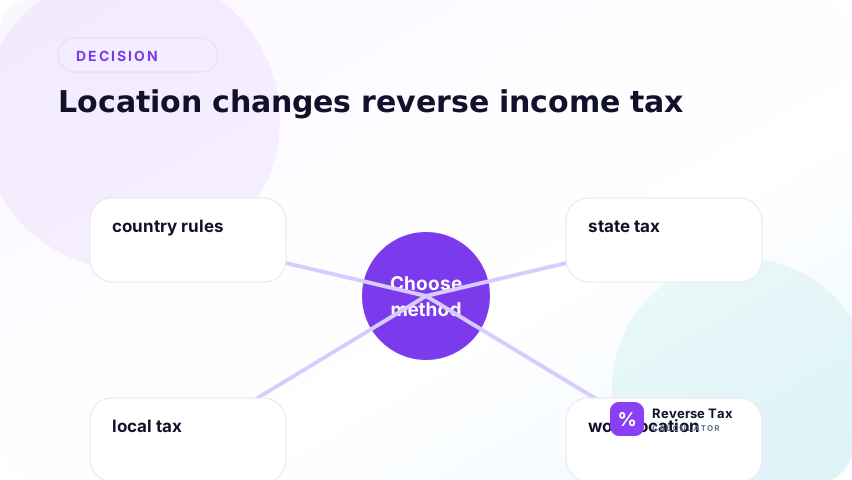
| Location factor | What it can change |
|---|---|
| Country | Tax brackets, credits, payroll taxes |
| State or province | Extra income tax or payroll deductions |
| City | Local income or wage tax |
| Residency | Which income is taxable |
| Work location | Source-based wage rules |
| Tax treaty | Cross-border treatment |
A calculator that ignores location may still produce arithmetic, but it may not produce a usable estimate.
Country-Level Limits
Country-level tax systems differ in structure. One country may use withholding tables, another may use pay-as-you-earn rules, and another may require social insurance contributions.
| Country-level issue | Reverse calculation effect |
|---|---|
| Progressive tax brackets | May require iteration |
| National insurance or payroll tax | Adds another layer |
| Tax credits | Reduce tax after calculation |
| Standard deductions or allowances | Reduce taxable income |
| Pay frequency rules | Change withholding |
This is why a generic reverse income tax calculator should clearly say which country it supports.
State, Province, and Local Limits
Subnational taxes can be just as important as national taxes.
| Layer | Why it matters |
|---|---|
| State income tax | Can change net pay |
| Provincial tax | Can have separate brackets |
| Local wage tax | Can reduce take-home pay |
| Local payroll tax | May apply to employer or employee |
| Special district or city tax | May apply by work or residence |
Two people with the same gross salary can have different net pay because they live or work in different places.
Payroll Withholding Limits
Payroll withholding is not always the same as final tax.
IRS Publication 15-T provides federal income tax withholding methods for U.S. employers. The IRS Tax Withholding Estimator asks about income, deductions, adjustments, and credits. Those official tools show that withholding depends on inputs, not just one percentage.
| Payroll input | Why it matters |
|---|---|
| Filing status | Affects withholding |
| W-4 or equivalent form | Controls employer withholding inputs |
| Pay frequency | Changes per-paycheck withholding |
| Year-to-date pay | Affects wage bases and thresholds |
| Pre-tax deductions | Change taxable wages |
| Post-tax deductions | Change final net pay |
Tax Residence and Work Location
Income tax may depend on tax residence, work location, or both. Remote work, cross-border employment, temporary assignments, and multi-state work can make a reverse calculation unreliable without detailed jurisdiction inputs.
| Situation | Risk |
|---|---|
| Lives in one place, works in another | More than one tax system may apply |
| Remote work | Work location rules may differ |
| Cross-border employee | Treaty and withholding issues |
| Temporary assignment | Special rules may apply |
| Multiple jobs | Withholding may be incomplete |
If the user’s location and work location are not known, a calculator should not pretend to be exact.
Example: Same Net Target, Different Jurisdiction
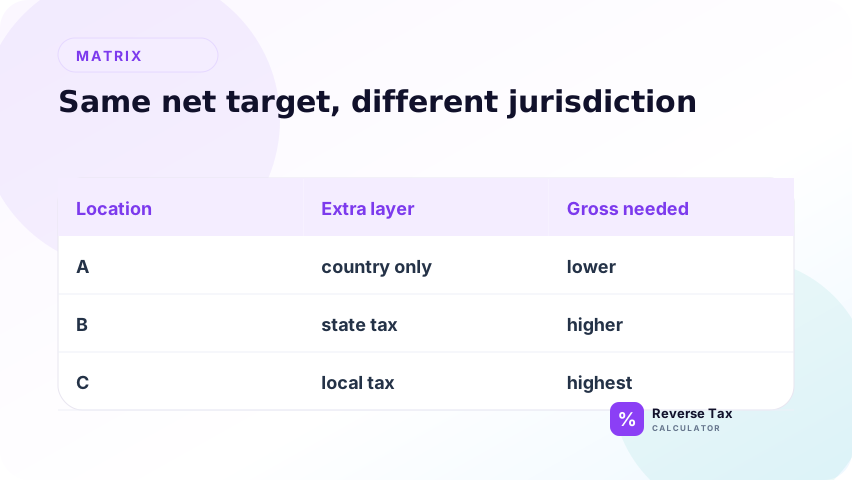
Suppose two workers both want 4,000 net pay. Worker A assumes a 20 percent total rate. Worker B assumes a 30 percent total rate.
Worker A:
4,000 / 0.80 = 5,000
Worker B:
4,000 / 0.70 = 5,714.29
| Worker | Assumed rate | Gross needed |
|---|---|---|
| A | 20 percent | 5,000.00 |
| B | 30 percent | 5,714.29 |
The same net target can require very different gross pay.
Example: Local Tax Changes the Result
Local tax can change a reverse income tax result because two taxpayers with the same net pay and federal assumptions may face different state, provincial, municipal, or payroll taxes. A calculator that ignores local tax may understate the gross income needed. This example shows why jurisdiction is not a cosmetic input in income-tax reverse calculations.
Suppose the target net is 3,000. A national-only estimate uses 22 percent, but the real combined rate with local tax is 25 percent.
National-only estimate:
3,000 / 0.78 = 3,846.15
Combined-rate estimate:
3,000 / 0.75 = 4,000.00
Difference:
153.85
That difference matters for salary planning and gross-up payments.
Example: Work Location vs Residence
Suppose a person lives in one jurisdiction but works in another. A simple calculator may ask for only one location, but the payroll result may depend on both.
| Factor | Possible effect |
|---|---|
| Residence | May determine resident tax |
| Work location | May determine wage sourcing |
| Employer payroll state | May determine withholding setup |
| Reciprocity rule | May change withholding |
| Local wage tax | May apply by work city |
If the calculator does not ask for both residence and work location, its estimate may be incomplete.
Example: Cross-Border Remote Work
A remote worker may be paid by an employer in one country, live in another country, and perform work in a third location during the year. A generic reverse income tax formula cannot resolve that.
| Missing fact | Why it matters |
|---|---|
| Tax residence | Determines broad tax obligations |
| Work days by location | May affect sourcing |
| Treaty treatment | May change withholding |
| Employer registration | May affect payroll |
| Social insurance system | May add non-income tax costs |
The correct answer is often not a formula. It is a jurisdiction analysis.
Decision Matrix
| Situation | Calculator reliability |
|---|---|
| One flat assumed rate | Good for concept only |
| Country and filing status known | Better |
| State or province known | Better |
| Pay frequency and deductions known | Stronger |
| Local tax applies but missing | Weak |
| Cross-border worker | Needs specialized guidance |
| Exact payroll needed | Use payroll system or official tools |
Source Hierarchy for Jurisdiction-Sensitive Pages
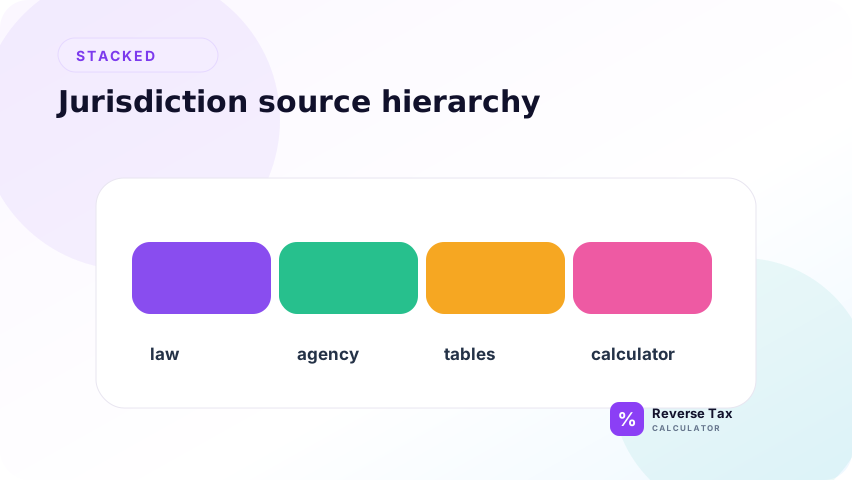
| Source type | Use |
|---|---|
| Official tax authority | Best for rates and rules |
| Official payroll publication | Best for withholding methods |
| Official estimator | Useful for individual planning |
| Employer payroll record | Useful for actual paycheck |
| Third-party calculator | Estimate only unless sources are clear |
For U.S. federal withholding, the IRS Tax Withholding Estimator and Publication 15-T are official sources.
Jurisdiction Checklist Before Using a Calculator
| Check | Why it matters |
|---|---|
| Country selected | Sets the tax system |
| State or province selected | Adds subnational rules |
| City or local tax checked | Can affect net pay |
| Residence known | Determines tax relationship |
| Work location known | Determines wage sourcing |
| Pay frequency known | Affects withholding |
| Deductions and credits known | Affects taxable income |
| Official source checked | Reduces outdated-rate risk |
If any of these are unknown, the result should be labeled as an estimate.
How This Affects Content and Calculator Design
A reverse income tax calculator should not hide jurisdiction limitations. The user should be told when a result is:
| Result type | Meaning |
|---|---|
| Formula-only estimate | Uses assumed rate only |
| Payroll estimate | Uses payroll inputs |
| Official-source estimate | Uses verified jurisdiction data |
| Final tax result | Requires return-level rules |
This protects trust and prevents the calculator from overpromising.
What a Calculator Can and Cannot Prove
| Can estimate | Cannot prove |
|---|---|
| Gross amount under selected assumptions | Exact legal tax liability |
| Effect of adding a local rate | Residency status |
| Difference between jurisdictions | Treaty treatment |
| Payroll gross-up under simple inputs | Employer compliance |
| Sensitivity to deductions | Final tax return result |
This limitation is not a weakness if it is clearly stated. It is an EEAT signal because income tax is jurisdiction-specific.
Common Mistakes
Common mistakes include assuming one country-wide formula, ignoring state or local taxes, ignoring social contributions, treating withholding as final tax, ignoring filing status, and using a calculator outside its supported jurisdiction. The safest workflow is to select jurisdiction first, then apply the rules and limitations for that jurisdiction.
The practical safeguard is to state calculator scope before showing a result. A reverse income tax estimate should say which jurisdiction, year, filing status, pay period, deductions, credits, and contributions it supports. If the user needs another jurisdiction or tax year, the calculator should warn them rather than silently reusing the wrong assumptions.
Using a Calculator for the Wrong Country
A U.S. withholding estimate should not be used for Canadian, UK, Australian, or other payroll systems.
Ignoring State or Local Tax
National tax may be only one part of the total burden.
Ignoring Residency
Tax residence can change what income is taxable and where.
Treating Withholding as Final Tax
Withholding is not always equal to tax due on the return.
Ignoring Payroll Deductions
Benefits, retirement contributions, garnishments, and post-tax deductions can change net pay.
Entity Map for Income Tax Jurisdiction
| Entity | Relationship |
|---|---|
| Taxpayer | Has residence and filing facts |
| Employer | Runs payroll withholding |
| Work location | May source wages |
| Residence jurisdiction | May tax income |
| Payroll method | Converts gross to withholding |
| Deductions and credits | Modify taxable income or tax |
| Net pay | Result after all applicable layers |
These entities explain why reverse income tax is not as portable as reverse sales tax.
What This Page Does Not Cover
| Topic | Better page |
|---|---|
| Net-to-gross salary | How to Calculate Gross Salary from Net Pay |
| Payroll taxes | How to Reverse Payroll Taxes |
| Progressive brackets | Why Progressive Tax Makes Reverse Calculation Harder |
| Deductions and credits | How Deductions, Credits, and Contributions Affect Reverse Income Tax |
Frequently Asked Questions
Why does reverse income tax depend on jurisdiction?
Because income tax rates, brackets, credits, payroll taxes, local taxes, residency rules, and withholding methods differ by jurisdiction.
Can one calculator handle every country?
Only if it has current rules and inputs for each country and tax system. A generic formula cannot do that alone.
Is withholding the same as final income tax?
No. Withholding is an amount taken from pay. Final tax is determined under the tax return rules.
Why does local tax matter?
Local tax can reduce net pay, so the gross amount needed for a target net amount can increase.
What should I use for U.S. federal withholding?
Use official IRS tools such as the Tax Withholding Estimator and Publication 15-T.
Sources
These sources support jurisdiction and withholding context. Income tax rules can vary by country, state, province, municipality, filing status, benefits, credits, and contributions. Use official tax authority calculators and guidance for real decisions. Use this page to understand why reverse income tax calculators need jurisdiction boundaries.
- IRS, Tax Withholding Estimator
- IRS, Publication 15-T, Federal Income Tax Withholding Methods for use in 2026