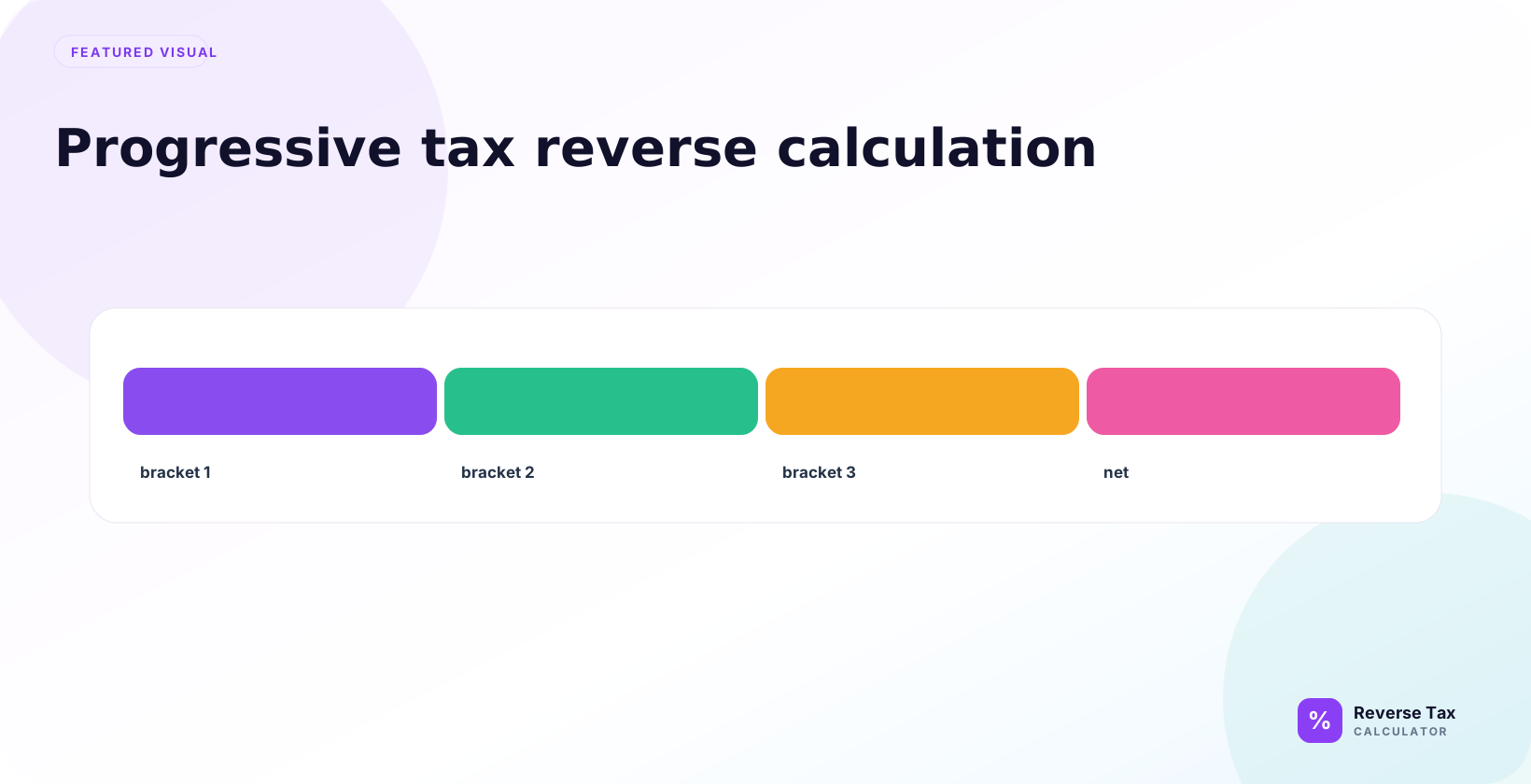
Progressive tax reverse calculation works backward through tax brackets because each slice of income is taxed at a different marginal rate. A single gross-up percentage cannot reproduce a progressive system when the target net amount crosses bracket thresholds. Accurate estimates require bracket limits, marginal rates, deductions, credits, payroll contributions, jurisdiction, tax year, and filing status before converting net income into gross income. Bracket order controls the reverse calculation.
What Is a Progressive Tax?
A progressive tax uses rates that increase as income moves through higher brackets. Different slices of income can be taxed at different rates.
| Term | Meaning |
|---|---|
| Bracket | Income range taxed at a stated rate |
| Marginal rate | Rate on the next dollar of income |
| Effective rate | Total tax divided by total income |
| Taxable income | Income after allowed adjustments or deductions |
The key point: not all income is taxed at the highest bracket rate.
Why Progressive Tax Is Harder to Reverse
Reverse calculations work best when one rate applies to one base.
Progressive tax breaks that simplicity:
| Flat tax | Progressive tax |
|---|---|
| One rate | Multiple rates |
| One multiplier | Multiple bracket calculations |
| Easy gross-up | May require iteration |
| Rate known upfront | Rate can change as gross changes |
When you increase gross pay to hit a net target, some of the increase may fall into a higher bracket. That changes the after-tax percentage.
Marginal Rate vs Effective Rate
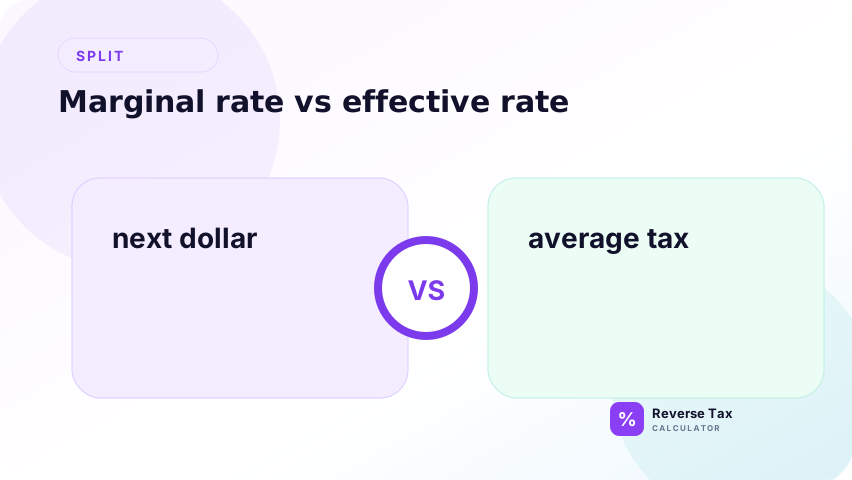
The marginal rate is the rate on the next dollar. The effective rate is total tax divided by total income.
Example:
| Income | Tax | Effective rate |
|---|---|---|
| 50,000 | 7,500 | 15 percent |
| 100,000 | 20,000 | 20 percent |
The effective rate can be much lower than the top marginal rate because lower brackets are taxed at lower rates.
Why Effective Rate Can Mislead a Reverse Calculation
If you gross up using the current effective rate, the next dollars of income may be taxed at the marginal rate, not the old average rate.
| Rate type | Use |
|---|---|
| Effective rate | Summarizes past or current tax burden |
| Marginal rate | Estimates tax on additional income |
| Blended rate | May be used for rough gross-up |
| Bracket calculation | Stronger for precision |
For bonuses, raises, or incremental payments, marginal rate can matter more than effective rate.
Flat Tax Example
A flat tax example is simple because one rate applies to the whole taxable base. If tax is 20%, a gross-up or reverse calculation can use one multiplier. Progressive tax is harder because different portions of income may be taxed at different marginal rates. The flat example is useful as a contrast, not as a model for complex income tax.
Suppose desired net pay is 1,000 and the tax rate is a flat 20 percent.
Gross = 1,000 / 0.80
Gross = 1,250
Tax:
1,250 x 20 percent = 250
Net:
1,250 - 250 = 1,000
One rate makes the reverse calculation direct.
Progressive Tax Example
Suppose a simplified bracket system:
| Income slice | Rate |
|---|---|
| First 1,000 | 10 percent |
| Amount above 1,000 | 20 percent |
If gross income is 1,500:
Tax on first 1,000:
1,000 x 10 percent = 100
Tax on next 500:
500 x 20 percent = 100
Total tax:
200
Net:
1,500 - 200 = 1,300
The effective rate is:
200 / 1,500 = 13.33 percent
But the marginal rate is 20 percent.
Why Net-to-Gross May Need Iteration
If the target net pay is 1,400, you cannot simply divide by one obvious rate without knowing which bracket the gross amount falls into.
An iterative approach:
- Guess a gross amount.
- Apply bracket rules.
- Calculate net.
- Compare net with the target.
- Adjust gross.
- Repeat.
This is why reverse income tax calculators may need more logic than reverse sales tax calculators.
Iteration Example
An iteration example shows why reverse income tax often needs repeated calculation. Start with a gross estimate, calculate tax across brackets and deductions, compare the resulting net amount with the target net, then adjust gross and repeat. This approach works better than one formula when rates, deductions, credits, and contributions interact.

Target net:
1,400
Guess gross:
1,600
Tax:
1,000 x 10 percent = 100
600 x 20 percent = 120
Total tax:
220
Net:
1,600 - 220 = 1,380
The net is 20 short. Increase the gross estimate and calculate again.
Second Iteration Example
Try gross income of 1,625.
Tax:
1,000 x 10 percent = 100
625 x 20 percent = 125
Total tax:
225
Net:
1,625 - 225 = 1,400
Now the target net is reached. The correct gross is 1,625 under this simplified bracket system.
This shows why progressive reverse calculations often solve by testing gross amounts rather than using one universal divisor.
How Deductions and Credits Interact
Deductions and credits can make reverse calculation even harder.
| Adjustment | Effect |
|---|---|
| Deduction | Reduces taxable income |
| Credit | Reduces tax after tax is calculated |
| Pre-tax contribution | Can reduce taxable wages |
| Post-tax deduction | Reduces final net pay |
| Phaseout | Can change as income rises |
When gross income changes, deductions, credits, or phaseouts may also change.
How a Deduction Changes the Reverse Path
Suppose a taxpayer has a fixed deduction of 500 before brackets apply.
| Step | Meaning |
|---|---|
| Gross income | Starting amount |
| Minus deduction | Finds taxable income |
| Apply brackets | Calculates tax |
| Subtract tax from gross | Finds net |
The reverse calculation now has to solve for gross income, while tax depends on taxable income. That makes the path longer than a flat-rate gross-up.
How a Credit Changes the Reverse Path
A credit reduces tax after the bracket calculation. If the credit is fixed, it may reduce the gross income needed to hit a net target.
| Adjustment | Timing |
|---|---|
| Deduction | Before tax |
| Credit | After tax |
| Post-tax deduction | After tax and after net calculation |
Using the wrong timing can produce a clean but wrong net-to-gross answer.
Why Withholding Is Not the Same as Final Tax
The IRS Tax Withholding Estimator asks about income, adjustments, deductions, and credits. IRS Publication 15-T gives federal income tax withholding methods. That shows withholding is a process based on inputs, not a single universal rate.
| Concept | Meaning |
|---|---|
| Withholding | Tax taken from pay during the year |
| Final tax | Tax determined on the return |
| Refund or balance due | Difference between withholding and final tax |
A reverse paycheck estimate may not equal final annual tax.
Why Supplemental Pay Can Be Different
Bonuses, commissions, relocation payments, and other supplemental wages may be handled differently by payroll systems. A progressive tax calculator that works for regular salary may not match a supplemental payment.
| Payment type | Reverse calculation concern |
|---|---|
| Regular wages | Pay-period withholding |
| Bonus | Supplemental treatment may apply |
| Commission | Timing and aggregation matter |
| Relocation payment | Taxability and gross-up policy matter |
| Severance | Payroll and withholding rules may differ |
This is why the article separates formula learning from payroll compliance.
Decision Matrix
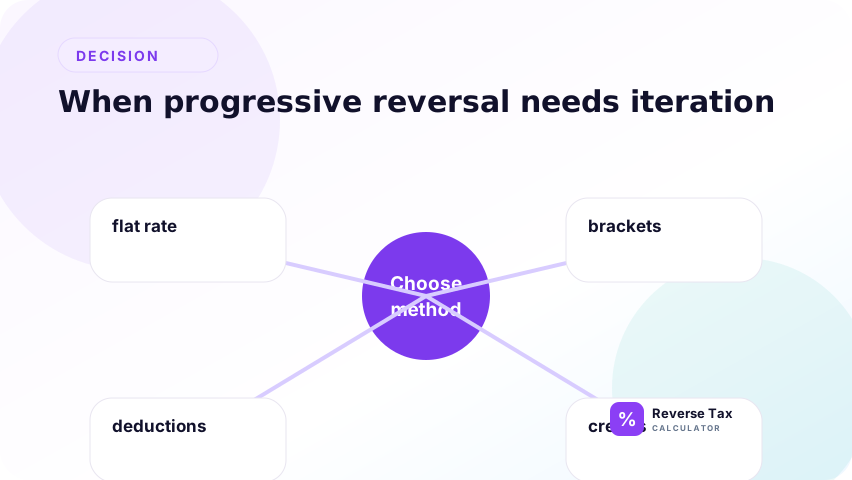
| Situation | Best method |
|---|---|
| One flat rate | Simple gross-up formula |
| One bracket only | Bracket formula may work |
| Multiple brackets | Bracket-by-bracket calculation |
| Target paycheck | Payroll calculator |
| U.S. federal withholding | IRS estimator or Publication 15-T method |
| Credits or phaseouts | Tax software or professional |
Operational Workflow for Progressive Reversal
- Define the net target and pay period.
- Estimate gross income.
- Apply deductions or pre-tax adjustments.
- Calculate taxable income.
- Apply bracket rules.
- Apply credits if relevant.
- Subtract tax and post-tax deductions.
- Compare net to target.
- Adjust gross and repeat.
This workflow is slower than a flat formula, but it explains why progressive tax reversal is more reliable when done iteratively.
What Data Makes the Calculation Stronger?
| Data point | Why it improves the estimate |
|---|---|
| Current gross pay | Shows current bracket position |
| Year-to-date wages | Helps estimate remaining withholding |
| Filing status | Changes withholding tables |
| Pay frequency | Changes paycheck calculation |
| Pre-tax deductions | Changes taxable wages |
| Credits | Reduces tax after calculation |
| State or local taxes | Adds additional brackets or rates |
The fewer inputs available, the more the result should be treated as a rough estimate.
Why Reverse Sales Tax Is Simpler
Reverse sales tax usually starts with one total and one rate:
Pre-tax price = Total / (1 + rate)
Progressive income tax may require several rates, deductions, and credits before the net amount is known.
| Reverse sales tax | Progressive income tax |
|---|---|
| One rate can be enough | One rate is often not enough |
| Tax base is usually the price | Taxable income may differ from gross |
| Result is arithmetic | Result depends on rules and inputs |
This comparison helps protect the sales tax calculator from being mistaken for a payroll engine.
What a Progressive Reverse Calculation Can and Cannot Prove
| Can estimate | Cannot prove |
|---|---|
| Gross needed under assumed brackets | Final tax liability |
| Effect of marginal rates | Correct withholding setup |
| Why flat formula may fail | Eligibility for credits |
| Approximate net-to-gross amount | Employer compliance |
The calculation is only as accurate as the bracket, deduction, credit, and payroll inputs.
Common Mistakes
Common mistakes include using one average rate as if it were a marginal rate, ignoring deductions and credits, ignoring payroll contributions, applying annual brackets to monthly pay without conversion, and expecting a single reverse formula to solve a progressive system. The safest method is to model the tax steps and iterate.
The most dangerous shortcut is solving progressive tax like a single sales tax rate. Income tax may use brackets, thresholds, phaseouts, credits, withholding tables, and pay-period rules. Reverse calculation should test a gross amount against those rules, compare the resulting net amount with the target, and iterate until the result is close enough.
Using the Top Marginal Rate on All Income
Only income in the top bracket is taxed at the top marginal rate.
Using the Effective Rate for Extra Income
Extra income may be taxed at the marginal rate, not the average rate.
Ignoring Deductions and Credits
Deductions and credits can change the taxable base and tax amount.
Treating Withholding as Final Tax
Withholding is not necessarily the final tax.
Using Sales Tax Formula for Income Tax
Sales tax reversal assumes one rate on one base. Progressive income tax does not.
Entity Map for Progressive Tax Reversal
| Entity | Role |
|---|---|
| Gross income | Starting point before tax |
| Taxable income | Income after deductions |
| Bracket | Rate range |
| Marginal rate | Rate on next dollar |
| Effective rate | Average tax rate |
| Credit | Reduces tax |
| Net income | Amount after tax |
| Iteration | Method to solve target net |
What This Page Does Not Cover
| Topic | Better page |
|---|---|
| Net-to-gross salary | How to Calculate Gross Salary from Net Pay |
| Gross-up formula | Gross-Up Formula for Taxes |
| Payroll taxes | How to Reverse Payroll Taxes |
| Reverse sales tax | Reverse Tax Formula |
Frequently Asked Questions
Why is progressive tax hard to reverse?
Because the tax rate can change as income moves through brackets.
Can I use one tax rate to estimate gross pay?
Yes for a rough estimate, but it may be wrong if multiple brackets, deductions, or credits apply.
What is the difference between marginal and effective rate?
Marginal rate is the rate on the next dollar. Effective rate is total tax divided by total income.
Why does a payroll calculator use iteration?
Because changing gross pay can change tax, deductions, and bracket placement.
Is withholding the same as final tax?
No. Withholding is a payment method. Final tax is determined on the tax return.
Sources
These sources support the progressive-tax and withholding context. Use official tax authority tables, withholding tools, and jurisdiction-specific guidance for real calculations. This page explains why progressive systems are harder to reverse, but it does not replace official calculators or professional payroll and tax advice.