A reverse income tax calculator estimates the gross income needed before tax to produce a target after-tax amount. The calculator reverses income tax by using an effective tax rate, tax brackets, deductions, credits, and payroll contributions to move from net income back to gross income. It gives an estimate rather than a filing result because jurisdictions, tax years, benefits, withholding rules, and progressive brackets change the final amount.
What Is a Reverse Income Tax Calculator?
A reverse income tax calculator is a net-to-gross calculator for income tax. It starts with a target net amount and works backward to estimate the gross amount before tax.
| Term | Meaning |
|---|---|
| Gross income | Amount before income tax and deductions |
| Net income | Amount after tax and deductions |
| Reverse income tax | Working backward from net to gross |
| Gross-up | Increasing gross pay so the employee receives a target net amount |
The calculator is not the same as a reverse sales tax calculator. Sales tax is usually a percentage added to a price. Income tax can involve brackets, withholding tables, credits, deductions, filing status, payroll taxes, state taxes, local taxes, and benefit deductions.
How Does a Reverse Income Tax Calculator Work?
A simple reverse income tax calculation divides the desired net amount by the after-tax percentage.
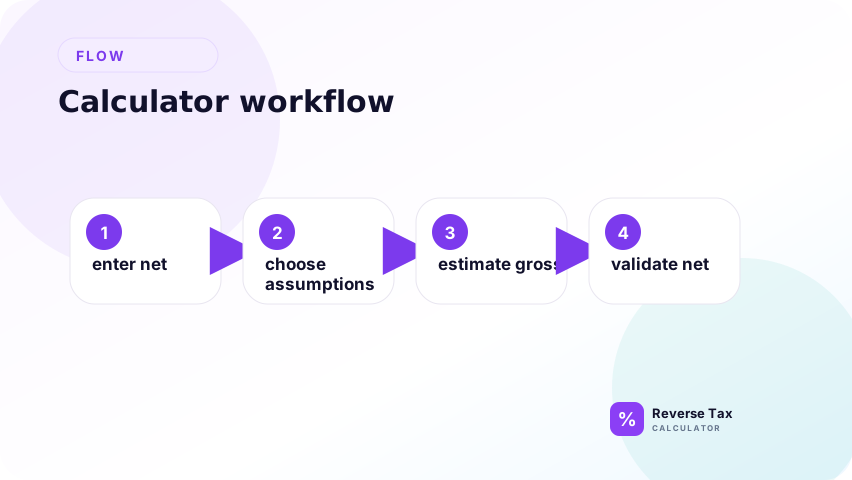
Basic flat-rate formula:
Gross amount = Net amount / (1 - tax rate)
Example:
Gross amount = 800 / (1 - 0.20)
Gross amount = 800 / 0.80
Gross amount = 1,000
This works only for a simple flat tax assumption. Real payroll can be more complex.
Why Is Reverse Income Tax Different from Reverse Sales Tax?
Reverse sales tax removes tax from a tax-inclusive price. Reverse income tax estimates gross income before income tax withholding or payroll deductions.
| Feature | Reverse sales tax | Reverse income tax |
|---|---|---|
| Starting value | Tax-inclusive price | Net pay or take-home amount |
| Main formula | Divide by tax multiplier | Divide by after-tax percentage or iterate |
| Tax structure | Often one rate | Often brackets and withholding rules |
| Common use | Receipts and invoices | Payroll, salary, bonuses |
| Accuracy risk | Rate and taxability | Withholding, deductions, filing status |
This difference matters because a simple reverse sales tax calculator should not be used as a payroll withholding calculator.
What Inputs Does a Reverse Income Tax Calculator Need?
A useful reverse income tax calculator needs more than a net amount.
| Input | Why it matters |
|---|---|
| Target net amount | Desired take-home pay |
| Pay frequency | Weekly, biweekly, monthly, annual |
| Filing status | Affects withholding or tax calculation |
| Location | Federal, state, local, or provincial taxes |
| Pre-tax deductions | Reduces taxable wages |
| Post-tax deductions | Reduces net pay after tax |
| Payroll taxes | May apply separately from income tax |
| Tax credits or adjustments | Can change final tax |
IRS Publication 15-T provides federal income tax withholding methods for 2026. The IRS Tax Withholding Estimator also asks about income, adjustments, deductions, and credits when estimating federal withholding.
What Can a Reverse Income Tax Calculator Estimate?
It can estimate:
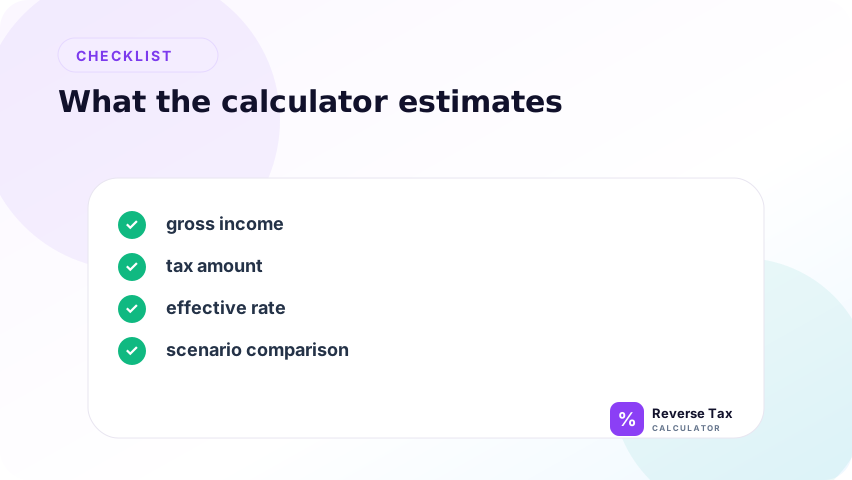
| Estimate | Example |
|---|---|
| Gross pay needed for target net pay | “I want 3,000 take-home” |
| Bonus gross-up | “Employee should receive 1,000 net bonus” |
| Net-to-gross salary | “What salary gives this monthly net?” |
| Withholding sensitivity | “What happens if rate changes?” |
| Employer payment planning | “How much gross is needed before taxes?” |
It is best used for planning, not as final payroll authority.
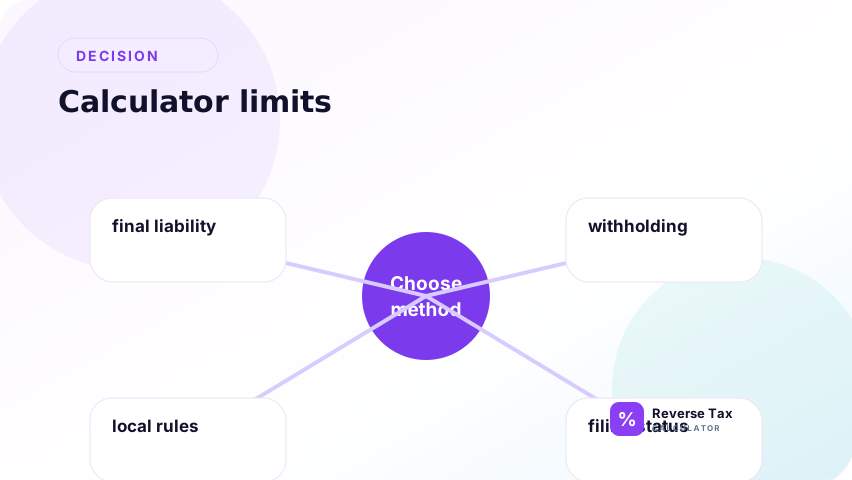
What Can It Not Prove?
| Calculator can estimate | Calculator cannot prove |
|---|---|
| Gross amount under assumed rates | Exact legal tax liability |
| Approximate withholding impact | Correct W-4 entries |
| Flat-rate gross-up | Full payroll compliance |
| Net-to-gross comparison | State and local rule accuracy without data |
| Bonus gross-up math | Employer reporting requirements |
This is an important trust boundary. Income tax is not just arithmetic. It is also withholding methodology and tax law.
When Should You Use a Reverse Income Tax Calculator?
Use it when the question starts with a desired net amount:
| User question | Reverse income tax fit |
|---|---|
| What gross salary gives me 4,000 net? | Yes |
| What gross bonus gives 1,000 net? | Yes |
| What is my pre-tax paycheck from net pay? | Maybe |
| How much tax is inside a receipt total? | No |
| What should my employer withhold? | Use official withholding tools |
Example: Net Pay to Gross Pay
Suppose the target net pay is 2,400 and the assumed total tax rate is 20 percent.
After-tax percentage:
1 - 0.20 = 0.80
Gross pay:
2,400 / 0.80 = 3,000
Estimated tax:
3,000 - 2,400 = 600
| Component | Amount |
|---|---|
| Target net pay | 2,400 |
| Assumed tax rate | 20 percent |
| Estimated gross pay | 3,000 |
| Estimated tax | 600 |
Example: Bonus Gross-Up
Suppose an employer wants an employee to receive 1,000 after a flat 25 percent withholding assumption.
After-tax percentage:
1 - 0.25 = 0.75
Gross bonus:
1,000 / 0.75 = 1,333.33
Estimated withholding:
1,333.33 - 1,000 = 333.33
| Component | Amount |
|---|---|
| Desired net bonus | 1,000.00 |
| Assumed withholding rate | 25 percent |
| Gross bonus | 1,333.33 |
| Estimated withholding | 333.33 |
This is a simple gross-up example. Real payroll may use supplemental wage rules, state withholding, payroll taxes, or employer-specific settings.
Why Real Payroll May Need Iteration
Real paycheck withholding may not be a single flat rate. Tax brackets, deductions, credits, and payroll taxes can make the effective rate change as gross pay changes.
In that case, a calculator may need to iterate:
- Guess a gross amount.
- Calculate estimated withholding.
- Compare estimated net pay to target net pay.
- Adjust gross amount.
- Repeat until the net amount is close.
This is why payroll gross-up tools are usually more complex than sales tax calculators.
How Official Withholding Tools Fit In
The IRS Tax Withholding Estimator is designed to estimate the correct federal tax withholding for W-2 wages or pension income. The IRS page says users may need recent paystubs, a spouse's paystubs if filing jointly, a recent tax return, and records for other income or deductions.
That tells us something important for reverse income tax content: a reliable income-tax estimate needs personal payroll and tax inputs. A simple reverse formula is useful for understanding the math, but it does not replace official withholding estimation.
| Need | Best source |
|---|---|
| Conceptual net-to-gross math | Reverse income tax guide |
| Federal withholding estimate | IRS Tax Withholding Estimator |
| Employer withholding method | IRS Publication 15-T |
| Final tax liability | Tax return or tax professional |
Why Pay Frequency Matters
A target net amount can mean different things depending on the pay period.
| Net target | Possible meaning |
|---|---|
| 1,500 | Weekly paycheck |
| 3,000 | Biweekly or monthly take-home |
| 6,000 | Monthly salary target |
| 72,000 | Annual after-tax income |
Before grossing up, define the period. A monthly net target should not be mixed with an annual tax rate unless both values are converted consistently.
Decision Matrix
| Situation | Best tool |
|---|---|
| Receipt total includes sales tax | Reverse sales tax calculator |
| Target net paycheck | Reverse income tax calculator |
| Federal withholding estimate | IRS Tax Withholding Estimator |
| Employer withholding method | IRS Publication 15-T |
| Bonus net amount target | Gross-up calculator |
| Exact tax filing liability | Tax return or tax professional |
Common Mistakes
Common mistakes include treating reverse income tax like reverse sales tax, using one flat rate for progressive tax, ignoring deductions, ignoring credits, ignoring payroll contributions, and using the wrong jurisdiction. A reverse income tax calculator usually estimates gross income from net income, so it needs filing status, location, pay period, deductions, credits, and contribution assumptions.
The practical safeguard is to treat every input as jurisdiction-specific. Net pay after federal tax only is different from net pay after federal, state, local, payroll, benefit, and retirement deductions. A calculator should state what it includes and excludes before showing a gross estimate. Otherwise, a precise-looking number can be built on missing assumptions.
Using Sales Tax Logic for Income Tax
Income tax is not usually a simple tax-inclusive price problem.
Ignoring Payroll Deductions
Health insurance, retirement contributions, garnishments, and other deductions can change net pay.
Using One Flat Rate for a Progressive Tax
A flat rate can be useful for examples, but real income tax may be progressive.
Confusing Withholding with Final Tax
Withholding is an estimate or prepayment. Final tax is determined on the tax return.
Ignoring Pay Frequency
Weekly, biweekly, semi-monthly, monthly, and annual calculations can produce different withholding patterns.
Ignoring State or Local Taxes
Federal withholding is only one layer. State, local, provincial, or payroll taxes can change the gross amount needed.
Entity Map for Reverse Income Tax
| Entity | Role |
|---|---|
| Net target | Desired take-home amount |
| Gross income | Amount before tax and deductions |
| Withholding | Estimated tax withheld from pay |
| Pay frequency | Period used for calculation |
| Filing status | Affects withholding method |
| Deduction | Reduces taxable or net pay |
| Official withholding method | Determines payroll calculation |
These entities must stay together. A reverse income tax calculator is weak if it asks only for net pay and ignores the other inputs.
What This Page Does Not Cover
| Topic | Better page |
|---|---|
| Net-to-gross salary steps | How to Calculate Gross Salary from Net Pay |
| Gross-up math | Gross-Up Formula for Taxes |
| Reverse payroll tax | Reverse Payroll Tax Calculation |
| Reverse sales tax | What Is Reverse Tax? |
Frequently Asked Questions
What is reverse income tax?
Reverse income tax means estimating the gross income needed to produce a target net amount after taxes.
Is reverse income tax the same as reverse sales tax?
No. Reverse sales tax removes tax from a price. Reverse income tax estimates gross pay or income from net pay.
Can a reverse income tax calculator tell my exact paycheck?
Only if it has the correct withholding rules, deductions, filing status, pay frequency, and location data.
What is a gross-up?
A gross-up increases gross pay so the recipient receives a desired net amount after taxes.
Should I use the IRS estimator?
For U.S. federal withholding planning, the IRS Tax Withholding Estimator is an official tool that can help estimate withholding.
Sources
These sources support income-tax and withholding context. Income tax calculations vary by jurisdiction, tax year, filing status, deductions, credits, payroll contributions, and local taxes. Use official tax authority calculators and payroll guidance for real decisions. Use this page to understand what a reverse income tax calculator can estimate and where its limits begin.
- IRS, Tax Withholding Estimator
- IRS, Publication 15-T, Federal Income Tax Withholding Methods for use in 2026