No-state-sales-tax states do not charge statewide sales tax, but local taxes or special transaction rules may still affect some purchases. Reverse sales tax in those states depends on whether the receipt actually includes a local, lodging, excise, marketplace, or other tax line. A zero statewide rate should not be used blindly when cities, boroughs, product categories, shipping, or seller collection rules create taxable charges. The printed receipt decides the calculation.
What Does No State Sales Tax Mean?
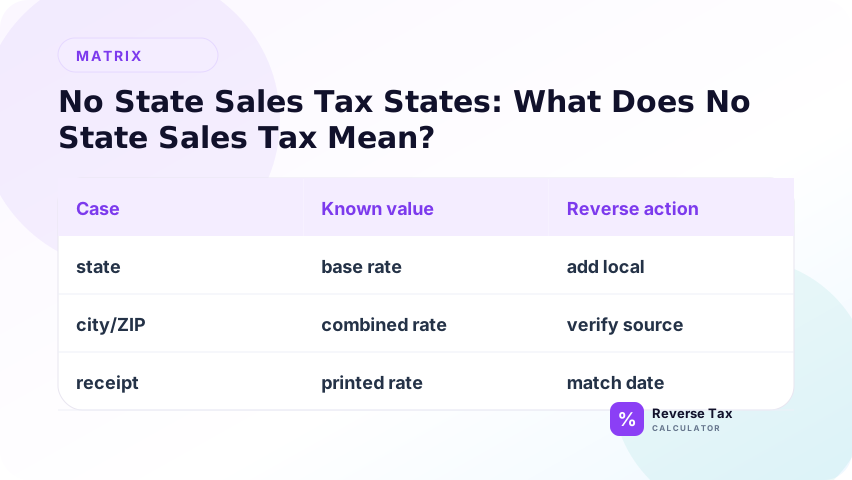
No state sales tax means the state does not impose a broad statewide sales tax on general retail sales. It does not automatically mean:
- every local government has no sales tax;
- every product is free from special taxes;
- hotel, rental, alcohol, tobacco, vehicle, or tourism taxes do not apply;
- a receipt total never contains tax.
For reverse tax, the practical question is not only “does the state have sales tax?” The better question is “did this transaction include a tax that should be removed?”
States with No Statewide Sales Tax
| State | Statewide sales tax? | Reverse-tax caution |
|---|---|---|
| Alaska | No statewide sales tax | Local sales taxes may apply in some places |
| Delaware | No statewide sales tax | Check special taxes or fees |
| Montana | No statewide sales tax | Check local resort or special taxes where relevant |
| New Hampshire | No statewide sales tax | Check meals, rooms, rentals, or special taxes |
| Oregon | No statewide sales tax | Check special local or product-specific charges |
This list is stable as a broad current U.S. sales-tax concept, but always verify current state and local rules for business or compliance use.
Important Local Tax Caveat
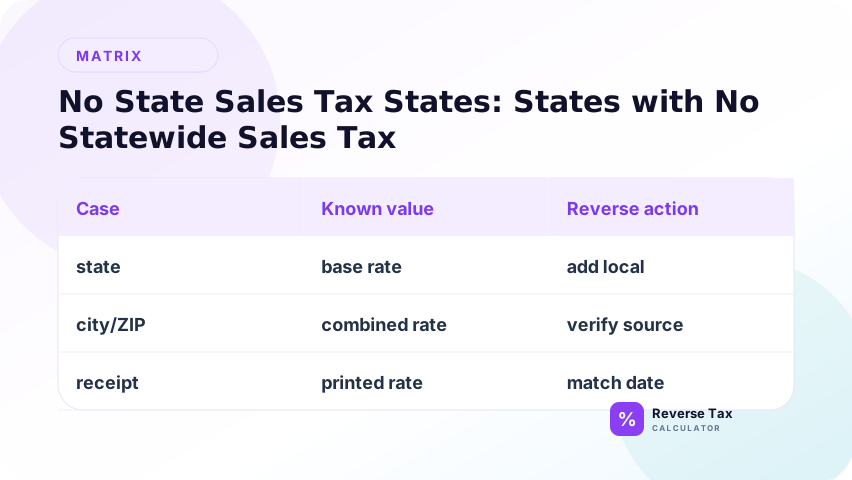
Alaska is the clearest caution. It has no statewide sales tax, but local governments can impose local sales taxes. That means “Alaska has no state sales tax” does not always mean an Alaska receipt has no sales tax.
| Phrase | Meaning |
|---|---|
| No state sales tax | No broad statewide sales tax |
| No local sales tax | Local jurisdiction does not impose local sales tax |
| No tax on this receipt | The specific transaction included no sales tax |
| 0 percent rate | No tax rate applied to the taxable amount |
Reverse tax should follow the receipt or official transaction rule, not a slogan.
State-by-State Practical Notes
| State | Practical note for reverse tax |
|---|---|
| Alaska | Check local municipality or borough sales tax before using 0 percent |
| Delaware | General retail sales tax is not statewide, but special taxes or fees can still exist |
| Montana | Check local resort or tourism-related taxes in certain places |
| New Hampshire | Check meals, rooms, rentals, and other special taxes |
| Oregon | General retail sales tax is not statewide, but special charges can still appear |
These notes are not a substitute for official rules. They are a calculation guardrail: do not use 0 percent unless the specific receipt or invoice has no included tax.
How No-State-Sales-Tax States Affect Reverse Tax
No-state-sales-tax states affect reverse tax because a 0% state rate does not always mean every receipt has no transaction tax. Some states may allow local taxes, special taxes, lodging taxes, excise taxes, or other charges. Reverse tax should follow the tax label on the receipt and the applicable local rules rather than assuming the state headline rate is the whole story.
If no sales tax was included, reverse tax is simple:
Pre-tax amount = Total / 1.00
So:
100.00 / 1.00 = 100.00
Included tax:
100.00 - 100.00 = 0.00
But if a local or special tax is included, use the actual rate.
Example 1: True 0 Percent Transaction
Suppose a receipt total is 100.00 and no sales tax applies.
| Component | Amount |
|---|---|
| Total | 100.00 |
| Rate | 0 percent |
| Pre-tax amount | 100.00 |
| Included tax | 0.00 |
There is no tax to remove.
Example 2: Local Tax in a No-State-Sales-Tax State
This example shows why "no state sales tax" is not the same as "no tax on the receipt." A local jurisdiction or special tax can still create a tax line in some places or transaction types. If a receipt shows tax, calculate the implied rate from subtotal and tax, then verify what local or special tax produced it.
Suppose a receipt total is 105.00 in a place with no statewide sales tax but a 5 percent local tax.
105.00 / 1.05 = 100.00
105.00 - 100.00 = 5.00
The included tax is local, not statewide.
Example 3: Special Tax or Fee
Suppose a hotel, rental, meal, or tourism transaction includes a special charge. Do not treat it as a normal retail sales tax unless the rule and receipt support that classification.
| Charge type | Reverse-tax caution |
|---|---|
| Hotel tax | May use lodging-specific rules |
| Rental tax | May use rental-specific rules |
| Alcohol tax | May be excise tax, sales tax, or both |
| Local resort tax | May apply only in certain places |
| Fee | May not be a percentage tax |
If it is a flat fee, the percentage reverse-tax formula may not apply.
No State Sales Tax vs No Tax Paid
These ideas are related but not identical.
| Statement | Reverse-tax meaning |
|---|---|
| State has no sales tax | Statewide retail sales tax is 0 percent |
| Local tax applies | Use local rate if included |
| Special tax applies | Treat according to special tax type |
| Receipt shows no tax | No percentage sales tax to remove |
| Receipt shows tax | Identify the tax before calculating |
The calculator input should follow the transaction, not just the state category.
Example 4: Receipt Shows No Tax Line
Suppose a receipt in Oregon shows:
| Field | Amount |
|---|---|
| Items | 150.00 |
| Tax | 0.00 |
| Total | 150.00 |
There is no reverse-tax calculation needed:
150.00 / 1.00 = 150.00
Included tax is 0.00.
Example 5: Receipt Shows a Percentage Local Tax
Suppose a receipt in a no-state-sales-tax state shows a local tax line:
| Field | Amount |
|---|---|
| Taxable subtotal | 200.00 |
| Local tax at 5 percent | 10.00 |
| Total | 210.00 |
Reverse tax from 210.00 using 5 percent:
210.00 / 1.05 = 200.00
210.00 - 200.00 = 10.00
The included tax is local, and the statewide rate is still 0 percent.
Decision Matrix
| Situation | Rate to use |
|---|---|
| Receipt shows no tax | 0 percent |
| Receipt shows local percentage tax | Use local rate |
| Receipt shows special percentage tax | Use that rate only if it applies to the base |
| Receipt shows flat fee | Do not use percentage reverse-tax formula for the fee |
| Online order shipped into state | Verify sourcing and tax collection rule |
| Business recordkeeping | Use official state and local guidance |
How to Check a Receipt in a No-State-Sales-Tax State
Look for these labels:
| Receipt label | What to do |
|---|---|
| Sales tax | Identify rate and base |
| Local tax | Use local rate if applicable |
| Resort tax | Verify local rule |
| Lodging tax | Treat as lodging-specific tax |
| Fee | Determine whether flat or percentage |
| Tax exempt | No reverse tax unless another tax line exists |
Common Mistakes
Common mistakes include assuming every purchase in a no-state-sales-tax state has no tax, ignoring local taxes, confusing sales tax with lodging or excise taxes, and using state-level lists for product-specific decisions. The safest workflow is to read the receipt label, identify the jurisdiction, and confirm with official sources before reversing or disputing tax.
The practical warning is that "no state sales tax" is a state-level label, not a universal tax-free guarantee. A hotel bill, rental, prepared food receipt, local jurisdiction, or special district may still show tax-like charges. Reverse tax should follow the receipt label and applicable local authority, not only a list of no-state-sales-tax states.
Assuming No State Tax Means No Local Tax
Local tax can still matter in some no-state-sales-tax states.
Removing Tax from a 0 Percent Receipt
If no tax was included, the pre-tax amount equals the total.
Treating Flat Fees Like Percentage Taxes
A flat fee should be subtracted or classified separately, not reversed through a percentage multiplier.
Ignoring Special Taxes
Meals, rooms, rentals, tourism, alcohol, tobacco, and vehicle transactions may have special rules.
Using a National List Instead of the Receipt
The receipt is stronger evidence of what was charged in the specific transaction.
Information Gain: What Competitor Lists Often Miss
Many pages stop after listing the five states. For reverse tax, that is incomplete because the calculation depends on transaction-level tax.
| Basic list answer | Better reverse-tax answer |
|---|---|
| Alaska has no state sales tax | Check local tax before using 0 percent |
| Delaware has no state sales tax | Check special transaction taxes |
| Montana has no state sales tax | Check resort or local special taxes |
| New Hampshire has no state sales tax | Check meals and rooms taxes |
| Oregon has no state sales tax | Check the receipt for special charges |
The useful question is not just where the state tax is zero. It is whether the total you are reversing contains any tax at all.
Reverse Tax Checklist for a No-State-Sales-Tax Receipt
Before entering 0 percent, check:
| Check | Why it matters |
|---|---|
| Does the receipt show a tax line? | If yes, 0 percent may be wrong |
| Is the tax local, lodging, meals, or special? | The formula input may need that rate |
| Is the charge a flat fee? | Percentage reverse tax may not apply |
| Is the transaction online? | Collection rules can differ |
| Is the receipt for a hotel, rental, or restaurant? | Special taxes are more common |
| Is this for bookkeeping? | Keep official evidence |
If every check points to no included tax, the reverse-tax answer is the total itself.
Reverse Tax Example: 0 Percent vs 5 Percent Local Tax
For a 525.00 total:
| Rate used | Pre-tax amount | Included tax |
|---|---|---|
| 0 percent | 525.00 | 0.00 |
| 5 percent | 500.00 | 25.00 |
This shows why no-state-sales-tax assumptions can create large differences. A local 5 percent tax changes the tax split by 25.00 on a 525.00 receipt.
What This Page Does Not Cover
| Topic | Better page |
|---|---|
| Choosing a rate | How to Choose the Correct Tax Rate |
| City, county, ZIP rates | City, County, and ZIP Sales Tax Rates |
| Taxable vs exempt | Taxable vs Tax-Exempt Transactions |
| Receipt rate formula | How to Find the Tax Rate on a Receipt |
Frequently Asked Questions
What states have no sales tax?
Alaska, Delaware, Montana, New Hampshire, and Oregon have no statewide sales tax.
Does Alaska have no sales tax?
Alaska has no statewide sales tax, but some local governments may impose local sales taxes.
Should I enter 0 percent in a reverse tax calculator?
Enter 0 percent only if the transaction did not include sales tax. If the receipt shows local tax, use the local rate.
Is no sales tax the same as tax exempt?
No. A no-state-sales-tax state is a jurisdiction feature. Tax exempt describes a transaction, item, buyer, or seller status.
Can special taxes apply in no-sales-tax states?
Yes. Some transactions may involve local taxes, lodging taxes, meals taxes, excise taxes, or fees.
Source Note
These sources support state-level context, but local and special taxes can still matter. Use official state tax authority pages and local guidance for current rate, taxability, lodging, excise, and special tax questions. Use this page for reverse-tax interpretation when a state headline rate appears to conflict with a receipt.