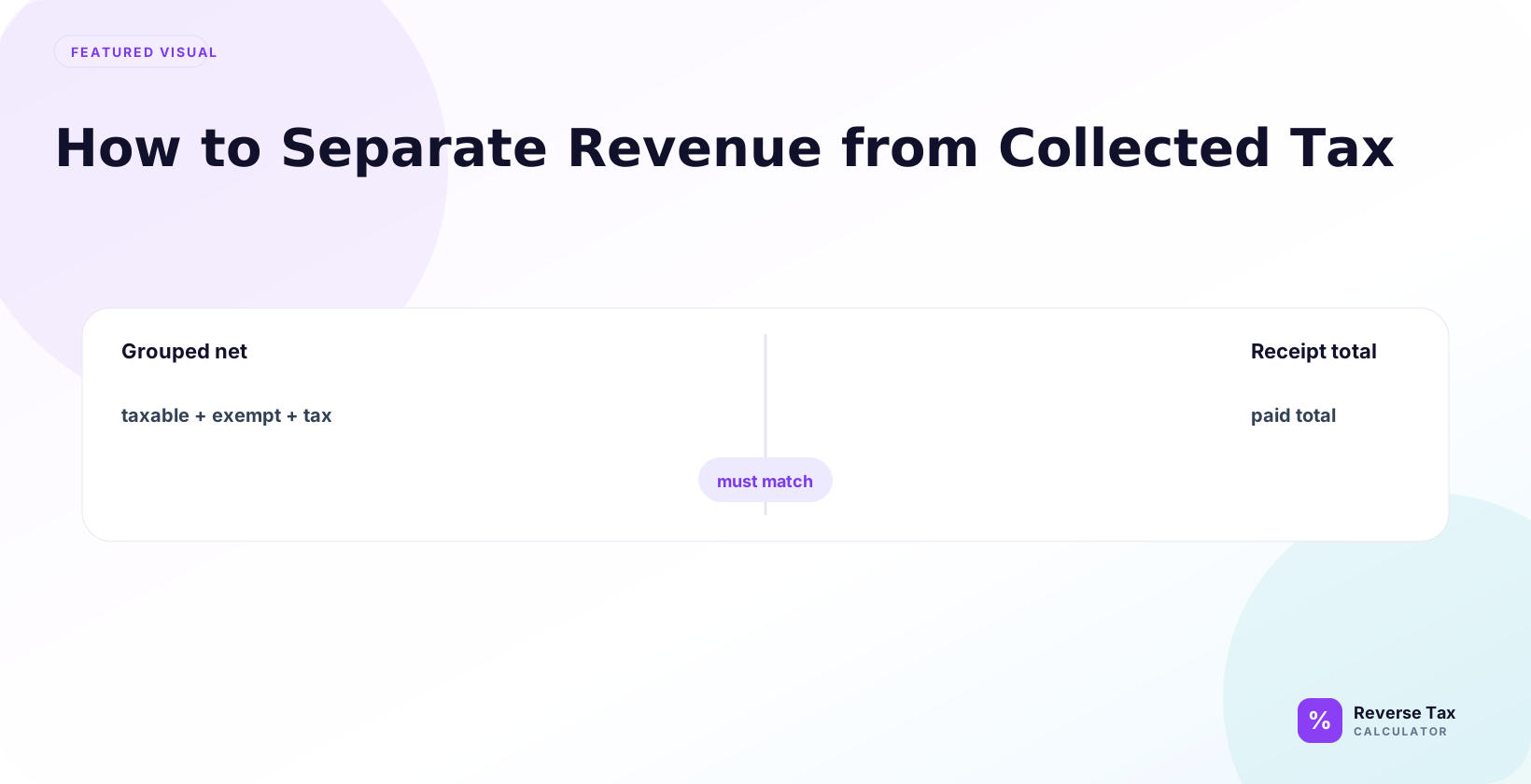
Separating revenue from tax means removing collected sales tax, VAT, GST, or HST from gross receipts before recording business income. Reverse tax divides a tax-inclusive total by the correct multiplier to find net revenue, then assigns the remaining amount to tax collected or payable. The separation must account for exemptions, refunds, discounts, shipping, marketplace remittance, mixed rates, filing periods, and rounding so revenue is not overstated.
Reverse tax is the method used when the total already includes tax.
How Do You Separate Revenue from Tax?
Separate revenue from collected tax by identifying the customer total, subtracting or calculating the tax portion, and recording only the before-tax amount as revenue. The collected tax portion should be tracked separately because it may represent a liability or clearing amount rather than earned income.
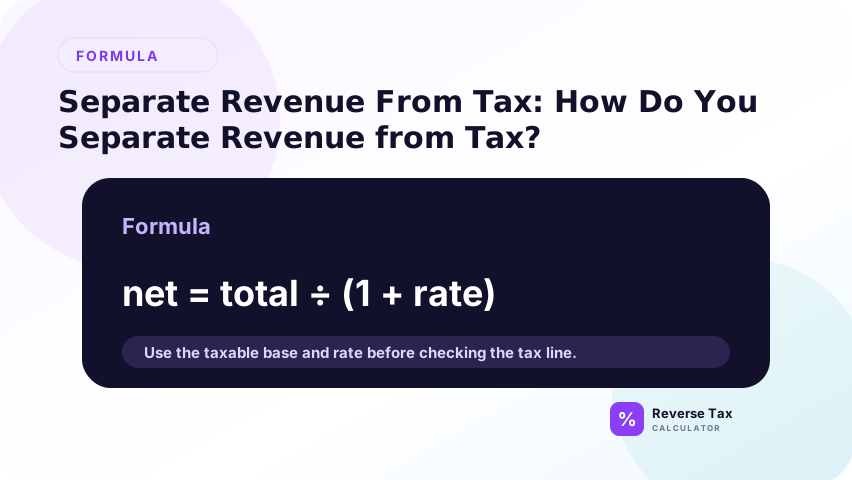
Use this formula:
Revenue before tax = Tax-inclusive total divided by (1 plus tax rate)
Collected tax = Tax-inclusive total minus revenue before tax
Example:
Customer total: $215.00
Tax rate: 7.5%
Revenue = $215.00 divided by 1.075 = $200.00
Collected tax = $15.00
What Is Revenue?
Revenue is the amount earned from selling goods or services before considering whether collected tax should be remitted or cleared separately. In reverse tax work, revenue usually means the amount left after included sales tax, VAT, GST, or similar tax is separated from a tax-inclusive total.
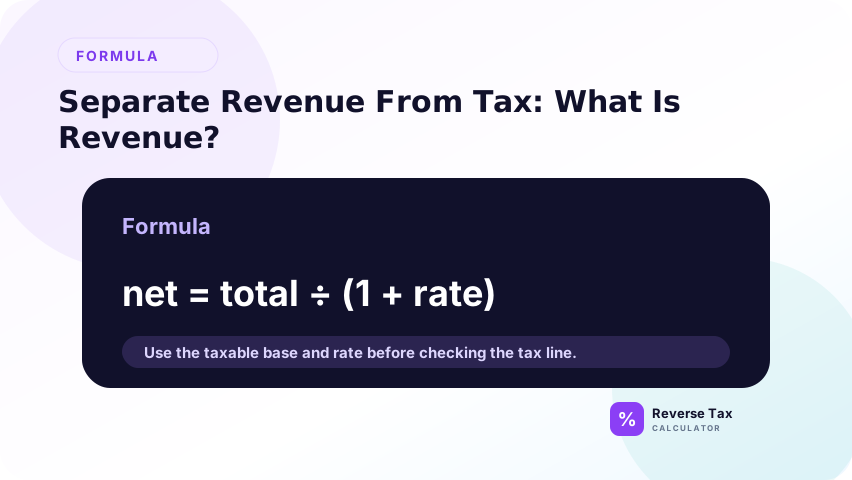
Revenue is the amount a business earns from selling goods or services. It excludes amounts the business collects on behalf of another party when those amounts are liabilities.
For sales tax bookkeeping, the seller often collects tax from the customer and later remits it. That collected tax should be tracked separately from earned revenue.
What Is Collected Tax?
Collected tax is the amount charged to the customer as tax or included inside a tax-inclusive price. It may pass through the business's bank account, but that does not automatically make it revenue. The accounting treatment depends on tax type, collection responsibility, and records.
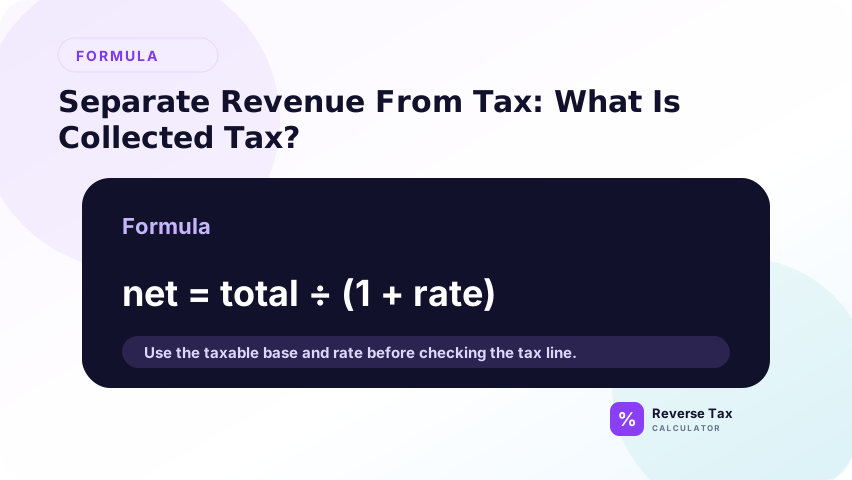
Collected tax is the tax charged to the customer as part of a taxable sale. It may appear as sales tax, VAT, GST, HST, PST, QST, lodging tax, excise tax, or another transaction tax.
The label matters, but the accounting question is similar: is this amount yours as revenue, or is it owed to a tax authority?
Why Does the Difference Matter?
If collected tax is recorded as revenue, sales look too high. If the later tax payment is recorded as an expense, profit may look too low. Separating revenue from collected tax keeps both the income statement and liability accounts cleaner.
IRS Publication 583 shows recordkeeping examples that separate net sales, sales tax, and daily receipts. That is a useful structure for small-business records.
How Do You Separate Revenue When Tax Is Shown Separately?
When tax is shown separately, subtract the tax amount from the total. The result is the revenue or before-tax sales amount. This method is stronger than reconstructing the tax from a rate because it uses the source document's own tax line and rounding.
If the receipt already shows subtotal and tax, use those lines.
Example:
Subtotal: $500.00
Sales tax: $40.00
Total: $540.00
Revenue is $500.00. Collected tax is $40.00.
No reverse formula is needed unless you need to verify the numbers.
How Do You Separate Revenue When Only Total Is Shown?
When only a tax-inclusive total is shown, divide the total by 1 plus the tax rate to estimate revenue before tax. Then subtract that revenue from the total to estimate collected tax. This works only when the total is a clean taxable amount at one rate.
Use reverse tax if you know the rate.
Example:
Total: $324.00
Rate: 8%
Revenue = $324.00 divided by 1.08 = $300.00
Collected tax = $24.00
If the rate is missing, you need the tax amount, subtotal, location rate, or another source field.
What If the Sale Includes Non-Taxable Items?
If the sale includes non-taxable items, separate them before calculating tax. Non-taxable revenue can still be revenue, but it should not be divided by 1 plus a tax rate. Mixed receipts need group-level revenue and tax separation.
Do not reverse the whole total at the taxable rate. Separate non-taxable items first.
Example:
Taxable item tax-inclusive amount: $108.00
Exempt item: $25.00
Rate: 8%
Taxable revenue = $108.00 divided by 1.08 = $100.00
Exempt revenue = $25.00
Collected tax = $8.00
Total revenue = $125.00
Why This Matters
If you reverse $133.00 at 8%, you get $123.15, which understates revenue. The exempt item should stay revenue at its full amount because no tax needs to be removed from it. This is a common semantic error in reverse tax work: the total contains multiple entity types, but the formula treats the total as one taxable entity. Separating taxable and exempt values first preserves the true revenue split.
What If the Sale Has Multiple Rates?
Group by rate before separating revenue. A multiple-rate sale should not be reversed with one blended rate unless the goal is only to estimate. The cleaner method is to create one group for each rate, calculate before-tax revenue for each group, and then add the group results together. This is especially important for restaurants, grocery stores, ecommerce carts, and invoices that combine standard-rated, reduced-rated, exempt, and fee-based lines.
| Group | Tax-inclusive total | Rate | Revenue | Collected tax |
|---|---|---|---|---|
| Standard items | $216.00 | 8% | $200.00 | $16.00 |
| Reduced items | $105.00 | 5% | $100.00 | $5.00 |
| Exempt items | $50.00 | 0% | $50.00 | $0.00 |
| Total | $371.00 | Mixed | $350.00 | $21.00 |
This prevents a blended-rate error.
How Do Discounts Affect Revenue Separation?
Discounts affect revenue when they reduce the selling price before tax. A pre-tax discount lowers revenue and tax. A post-tax credit or third-party reimbursement may not reduce the same base. The revenue split should follow the receipt or invoice sequence.
A discount can reduce revenue, taxable base, or customer payment depending on its type.
Retailer discounts usually reduce revenue. Manufacturer coupons may create third-party consideration. Gift cards usually reduce payment due, not revenue earned at redemption if the gift card was previously deferred.
Classify the discount before separating revenue.
Store Discount
The seller accepted less revenue for the item. A store discount usually reduces the taxable selling price because the seller lowered the price before tax was calculated. When the seller-funded discount appears before the tax line, revenue and tax should usually be based on the discounted selling price. Do not remove tax from the original list price if the customer never paid that amount.
Manufacturer Coupon
The seller may receive value from a third party, so customer cash alone may understate the sale. Some systems show the customer discount at checkout, while accounting records later recognize reimbursement income or a receivable. For reverse tax and revenue separation, inspect the source report to see whether the taxable base used the pre-coupon or post-coupon amount. This prevents the coupon from being misclassified as either revenue loss or tax reduction.
Gift Card Redemption
The customer uses stored value. The revenue question depends on when the gift card liability was recorded and released. If a customer pays a $108.00 tax-inclusive sale with a $50.00 gift card and $58.00 in cash, the revenue and tax calculation still starts from the $108.00 sale. The payment split affects cash and gift card liability, not necessarily the taxable base.
How Do Refunds Affect Revenue and Collected Tax?
Refunds can reduce both revenue and collected tax. A refund should be matched to the original sale whenever possible so the refunded tax portion uses the original rate and taxable base. Partial refunds need item-level or group-level allocation.
When a taxable sale is refunded, reverse both revenue and the tax liability if tax is refunded to the customer.
Refund example:
Tax-inclusive refund: $64.80
Rate: 8%
Revenue reversal = $64.80 divided by 1.08 = $60.00
Tax reversal = $4.80
How Do Tips Affect Revenue Separation?
Optional tips should usually be separated from product or service revenue before reverse tax is applied. Mandatory service charges may need separate review because they can be revenue and may be taxable depending on rules and receipt structure.
Optional tips should not be mixed with product revenue. Remove optional tips from the total before separating revenue from sales tax.
Mandatory service charges may be revenue and may be taxable depending on the rules. Treat them as separate lines.
Example: Tax-Inclusive Revenue Report
If a report shows $10,800 in tax-inclusive taxable sales at 8%, revenue before tax is $10,000 and collected tax is $800. The calculation is useful only if the report excludes exempt sales, tips, fees, and other non-tax items from the taxable total.
A point-of-sale report shows:
Tax-inclusive taxable sales: $5,400.00
Exempt sales: $600.00
Rate: 8%
Taxable revenue = $5,400.00 divided by 1.08 = $5,000.00
Collected tax = $400.00
Total revenue = $5,000.00 plus $600.00 = $5,600.00
The total receipts were $6,000.00, but revenue was $5,600.00 because $400.00 was collected tax.
Example: Bank Deposit Is Lower Than Revenue
A bank deposit can be lower than revenue because processor fees, marketplace fees, refunds, or reserves were deducted before cash reached the bank. Revenue separation should start from sales records, not only from the deposited amount.
A platform reports:
Customer order before tax: $100.00
Tax collected by marketplace: $8.00
Platform fee: $15.00
Seller payout: $85.00
Revenue may still be $100.00 even though the bank deposit is $85.00. The missing $15.00 is not missing revenue. It is a fee withheld before payout.
What Reports Should Match After Separation?
After separation, revenue reports, tax reports, payable accounts, deposit reconciliation, and refund records should explain each other. They do not always equal each other directly, but differences should have clear causes such as fees, timing, or marketplace collection. The goal is not to force every report to show the same number. The goal is to explain why each report shows a different number.
Revenue separation should connect several reports.
Sales Report
The sales report shows gross item sales, discounts, tax, and refunds. It is usually the best starting point because it is closest to the customer transaction. Use it to identify the original sale amount, tax charged, taxable and non-taxable lines, and refund history. The sales report may not equal the bank deposit because fees, reserves, payout timing, and processor deductions happen after the sale.
Bank Feed
The bank feed shows actual cash deposits after timing and fees. It is useful for confirming settlement, but it is a weak source for separating revenue from collected tax because the deposit may combine many transactions. If you start from the bank feed, reconcile backward to order, invoice, receipt, or settlement records before using any reverse tax formula.
Tax Filing Report
The tax filing report shows taxable sales, exempt sales, and tax due by jurisdiction. It may group transactions differently from the accounting system, especially when returns, marketplace sales, or exempt certificates are involved. Use it as a compliance-facing view. If it disagrees with the sales report, investigate timing, excluded channels, marketplace-collected tax, and rounding before changing the ledger.
General Ledger
The general ledger shows revenue, Sales Tax Payable, fees, refunds, and cash. It is the final accounting record, not always the best raw calculation source. After separating revenue from collected tax, the ledger should show earned revenue apart from taxes collected for remittance or clearing. If collected tax is buried in revenue, financial statements and tax payable balances become harder to trust.
Decision Matrix: Revenue or Collected Tax?
| Amount | Revenue? | Collected tax? | Note |
|---|---|---|---|
| Product price before tax | Yes | No | Main sale |
| Sales tax charged | No | Yes | Liability |
| Exempt product price | Yes | No | Revenue with no tax |
| Optional tip | Usually no product revenue | No sales tax | Separate liability or payroll flow |
| Shipping fee | Maybe | Maybe | Depends on taxability and accounting policy |
| Marketplace fee | No | No | Usually expense |
Operational Workflow
| Step | Action | Result |
|---|---|---|
| 1 | Start with transaction report | Source total |
| 2 | Remove non-sale lines | Cleaner revenue base |
| 3 | Group by rate and taxability | Correct calculation |
| 4 | Apply reverse tax | Revenue and tax split |
| 5 | Post revenue and payable | Accurate books |
| 6 | Reconcile to tax return | Filing support |
Common Errors
| Error | Effect | Better action |
|---|---|---|
| Treating collected tax as revenue | Overstates sales | Use liability account |
| Treating remittance as expense | Understates profit | Debit payable |
| Using one rate for all sales | Misallocates revenue | Group by rate |
| Ignoring exempt items | Understates revenue | Separate exempt revenue |
| Using bank deposit only | Misses fees and timing | Use sales reports |
Information Gain: Revenue Separation Is Not the Same as Cash Reconciliation
Cash reconciliation answers whether deposits match bank activity. Revenue separation answers how much of the customer charge belongs to revenue versus tax liability.
Those are related but not identical. A platform payout can be lower than revenue because fees were withheld. A cash deposit can be higher than revenue because it includes tax. Reverse tax belongs inside a broader reconciliation workflow.
How Should You Document the Split?
Document the rate, taxable base, exempt base, tax amount, refund adjustments, and source report. A good record lets another person rebuild your number without guessing.
IRS Publication 583 focuses on keeping business records that support reported amounts. For revenue and collected tax, the supporting record should show both the transaction source and the calculation used to separate tax from revenue.
Monthly Close Checklist for Revenue and Tax
Use a close checklist so the same logic is applied every month.
| Check | Question | Why it matters |
|---|---|---|
| Rate groups | Were sales grouped by rate? | Prevents blended-rate errors |
| Exempt sales | Were exempt sales kept in revenue? | Avoids understating revenue |
| Collected tax | Does tax match payable? | Supports liability balance |
| Refunds | Were refunded taxes reversed? | Prevents overpaying tax |
| Marketplace orders | Who remitted the tax? | Avoids double counting |
| Deposits | Do payouts reconcile to reports? | Explains cash differences |
Example: Month-End Revenue Bridge
A month-end revenue bridge starts with gross sales, subtracts collected tax, separates exempt sales, accounts for refunds and discounts, and reconciles to deposits after fees. This bridge explains why sales, tax payable, and bank deposits are related but not identical.
Start with customer charges:
Customer tax-inclusive charges: $21,600.00
Rate: 8%
Net taxable revenue = $21,600.00 divided by 1.08 = $20,000.00
Collected tax = $1,600.00
Add exempt revenue: $2,500.00
Subtract refunds before tax: $700.00
Adjusted revenue = $21,800.00
This bridge is stronger than one formula because it explains how the final revenue number was built.
Why Collected Tax Should Not Hide Margin
Collected tax can inflate gross totals and make revenue appear larger than it is. Separating tax helps show actual sales performance and margin. Without the split, a business may compare tax-inclusive totals against tax-exclusive costs and misread profitability.
If collected tax is left inside revenue, gross margin percentages can look lower or higher depending on how costs are recorded. Clean separation makes product margin, fee margin, and tax liability easier to understand. It also helps owners compare periods when rates changed or when more sales shifted into higher-tax locations.
Trust Boundary
This page explains revenue separation mechanics. It does not decide taxability, filing treatment, marketplace collection rules, revenue recognition policy, or whether a business should collect tax. Use accounting records and official guidance for compliance-sensitive decisions.
this page explains calculation and bookkeeping logic. It does not determine the legal definition of gross receipts, taxable sales, or reportable revenue in every jurisdiction.
For tax returns, verify the treatment with official state, local, or national guidance and your accounting professional.
For journal-entry workflow, use separating sales tax for bookkeeping.
If the tax portion affects a liability account, review sales tax payable.
If the sale includes discounts or shipping, check discounts and coupons and shipping charges before calculating revenue.
Frequently Asked Questions
Is collected sales tax part of revenue?
Collected sales tax is usually tracked separately as a liability, not ordinary revenue. The seller may receive the cash, but the tax portion is generally owed to a tax authority or cleared through a marketplace process. The exact treatment depends on tax type and platform responsibility. For clean reporting, keep customer revenue, seller-collected tax, marketplace-collected tax, and cash settlement as separate concepts.
How do I separate revenue from tax in a total?
Divide the tax-inclusive total by 1 plus the tax rate, then subtract that before-tax amount from the total to find the tax portion. This works best when the total contains only taxable items at one rate. If the total includes exempt items, shipping, tips, gift cards, or multiple rates, separate those components first and reverse only the tax-inclusive taxable group.
What if the receipt has tax-exempt items?
Separate exempt items first. Do not reverse the whole total at the taxable rate because exempt items remain revenue at their full selling price. If a receipt includes taxable goods, exempt goods, and tax, calculate the taxable group separately and then add exempt revenue back afterward. This avoids understating revenue and inventing tax on items that were not taxed.
Should I use bank deposits to calculate revenue?
Use transaction reports when possible. Bank deposits can include tax, fees, tips, refunds, chargebacks, reserves, and settlement timing. A deposit is strong cash evidence, but it is not automatically a clean sales number. Start from receipts, invoices, order reports, or settlement detail, separate revenue and collected tax, then reconcile the result to the bank feed.
Where does collected tax go?
Collected tax commonly goes to Sales Tax Payable, VAT Payable, GST Payable, or a similar liability account until remitted, cleared, or adjusted. Marketplace-collected tax may need a different account or memo treatment because the marketplace may remit it directly. The important control is visibility: do not hide tax inside revenue or platform payout deposits.
Sources and Notes
- Formula source: arithmetic relationship between tax-inclusive total, revenue before tax, collected tax, and rate.
- IRS Publication 583, Starting a Business and Keeping Records
- Accuracy note: verify jurisdiction-specific tax return reporting rules before filing.