Reverse payroll tax calculation estimates gross pay from take-home pay by adding back income tax withholding, payroll taxes, and employee contributions. The calculation uses net pay, pay frequency, withholding rate, contribution rules, and taxable wage base to approximate gross wages. Payroll results depend on jurisdiction, tax year, filing status, benefits, pension contributions, social insurance, local taxes, and whether deductions occur before or after tax. Employer-side taxes are not part of employee net pay.
What Does Reverse Payroll Tax Mean?
Reverse payroll tax means working backward from a net paycheck or target take-home amount to estimate the gross wages before payroll taxes.
| Term | Meaning |
|---|---|
| Gross wages | Pay before payroll taxes and deductions |
| Net pay | Pay after taxes and deductions |
| Payroll tax | Tax connected to wages or payroll |
| Reverse payroll tax | Estimating gross wages from net pay |
This page focuses on the calculation concept, not employer payroll compliance.
Payroll Tax vs Income Tax
Payroll tax and income tax are related, but they are not the same.
| Feature | Payroll tax | Income tax withholding |
|---|---|---|
| Common U.S. examples | Social Security and Medicare | Federal income tax |
| Rate structure | Often fixed rates with thresholds | Tables, status, deductions, credits |
| Wage base | Social Security has one | Income tax does not use the same wage base |
| Employer role | Withholds and may also pay employer share | Withholds from employee wages |
| Reverse calculation risk | Wage base and thresholds | Progressive brackets and W-4 inputs |
Real paycheck reversal may need both payroll tax and income tax withholding.
Current U.S. Payroll Tax Components
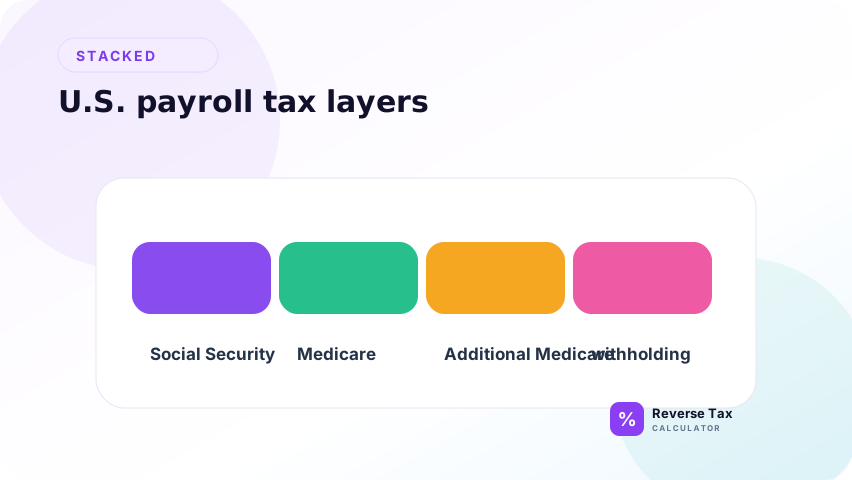
IRS Topic 751 states that FICA taxes are composed of Social Security taxes and Medicare taxes. It lists the current Social Security tax rate as 6.2 percent for the employer and 6.2 percent for the employee. It lists Medicare as 1.45 percent for the employer and 1.45 percent for the employee.
| Component | Employee rate | Employer rate | Important limit |
|---|---|---|---|
| Social Security | 6.2 percent | 6.2 percent | Wage base applies |
| Medicare | 1.45 percent | 1.45 percent | No wage base limit |
| Additional Medicare | 0.9 percent employee withholding | No employer match | Applies after threshold |
IRS Topic 751 states that employers must withhold Additional Medicare tax on wages paid over 200,000 in a calendar year, without regard to filing status. SSA states the 2026 OASDI contribution and benefit base is 184,500.
Simple Reverse Payroll Tax Formula
For a flat payroll tax rate:
Gross pay = Net pay / (1 - payroll tax rate)
Example:
Gross pay = 1,000 / (1 - 0.0765)
Gross pay = 1,000 / 0.9235
Gross pay = 1,082.84
This example uses 7.65 percent as a simple employee-side Social Security plus Medicare rate under the wage base and below the Additional Medicare threshold.
Example: Reverse FICA from Net Pay
Suppose the target net after employee-side Social Security and Medicare is 923.50.
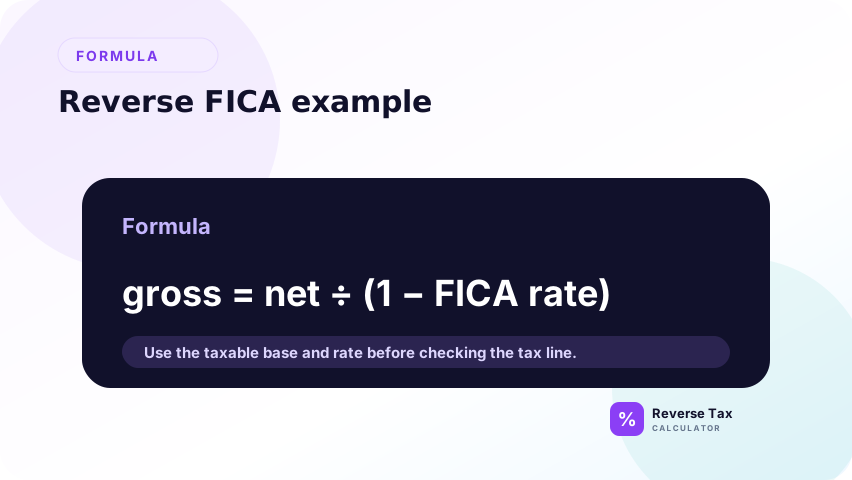
Payroll tax rate:
6.2 percent + 1.45 percent = 7.65 percent
After-tax percentage:
1 - 0.0765 = 0.9235
Gross pay:
923.50 / 0.9235 = 1,000.00
Payroll tax:
1,000.00 - 923.50 = 76.50
| Component | Amount |
|---|---|
| Gross pay | 1,000.00 |
| Social Security at 6.2 percent | 62.00 |
| Medicare at 1.45 percent | 14.50 |
| Net after these taxes | 923.50 |
Why Wage Bases Make Payroll Reversal Harder
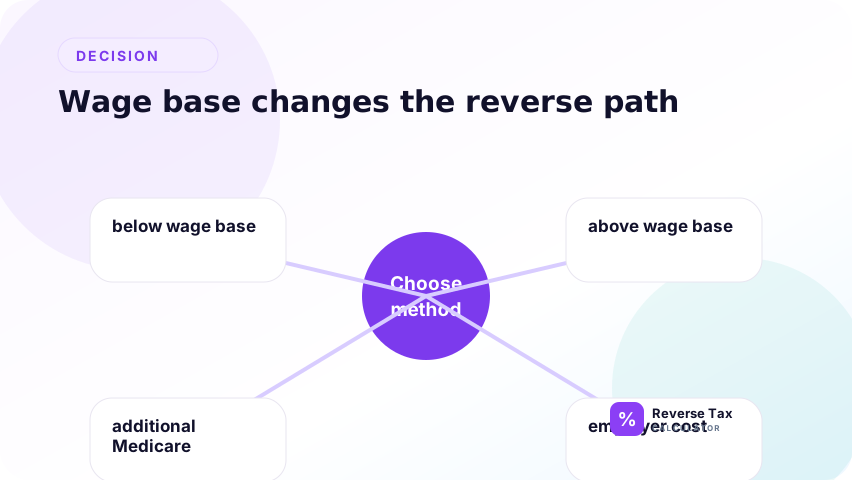
Social Security tax has a wage base. SSA states that the 2026 contribution and benefit base is 184,500. Wages above the wage base are not subject to the Social Security portion, but Medicare continues because IRS Topic 751 states there is no wage base limit for Medicare.
| Wage range | Payroll tax issue |
|---|---|
| Below Social Security wage base | Social Security and Medicare may both apply |
| Above Social Security wage base | Social Security may stop, Medicare continues |
| Above Additional Medicare threshold | Extra employee Medicare withholding may apply |
This means a single flat payroll-tax rate may not apply to the entire paycheck or year.
Example: Above the Social Security Wage Base
Suppose an employee has already reached the Social Security wage base for the year. A later paycheck may still have Medicare withholding but no employee Social Security withholding.
If only Medicare at 1.45 percent applies:
Net = Gross x 0.9855
Gross = Net / 0.9855
For a 1,000 net target:
1,000 / 0.9855 = 1,014.71
This is very different from grossing up by 7.65 percent.
Example: Payroll Tax Before the Wage Base Is Reached
Suppose an employee has not reached the Social Security wage base and the target net after employee Social Security and Medicare is 2,000.
Employee-side rate:
6.2 percent + 1.45 percent = 7.65 percent
After-tax percentage:
1 - 0.0765 = 0.9235
Gross estimate:
2,000 / 0.9235 = 2,165.67
Estimated employee payroll tax:
2,165.67 - 2,000 = 165.67
This is a simplified employee-side example. It does not include federal income tax, state tax, benefits, or employer taxes.
How Additional Medicare Tax Changes the Calculation
IRS Topic 751 states that employers withhold Additional Medicare tax at 0.9 percent on an employee's wages paid in excess of 200,000 in a calendar year.
When that applies, employee-side Medicare withholding can effectively include:
1.45 percent + 0.9 percent = 2.35 percent
There is no employer match for Additional Medicare tax.
| Situation | Employee-side Medicare rate |
|---|---|
| Below Additional Medicare threshold | 1.45 percent |
| Above withholding threshold | 2.35 percent on excess wages |
Employee Tax vs Employer Payroll Cost
Reverse payroll tax can mean two different things:
| Question | Focus |
|---|---|
| What gross pay gives this net paycheck? | Employee withholding |
| What does this employee cost the employer? | Employer payroll taxes and benefits |
The employee's net pay is reduced by employee withholding. Employer payroll taxes are an additional employer cost and usually do not reduce the employee's paycheck.
Payroll Tax Layer Table
| Layer | Affects employee net? | Affects employer cost? |
|---|---|---|
| Employee Social Security | Yes | No |
| Employee Medicare | Yes | No |
| Additional Medicare withholding | Yes | No employer match |
| Employer Social Security | No | Yes |
| Employer Medicare | No | Yes |
| Federal income tax withholding | Yes | No |
| Benefits and deductions | Depends | Depends |
This table prevents a common gross-up mistake: mixing employer cost with employee net-pay math.
Reverse Payroll Tax Decision Matrix
| Situation | Best method |
|---|---|
| Simple wages below Social Security wage base | Use 7.65 percent example carefully |
| Above Social Security wage base | Remove Social Security from rate |
| Above Additional Medicare threshold | Include extra Medicare withholding on excess |
| Income tax also withheld | Use payroll calculator or estimator |
| Pre-tax deductions exist | Adjust taxable wages first |
| Exact employer payroll | Use payroll system and official rules |
Operational Workflow
Use this workflow before reversing payroll taxes:
- Define whether the target is employee net pay or employer cost.
- Identify which taxes apply to the wage amount.
- Check whether the Social Security wage base has been reached.
- Check whether Additional Medicare withholding applies.
- Separate income tax withholding from payroll taxes.
- Add deductions and benefits only after classifying them.
- Calculate, then compare the result with a payroll system or official method.
Rate Source Table
| Payroll item | Official source used here |
|---|---|
| Social Security employee and employer rate | IRS Topic 751 and SSA |
| Medicare employee and employer rate | IRS Topic 751 and SSA |
| 2026 wage base | SSA contribution and benefit base |
| Additional Medicare threshold | IRS Topic 751 |
| Federal withholding methods | IRS Publication 15-T |
What a Reverse Payroll Calculation Can and Cannot Prove
| Can estimate | Cannot prove |
|---|---|
| Gross pay from a flat payroll-tax assumption | Exact paycheck |
| Employee-side FICA effect | Employer compliance |
| Effect of wage base | Final tax liability |
| Additional Medicare threshold impact | Correct income tax withholding |
Payroll reversal is a planning calculation unless it uses official payroll methods and the full employee record.
Common Mistakes
Common mistakes include treating payroll tax like a simple sales tax, ignoring employer-side taxes, ignoring wage bases, ignoring pre-tax benefits, mixing annual and per-paycheck amounts, and using one rate for federal, state, local, and contribution rules. The safest workflow is to classify each payroll tax and deduction before attempting a reverse calculation.
The practical correction is to separate employee withholding, employer taxes, wage-base-limited taxes, pre-tax deductions, post-tax deductions, and pay frequency. Reverse payroll tax is a payroll model, not just a percentage formula. If the model does not match the paycheck structure, the gross estimate can be materially wrong.
Using 7.65 Percent for Every Dollar
Social Security has a wage base and Additional Medicare has a threshold.
Mixing Employer and Employee Taxes
Employee net pay is affected by employee withholding. Employer payroll tax is a separate employer cost.
Ignoring Income Tax Withholding
Payroll taxes are not the only amounts withheld from pay.
Ignoring Pre-Tax Deductions
Pre-tax deductions can change taxable wages.
Treating Withholding as Final Tax
Withholding is not always equal to final tax liability.
What This Page Does Not Cover
| Topic | Better page |
|---|---|
| Reverse income tax overview | What Is a Reverse Income Tax Calculator? |
| Net-to-gross salary | How to Calculate Gross Salary from Net Pay |
| Progressive tax brackets | Why Progressive Tax Makes Reverse Calculation Harder |
| Gross-up formula | Gross-Up Formula for Taxes |
Frequently Asked Questions
How do I reverse payroll taxes?
For a simple flat payroll tax, divide the target net pay by 1 - payroll tax rate. For real payroll, account for wage bases, Medicare thresholds, deductions, income tax withholding, and pay frequency.
What is employee FICA in a simple example?
Under the wage base and below Additional Medicare thresholds, employee Social Security at 6.2 percent plus Medicare at 1.45 percent totals 7.65 percent.
Does Medicare tax have a wage base limit?
IRS Topic 751 states there is no wage base limit for Medicare tax.
What is the 2026 Social Security wage base?
SSA states that the 2026 contribution and benefit base is 184,500.
Can I use this for exact payroll?
Not by itself. Exact payroll needs current official rules, employee inputs, deductions, and payroll system settings.
Sources
These sources support payroll-tax context, but payroll rules vary by jurisdiction, tax year, wage base, employer status, employee status, and benefit elections. Use official tax authority and payroll guidance for real calculations. Use this page to understand why reversing payroll taxes requires more than one gross-to-net formula.
- IRS, Topic no. 751, Social Security and Medicare withholding rates
- SSA, Contribution and Benefit Base
- IRS, Publication 15-T, Federal Income Tax Withholding Methods for use in 2026