
Refunds and returns use reverse tax when a tax-inclusive refund amount must be split into the price returned and tax returned. The original sale rate and taxable base matter because a refund should generally reverse the tax that was charged on the returned item. Partial returns, non-refundable shipping, coupons, restocking fees, mixed-rate baskets, and rounding can change the tax portion shown on the refund receipt.
The key question is: did the refund include tax, and was the returned item taxable in the original sale?
How Do You Reverse Tax from a Refund?
Reverse tax from a refund only when the refund amount includes tax from a taxable sale. Divide the tax-inclusive refund by 1 plus the original tax rate to find the pre-tax refund, then subtract that amount from the refund total to find refunded tax. If the refund is a goodwill credit, store credit, shipping-only refund, or marketplace payout adjustment, identify the returned taxable line before calculating.
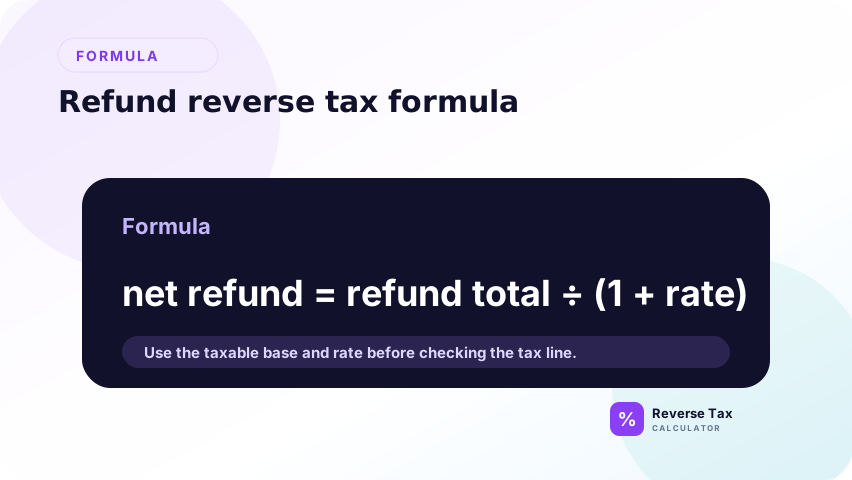
Use this formula when the refund includes tax:
Pre-tax refund = Refund total divided by (1 plus tax rate)
Refunded tax = Refund total minus pre-tax refund
Example:
Refund total: $108.00
Rate: 8%
Pre-tax refund = $100.00
Refunded tax = $8.00
Why Refunds Need Their Own Reverse Tax Logic
Refunds need their own logic because they are not always simple negative sales. A refund can include item price, tax, shipping, discounts, restocking fees, store credit, gift card value, marketplace adjustments, or cash settlement timing. The workflow should answer what was returned, whether tax was refunded, which original rate applied, and how the refund affected payable and revenue.
Refunds are not just negative sales. A refund can include product price, sales tax, shipping, discounts, restocking fees, gift card credits, or marketplace adjustments.
If you reverse the wrong amount, you may reduce revenue, Sales Tax Payable, or cash incorrectly.
Full Refund Example
A full refund is the cleanest reverse tax case because the refund usually mirrors the original taxable sale. The calculation should still use the original rate and original receipt evidence. This example shows how revenue reversal and tax reversal split apart when the customer receives the full tax-inclusive amount back.
Original sale:
Item price: $100.00
Tax: $8.00
Total: $108.00
Full refund: $108.00
Reverse tax:
Sales reversal = $108.00 divided by 1.08 = $100.00
Tax reversal = $8.00
The refund reverses both revenue and collected tax.
Partial Refund Example
A partial refund needs line-level logic because only part of the original order was returned. Match the refund to the returned item, original price, original rate, and taxability. Do not reverse the whole order if only one item came back. The formula works only on the tax-inclusive amount tied to the returned taxable line.

Original sale:
Two taxable items at $50.00 each
Total before tax: $100.00
Tax at 8%: $8.00
Total: $108.00
Customer returns one item and receives $54.00.
Pre-tax refund = $54.00 divided by 1.08 = $50.00
Refunded tax = $4.00
What If the Refund Does Not Include Tax?
If the refund does not include tax, do not reduce tax payable automatically. A goodwill credit, restocking adjustment, shipping-only refund, or customer service credit can reduce cash without reversing the original taxable sale. The source refund receipt should show whether tax was actually returned to the customer.
If the refund is a goodwill credit, shipping-only refund, restocking adjustment, or post-sale credit that does not include tax, do not reverse tax from it automatically.
Example:
Customer receives $10.00 goodwill credit.
No tax was refunded.
Accounting should not reduce Sales Tax Payable unless the tax liability changed.
How Do Returns Affect Sales Tax Payable?
Returns affect Sales Tax Payable only when the tax liability or clearing amount changes. If tax was collected and then refunded to the customer, the payable may decrease. If no tax was refunded, the payable should not be reduced simply because cash changed. For reconciliation, keep refunded revenue and refunded tax as separate fields.

If tax was originally collected and then refunded to the customer, Sales Tax Payable may decrease. If the tax was not refunded, or if the jurisdiction does not allow the adjustment, the payable treatment may differ.
For internal reconciliation, track refunded tax separately from refunded revenue.
How Do Exchanges Affect Reverse Tax?
An exchange is often a return plus a new sale. Treat those two events separately so the returned item, replacement item, price difference, and tax difference stay visible. This avoids hiding a new taxable sale inside a refund line or treating an even exchange as if it changed Sales Tax Payable.
An exchange may be a return plus a new sale.
Equal Exchange
An equal exchange may net to zero tax when the replacement item has the same taxable price and rate. The receipt should still preserve the exchange evidence because the original tax was effectively offset by the replacement sale. This is important for audit trails where cash did not move but inventory and tax logic did.
If the replacement item has the same taxable price and rate, tax may net to zero.
Higher-Value Exchange
In a higher-value exchange, tax may apply to the additional taxable price difference. The customer may pay only the difference plus tax on that difference, depending on POS rules. Reverse tax should identify the incremental taxable amount rather than treating the full replacement item as an unrelated new sale.
Tax may apply to the price difference.
Lower-Value Exchange
In a lower-value exchange, part of the original sale may be refunded and part may be replaced by the new item. The refund can include tax on the price difference if tax was returned to the customer. Use the exchange receipt because cash, store credit, and tax can move differently.
Tax may be partially refunded.
Use the receipt or POS exchange record rather than guessing.
How Do Restocking Fees Affect Refund Tax?
A restocking fee can reduce the cash refund but may not reduce the original tax in the same way. Treat the fee as a separate line.
Example:
Original total: $108.00
Restocking fee retained: $10.00
Cash refund: $98.00
Do not simply reverse $98.00 at 8% without understanding whether tax was refunded on the full item, the net amount, or another base.
How Do Shipping Refunds Affect Reverse Tax?
Shipping refunds affect reverse tax only when shipping was taxable and the shipping charge was actually refunded. If shipping was not refunded, it should stay outside the refund calculation. If shipping was refunded but non-taxable, it may reduce cash without reducing tax. Separate item refund, shipping refund, and tax refund before calculating.
Shipping refunds depend on whether shipping was taxable and whether shipping was refunded.
If shipping was non-taxable, refunding shipping should not reduce sales tax. If taxable shipping was refunded, part of the refund may include tax.
Separate item refund and shipping refund when possible.
How Do Marketplace Refunds Affect Reverse Tax?
Marketplace refunds require order-level detail because a payout reduction is not the same as a tax-inclusive refund base. The platform may refund item price, tax, shipping, fees, or reserves in different lines and different periods. Identify whether the marketplace or the seller handled the tax so the seller does not double-adjust Sales Tax Payable.
Marketplace refunds may include product refund, tax refund, shipping refund, platform fee adjustment, and payout reduction.
Do not reverse the net payout reduction. Use order-level refund detail.
If the marketplace originally collected and remitted tax, the platform report may handle the tax reversal. The seller should avoid posting duplicate payable adjustments.
Decision Matrix: How Should You Reverse a Refund?
| Refund type | Reverse tax? | Reason |
|---|---|---|
| Full taxable refund including tax | Yes | Reverses sale and tax |
| Partial taxable refund including tax | Yes | Reverses returned item |
| Store credit without tax change | No or separate | May not affect tax |
| Shipping-only refund | Depends | Shipping taxability matters |
| Restocking fee | Separate | Reduces cash refund |
| Marketplace refund | Use platform detail | Remitter may differ |
| Exempt item refund | No tax reversal | No original tax |
Operational Workflow for Refund Tax
| Step | Action | Output |
|---|---|---|
| 1 | Match refund to original sale | Taxability and rate |
| 2 | Identify refunded lines | Product, shipping, fee, tax |
| 3 | Confirm whether tax was refunded | Payable effect |
| 4 | Reverse tax if included | Revenue and tax split |
| 5 | Record restocking or fee lines | Clean accounting |
| 6 | Reconcile to payout or cash | Settlement support |
| 7 | Save receipt or refund report | Audit trail |
Common Refund Tax Errors
| Error | Effect | Fix |
|---|---|---|
| Reversing net cash refund only | Misstates tax | Use refund line detail |
| Reducing payable when tax was not refunded | Understates liability | Confirm tax refund |
| Ignoring restocking fees | Misstates revenue | Separate fee |
| Treating exchange as one refund | Hides new sale | Split return and sale |
| Double adjusting marketplace tax | Misstates payable | Check remitter |
| Using current rate for old sale | Wrong split | Use original sale rate |
What If the Original Tax Rate Changed?
Use the original rate for the original sale. A refund issued after a rate change should still trace back to the transaction that created the tax. This is especially important for older purchases, marketplace sales, or location changes. If the original receipt is missing, label the calculation as an estimate and avoid treating it as final filing support.
Use the rate from the original sale when reversing the original sale. A refund in 2026 for a 2025 purchase should generally be matched to the original transaction facts, not the current rate.
If the original sale cannot be found, label the calculation as an estimate and review policy.
How Should Refunds Appear in Reports?
Refund reporting should show revenue reversal, tax reversal, and cash returned.
| Report line | Example |
|---|---|
| Revenue reversal | $100.00 |
| Tax reversal | $8.00 |
| Cash refund | $108.00 |
| Restocking fee retained | If applicable |
| Net payout impact | Settlement report |
Example: Partial Refund with Shipping Not Refunded
This example shows why the refund base is not always the full order total. Shipping remains outside the calculation because it was not refunded. If shipping had been refunded and was taxable, it would need its own treatment. Start with the returned taxable item, then reconcile the result to the actual refund cash.
Original order:
Item: $100.00
Tax at 8%: $8.00
Shipping: $10.00
Total: $118.00
Customer returns the item, but shipping is not refunded.
Refund total: $108.00
Pre-tax item refund = $108.00 divided by 1.08 = $100.00
Refunded tax = $8.00
Shipping remains outside the refund calculation because it was not returned to the customer.
Example: Refund with Restocking Fee
A restocking fee can reduce cash returned without proving that tax was reduced on the same net amount. The refund receipt should show whether tax was refunded on the full item, the item after restocking fee, or not at all. Do not reverse tax from the net cash refund unless the source document supports that base.
Original taxable sale:
Item: $200.00
Tax at 8%: $16.00
Total: $216.00
Restocking fee retained: $20.00
Cash refund: $196.00
The cash refund alone does not prove the tax reversal. The seller needs the refund receipt to show whether tax was refunded on the full item, the net item after restocking, or another base.
How Do Store Credits Affect Refund Tax?
A store credit changes payment form, not automatically tax treatment. If the credit represents a tax-inclusive return of a taxable item, the tax reversal may match a cash refund. If the credit is goodwill or promotional value, it may not affect tax. Keep store credit, refunded tax, and future redemption as separate records.
A store credit may replace cash refund, but the tax question is still whether the original taxable sale was reversed. If the customer receives a credit for the full tax-inclusive return, the tax reversal may be the same as a cash refund. If the credit is a goodwill amount, it may not change tax.
Refund Audit Checklist
| Check | Why it matters |
|---|---|
| Original sale found | Confirms rate and taxability |
| Returned item identified | Prevents refunding wrong tax |
| Tax refunded shown | Supports payable adjustment |
| Shipping separated | Avoids wrong base |
| Restocking fee separated | Explains cash difference |
| Marketplace remitter identified | Avoids double adjustment |
How Do Refunds Affect Revenue Reports?
Refunds should reduce revenue for the returned item, not disappear into miscellaneous expenses. If tax was refunded, the tax portion should reduce the appropriate liability or clearing account according to the applicable rule. Reports should show gross sales, returns, refunded tax, restocking fees, marketplace adjustments, and net sales separately.
Refunds should reduce revenue for the returned taxable item, not simply appear as a miscellaneous expense. If the refund includes tax, the tax portion should reduce tax liability or tax clearing according to the applicable rule.
This helps keep gross sales, net sales, tax collected, and cash refunds aligned.
How Do Refunds Affect Marketplace Payouts?
A refund can reduce a future payout rather than the payout from the original sale period. This creates timing differences.
Example:
Sale happened in June.
Refund happened in July.
Marketplace reduces July payout.
The July cash deposit is lower, but the original June order still needs its own revenue and tax record. Match refund reports to original orders before adjusting tax.
What Records Should Be Saved for Refunds?
Save enough evidence to prove the refund split. Keep the original receipt, refund receipt, returned item, refunded tax line, reason code, payment method, marketplace adjustment, and customer service note when available. For reconciliation, connect refund tax to Sales Tax Payable and gross receipts reconciliation.
Save the original receipt, refund receipt, item returned, refunded tax line, reason code, payment method, marketplace adjustment if applicable, and any customer service note. This evidence explains why Sales Tax Payable changed.
What If the Refund Is Estimated?
If refund tax is estimated, label the estimate clearly and state what evidence is missing. Common missing facts include original rate, returned item, tax refunded, shipping treatment, restocking fee treatment, or marketplace remitter. Estimated refund tax can support internal review, but it should not be treated as final filing evidence without source records.
Label the estimate clearly and keep the reason. Estimated refund tax should not be treated as final filing support without source records.
Information Gain: Refund Total Is Not Always the Refund Base
The information gain is that refund cash is not always the reverse tax base. A refund can be reduced by restocking fees, issued as store credit, split across shipping and item lines, processed through a marketplace, or posted in a later payout period. The correct base is the returned taxable line that included tax, not necessarily the final cash that moved.
Many refund calculations start with cash returned. That can be wrong. Cash returned may be after restocking fees, gift card credits, marketplace offsets, or shipping adjustments.
The better method starts with the returned taxable line and then reconciles to cash.
Trust Boundary
This page explains refund arithmetic and documentation controls. It cannot decide refund eligibility, statutory adjustment rules, marketplace remittance responsibility, or whether a seller may amend a filed return. For numeric practice, see the reverse tax refund example. For ecommerce refunds, connect the calculation to marketplace payout reconciliation.
A reverse tax calculator can split a tax-inclusive refund into pre-tax refund and refunded tax. It cannot decide refund eligibility, statutory tax refund rules, marketplace remittance treatment, or whether a seller may adjust a filed return.
Use official tax authority guidance and accounting review for filing adjustments.
Frequently Asked Questions
How do I calculate tax included in a refund?
Divide the tax-inclusive refund by 1 plus the original tax rate, then subtract the pre-tax refund from the refund total. This works only when the refund amount includes tax for a taxable item. If the refund includes shipping, restocking fees, store credit, or marketplace adjustments, separate those lines first.
Divide the tax-inclusive refund by 1 plus the original tax rate, then subtract that pre-tax amount from the refund total.
Should I use the current rate or original rate?
Use the original sale rate when the refund reverses the original taxable sale. The refund may happen later, but the tax was created by the original transaction. If the original rate is missing, document the estimate and avoid using the result as final compliance support until the original record is found.
Use the original sale rate when matching a refund to an original taxable sale.
Does every refund reduce Sales Tax Payable?
No. Sales Tax Payable should decrease only when the tax liability or clearing amount is actually reduced. A goodwill credit, shipping-only credit, restocking fee, or cash adjustment may not refund tax. Separate refunded revenue, refunded tax, and settlement cash before changing the payable account.
No. It depends on whether tax was refunded and whether the seller is allowed to adjust the liability.
How do marketplace refunds work?
Marketplace refunds should be read from platform refund detail, not just payout reduction. The platform may refund tax and adjust its own remittance records, while the seller sees only a cash settlement effect. Identify whether the marketplace or seller handled tax before posting any payable adjustment.
Use the marketplace refund detail and identify whether the platform or seller handled the tax.
What if only part of the order was returned?
Reverse tax only for the returned taxable line or the tax-inclusive refund tied to that line. A partial return should not recalculate the whole order unless every taxable line was returned. Match the returned item, original rate, taxability, discount allocation, and refunded tax line before deciding the revenue and tax reversal.
Reverse tax only for the returned taxable line or the tax-inclusive refund tied to that line.
Sources and Notes
- Formula source: arithmetic relationship between tax-inclusive refund, pre-tax refund, tax, and rate.
- IRS Publication 583, Starting a Business and Keeping Records
- Accuracy note: refund and sales tax adjustment rules vary by jurisdiction and marketplace arrangement.