Discounts, shipping, and tips affect reverse tax because each line may be taxable, exempt, or calculated after the main sale amount. The reverse formula works cleanly when the tax-inclusive total contains one taxable base and one rate, but mixed charges require separate groups. Shipping may be taxable in some places, tips may be treated differently from product sales, and discounts can reduce the base before tax is added.
What Is an Adjusted Total Reverse Tax Example?
An adjusted total reverse tax example is a calculation where the visible total includes more than just item price and tax. It may include:
| Adjustment | Common label | Why it matters |
|---|---|---|
| Discount | Promo, coupon, markdown | May reduce taxable base |
| Shipping | Delivery, freight, postage | May be taxable or non-taxable |
| Handling | Handling, processing fee | Often treated differently from shipping |
| Tip | Tip, gratuity | May be optional or mandatory |
| Service charge | Service fee, automatic gratuity | May be taxable in some rules |
| Credit | Store credit, refund credit | May be payment rather than price |
The formula is still simple, but the input selection is not.
Why Discounts, Shipping, and Tips Change Reverse Tax
Reverse tax only works cleanly when the total is tax-inclusive and one rate applies to all of it. Adjustments create a classification problem before the math starts.
Official tax guidance often treats these adjustments differently. For example, California CDTFA guidance says an optional tip is not subject to tax, while a mandatory tip or service charge is included in taxable gross receipts. California CDTFA also says sales tax may apply to delivery, shipping, and handling charges depending on the specific facts and records. New York tax guidance explains that store-issued coupons and manufacturer coupons can affect sales tax differently.
The information gain is this: the hardest part is not the division. The hardest part is deciding which dollars belong in the taxable reverse-tax base.
Example 1: Reverse Tax After a Discount
Suppose an item is marked 120.00 before discount. A store discount reduces the taxable selling price to 100.00, and tax is 8 percent.
| Line | Amount |
|---|---|
| Original price | 120.00 |
| Store discount | 20.00 |
| Taxable price after discount | 100.00 |
| Tax at 8 percent | 8.00 |
| Total | 108.00 |
If you only know the total of 108.00 and the rate of 8 percent:
108.00 / 1.08 = 100.00
108.00 - 100.00 = 8.00
Reverse tax returns the discounted taxable base, not the original sticker price.
Why the Original Price Does Not Return
The original 120.00 was reduced before tax. Reverse tax reconstructs the amount that was actually taxed. It does not recover the pre-discount price unless the discount is separately known.
Store Coupon vs Manufacturer Coupon
Coupon type can matter. New York tax guidance explains that store-issued coupons and manufacturer coupons can affect the sales tax computation differently. That does not mean New York rules apply everywhere. It means a discount label is not enough by itself.
| Coupon or discount type | Reverse tax risk |
|---|---|
| Store discount | May reduce taxable base |
| Store-issued coupon | May reduce taxable base depending on rule |
| Manufacturer coupon | May be treated differently |
| Loyalty reward | Depends on program structure |
| Gift card | Usually payment, not a price reduction |
When the receipt uses a coupon, identify the coupon type before deciding what amount to reverse.
Example 2: Reverse Tax with Shipping
Suppose an order shows:

| Line | Amount |
|---|---|
| Taxable item value | 100.00 |
| Tax at 8 percent | 8.00 |
| Shipping | 10.00 |
| Total | 118.00 |
If shipping is not taxable in this specific transaction, do not reverse tax from 118.00.
First remove shipping:
118.00 - 10.00 = 108.00
Then reverse the taxable part:
108.00 / 1.08 = 100.00
108.00 - 100.00 = 8.00
If shipping is taxable, the calculation changes because the taxable base includes shipping. That is why shipping must be classified before reverse tax.
Shipping Decision Table
| Shipping situation | Reverse-tax treatment |
|---|---|
| Shipping is not taxable and separately stated | Remove shipping first |
| Shipping is taxable | Include it in the taxable total |
| Handling is taxable | Include handling if rule requires |
| Shipping and handling are combined | Verify rule before calculating |
| Shipping amount is unknown | Result may not be reliable |
Shipping vs Handling
Shipping and handling may look similar on a receipt, but tax rules can treat them differently. California CDTFA guidance warns businesses to use specific terms such as shipping, delivery, freight, postage, or handling because the label and records can affect tax treatment.
For reverse tax, that means a line labeled shipping and handling should not be treated automatically as non-taxable shipping.
| Label | Reverse-tax caution |
|---|---|
| Shipping | Verify whether taxable |
| Delivery | Verify whether taxable |
| Freight | Verify whether taxable |
| Postage | Verify whether separately stated |
| Handling | Verify separately from shipping |
| Shipping and handling | Do not assume one treatment |
Example 3: Reverse Tax with Tips or Service Charges
Suppose a restaurant bill shows:
| Line | Amount |
|---|---|
| Food and drink after tax | 108.00 |
| Optional tip | 20.00 |
| Total paid | 128.00 |
If the tip is optional and not taxable under the applicable rule, do not reverse tax from 128.00. Reverse the food and drink amount:
108.00 / 1.08 = 100.00
108.00 - 100.00 = 8.00
The optional tip is separate from the taxable reverse-tax calculation.
If a mandatory service charge is taxable under the applicable rule, it may need to be included in the taxable base. The calculation depends on how the bill was structured.
Optional Tip vs Mandatory Service Charge
California CDTFA guidance gives a useful example of the distinction: optional tips are not subject to tax, while mandatory tips or service charges are included in taxable gross receipts. Other places can use different wording, but the operational lesson is portable.
| Charge type | Reverse-tax treatment |
|---|---|
| Blank tip line filled by customer | Usually separate from taxable base |
| Suggested tip amount | Usually separate if customer chooses |
| Mandatory service charge | May be part of taxable base |
| Automatic gratuity | Verify rule and receipt label |
| Employee tip paid separately | Usually not part of item tax base |
Do not reverse a restaurant total until the tip or service charge is classified.
Combined Example
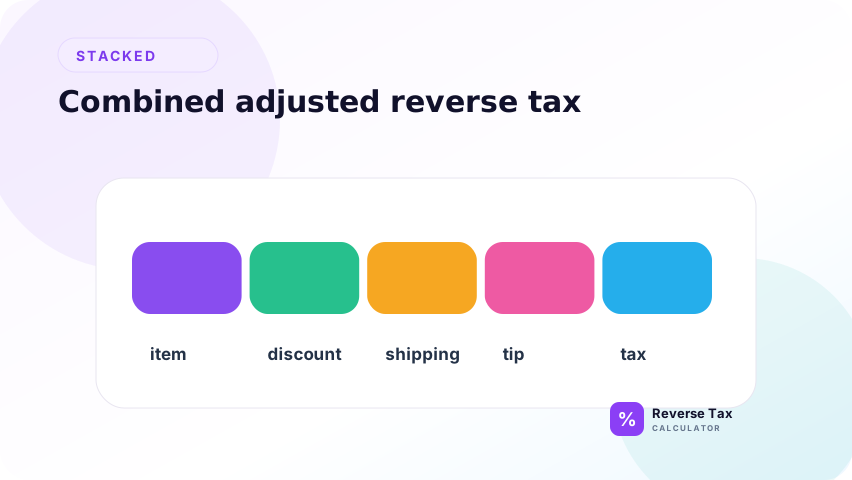
Suppose an order includes a discount, non-taxable shipping, and an optional tip:
| Line | Amount |
|---|---|
| Item before discount | 120.00 |
| Discount | 20.00 |
| Taxable item price | 100.00 |
| Tax at 8 percent | 8.00 |
| Non-taxable shipping | 10.00 |
| Optional tip | 15.00 |
| Final total | 133.00 |
Do not divide 133.00 by 1.08.
Correct workflow:
- Remove non-taxable shipping: 10.00.
- Remove optional tip: 15.00.
- Reverse only the tax-inclusive taxable item amount: 108.00.
Calculation:
133.00 - 10.00 - 15.00 = 108.00
108.00 / 1.08 = 100.00
108.00 - 100.00 = 8.00
The taxable base is 100.00, the included tax is 8.00, and the full final total is still 133.00.
Adjustment Decision Matrix
| Adjustment | Include before reverse tax? | Reason |
|---|---|---|
| Store discount before tax | No, it already reduced base | Reverse returns discounted base |
| Manufacturer coupon | Depends | Official rules can differ |
| Non-taxable shipping | No | Remove before reversing |
| Taxable shipping | Yes | It is part of taxable base |
| Handling charge | Depends | Often different from shipping |
| Optional tip | Usually no | It may not be taxable |
| Mandatory service charge | Depends, often yes | It may be taxable |
| Store credit | Usually no | It is often payment, not price |
| Refund credit | Depends | It may reverse a prior sale |
Operational Workflow
Use this workflow before entering a number into a calculator:
- Start with the final total.
- Identify all visible adjustments.
- Classify each adjustment as taxable, non-taxable, payment, or unknown.
- Remove non-taxable and payment items.
- Group remaining taxable amounts by rate.
- Reverse each group using the correct multiplier.
- Check the result by calculating forward.
This workflow is slower than a single formula, but it prevents the large errors that happen when the wrong total is used.
What Happens If You Use the Wrong Total?
Using the wrong total can create a believable but false answer.
In the combined example, the final total is 133.00. If you incorrectly divide 133.00 by 1.08:
133.00 / 1.08 = 123.15
133.00 - 123.15 = 9.85
That result implies 9.85 of tax. The correct included tax is 8.00 because shipping and the optional tip were not part of the taxable reverse-tax base in the example.
| Method | Included tax |
|---|---|
| Wrong final-total method | 9.85 |
| Correct adjusted-base method | 8.00 |
| Error | 1.85 |
This is the core reason adjusted-total examples deserve their own page.
Common Mistakes
| Mistake | Why it weakens the result |
|---|---|
| Dividing the final paid total by one multiplier | Includes non-taxable or payment amounts |
| Ignoring discounts | Reconstructs the wrong base |
| Treating all shipping as taxable or non-taxable | Shipping rules vary |
| Treating all tips the same | Optional and mandatory charges can differ |
| Ignoring coupons | Coupon type can change the taxable amount |
| Using a guessed rate | Tax split becomes unreliable |
| Ignoring rounding | One-cent differences may be normal |
What This Page Does Not Cover
| Topic | Better page |
|---|---|
| Multiple items only | Reverse Tax Example with Multiple Items |
| Receipt workflow | Reverse Tax Example Using a Receipt |
| Invoice workflow | Reverse Tax Example Using an Invoice |
| Refunds | Reverse Tax Example for a Refund |
| Rounding | How to Round Reverse Tax Calculations |
Frequently Asked Questions
Do I reverse tax before or after a discount?
Reverse tax from the tax-inclusive amount after the discount if the discount reduced the taxable price before tax.
Should shipping be included when removing tax?
Only include shipping if it was taxable in that transaction. If it was non-taxable and separately stated, remove it before reversing tax.
Are tips included in reverse tax?
Optional tips are often separate from the taxable amount, but mandatory service charges can be treated differently. Verify the rule for the transaction.
Can I use the final total if it includes a tip?
Usually not if the tip is optional and not taxable. Remove the tip first, then reverse the taxable bill amount.
Why does a coupon change sales tax?
Some official rules treat store-issued coupons and manufacturer coupons differently. The coupon type can change whether tax is calculated before or after the discount.
Sources
- California Department of Tax and Fee Administration, Tips, Gratuities, and Service Charges
- California Department of Tax and Fee Administration, Shipping and Delivery Charges
- New York State Department of Taxation and Finance, Coupons and Food Stamps
> Accuracy note: discounts, shipping, handling, tips, and service charges are rule-sensitive. Use this page to choose the correct calculation structure, then verify the official treatment for the specific jurisdiction and transaction.