
The reverse tax formula works because a tax-inclusive total is the pre-tax price multiplied by one plus the tax rate. Dividing by that multiplier cancels the original tax addition and returns the taxable base, while subtracting the base from the total gives the included tax. The logic holds for one rate and one taxable base, but mixed receipts, exempt items, stacked taxes, and rounding can change the practical result.
The formula is:
Pre-tax price = Total / (1 + Rate / 100)
What Is the Logic Behind the Formula?
The logic behind the reverse tax formula is that a tax-inclusive total is the original price plus tax on that original price. The total is not the original price plus tax on the total. Once tax is added, the gross amount becomes a multiplier of the net amount. Reverse tax divides by that multiplier to recover the original base.

The logic starts with the forward tax calculation.
Tax is added to a pre-tax price. The tax-inclusive total is the original price plus the tax amount.
If the rate is 10 percent, the total is 110 percent of the original price.
Why Does the Formula Start with the Total?
Reverse tax starts with the total because the user usually knows the final receipt, invoice, or price tag amount first.
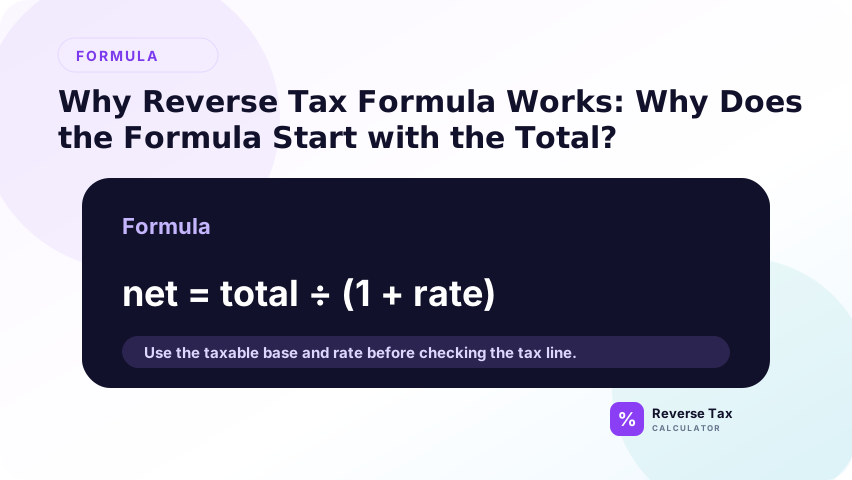
The unknown value is the pre-tax price. The formula works backward from the known final total to the unknown base.
| Known value | Unknown value |
|---|---|
| Tax-inclusive total | Pre-tax price |
| Tax rate | Included tax |
| Tax multiplier | Original taxable base |
This is why the formula uses division rather than subtraction.
How Forward Tax Creates the Total
Forward tax creates the total by multiplying the original price by one plus the tax rate. A $100.00 item at 8% becomes $100.00 multiplied by 1.08, which equals $108.00. The multiplier contains both the original 100% price and the 8% tax. Reverse tax works because division undoes that multiplication.

Forward tax starts with a pre-tax price.
The tax amount is:
Tax = Pre-tax price x Rate / 100
The total is:
Total = Pre-tax price + Tax
Substitute the tax expression:
Total = Pre-tax price + Pre-tax price x Rate / 100
How Algebra Reverses the Formula
Algebra reverses the formula by isolating the original price. If total equals original price multiplied by 1 plus rate, then original price equals total divided by 1 plus rate. This is not a trick. It is the same equation solved backward. The formula is reliable when the total is a clean tax-inclusive amount at one rate.
Factor out the pre-tax price:
Total = Pre-tax price x (1 + Rate / 100)
Now divide both sides by the multiplier:
Pre-tax price = Total / (1 + Rate / 100)
That is the reverse tax formula.
Why Division Reverses Multiplication
The forward calculation multiplies the pre-tax price by the tax multiplier.
The reverse calculation divides by that multiplier.
| Forward direction | Reverse direction |
|---|---|
| Pre-tax price x multiplier = total | Total / multiplier = pre-tax price |
This is the same inverse relationship used in basic algebra.
Why Subtracting the Rate Fails
Subtracting the rate from the total fails because it treats the total as the tax base.
The tax rate was applied to the pre-tax price, not the final total.
Example:
| Method | Result from 110.00 at 10 percent |
|---|---|
| Divide by 1.10 | 100.00 |
| Subtract 10 percent from total | 99.00 |
The subtraction method creates the wrong base.
Proof with Numbers
A numeric proof helps users see why subtraction fails. If the pre-tax price is $100.00 and tax is 8%, the total is $108.00. Dividing $108.00 by 1.08 returns $100.00. Subtracting 8% of $108.00 removes $8.64, which is too much because the tax was calculated on $100.00, not on $108.00.
Suppose the pre-tax price is 200.00 and the tax rate is 8 percent.
Forward calculation:
Tax = 200 x 0.08 = 16
Total = 200 + 16 = 216
Reverse calculation:
Pre-tax price = 216 / 1.08 = 200
The reverse formula returns the starting price.
Proof with a 20 Percent VAT Example
A 20% VAT example is useful because many users expect VAT to be 20% of the gross price. If the net price is 100.00, VAT is 20.00 and gross is 120.00. The VAT portion is 20.00, which is one sixth of the gross price. Dividing by 1.20 returns the net price correctly.
Suppose the pre-tax price is 100.00 and VAT is 20 percent.
Forward:
100 x 1.20 = 120
Reverse:
120 / 1.20 = 100
VAT:
120 - 100 = 20
The formula works because the same multiplier appears in both directions.
Proof with Variables
A variable proof shows that the formula is not tied to one tax rate. Let N be net price, r be the decimal tax rate, and T be the tax-inclusive total. Forward tax is T = N × (1 + r). Solving for N gives N = T / (1 + r). The tax amount is T minus N.
Let:
- P = pre-tax price
- R = rate as a decimal
- T = total
Forward:
T = P x (1 + R)
Reverse:
P = T / (1 + R)
This proves the reverse formula is the inverse of the forward formula.
Why the Tax Rate Must Be Part of the Multiplier
The tax rate must be part of the multiplier because the final total includes both the original price and the added tax.
If the rate is 8 percent, the total is 108 percent of the original price. Written as a multiplier, that is 1.08.
| Rate | Meaning | Multiplier |
|---|---|---|
| 5 percent | 105 percent of base | 1.05 |
| 8 percent | 108 percent of base | 1.08 |
| 10 percent | 110 percent of base | 1.10 |
| 20 percent | 120 percent of base | 1.20 |
Reverse tax divides by the full multiplier because the total contains the full base plus tax.
Why the Tax Share of the Total Is Smaller Than the Tax Rate
The tax share of a tax-inclusive total is smaller than the stated tax rate.
At a 20 percent tax rate, the tax is 20 percent of the pre-tax price. It is not 20 percent of the tax-inclusive total.
Example:
| Amount | Value |
|---|---|
| Pre-tax price | 100.00 |
| Tax at 20 percent | 20.00 |
| Total | 120.00 |
| Tax share of total | 16.67 percent |
This is why multiplying a tax-inclusive total by the tax rate overstates the included tax.
How the Formula Explains the Tax Fraction
The tax fraction shows the tax share of a tax-inclusive total.
For a 20 percent rate:
Tax fraction = 20 / (100 + 20)
Tax fraction = 20 / 120
Tax fraction = 1 / 6
That means VAT is one sixth of a 20 percent VAT-inclusive total. The rate is still 20 percent of the net price.
| Rate | Tax fraction of total |
|---|---|
| 5 percent | 5 / 105 |
| 10 percent | 10 / 110 |
| 20 percent | 20 / 120 |
This is another way to prove the same relationship.
Algebra Proof Using Tax Share
The tax-share proof explains why the tax portion of a gross total is smaller than the stated tax rate. The tax share of the total is r divided by 1 plus r. At 20%, that is 0.20 / 1.20, or one sixth. This proof is useful when the user needs tax amount directly rather than net amount.
The included tax can also be found from the total with this structure:
Included tax = Total x (Rate / (100 + Rate))
For 20 percent:
Included tax = 120 x (20 / 120)
Included tax = 20
This direct tax formula is mathematically consistent with first finding the pre-tax price and subtracting it from the total.
Decision Matrix: Which Explanation Do You Need?
| Need | Best page |
|---|---|
| Exact formula | Reverse Tax Formula |
| Algebra proof | This page |
| Step-by-step use | How to Calculate Tax Backwards |
| Error explanation | Why Subtracting the Tax Percentage Is Wrong |
| Worked examples | Reverse Tax Calculation Worked Examples |
When the Proof Assumes a Simple Tax
The simple proof assumes one tax rate, one taxable base, no exempt lines, no stacked tax, and no non-tax amounts inside the total. That assumption is common in simple receipts and VAT-inclusive examples, but it does not describe every real transaction. When the base is mixed, separate the receipt into clean groups first.
The proof assumes one percentage rate applied to one taxable base.
If multiple taxes, exempt items, discounts, or stacked rates are involved, the same general logic may apply, but the multiplier may need to be adjusted.
Why the Formula Still Works for Additive Taxes
The formula still works for additive taxes when all tax rates apply to the same base. If GST and PST both apply to a $100.00 base additively, the total multiplier is 1 plus GST rate plus PST rate. Reverse tax divides by that combined multiplier. If tax bases differ, the formula must be applied by group, not to the whole total.
If two taxes apply to the same base additively, the combined multiplier can still work.
Example:
Rate A = 5 percent
Rate B = 7 percent
Combined rate:
12 percent
Multiplier:
1.12
A 112.00 total reverses to:
112 / 1.12 = 100
This works only when both taxes apply to the same base.
Why the Formula Changes for Split Bases
If part of the total is exempt, the whole total does not share one multiplier.
Example:
| Component | Amount |
|---|---|
| Taxable total after tax | 108.00 |
| Exempt amount | 50.00 |
| Full total | 158.00 |
Correct:
108 / 1.08 = 100
Incorrect:
158 / 1.08 = 146.30
The wrong method treats the exempt amount as taxable.
What the Formula Can and Cannot Prove
| Formula can prove | Formula cannot prove |
|---|---|
| Arithmetic relationship between total and base | Correct tax rate |
| Why division is used | Product taxability |
| Why subtracting percentage fails | Exemption status |
| Tax share of total | Compliance treatment |
| Simple one-rate result | Rounding method used by a receipt |
This is the trust boundary of the page. The proof is mathematical, not legal.
Why This Matters for Real Receipts
Real receipts often contain more than one kind of amount. The formula works perfectly only after the correct taxable total has been isolated.
If the receipt includes an exempt item, optional tip, refund credit, or non-taxable fee, those amounts must be separated before the multiplier proof applies.
The formula is strong, but it needs the right input.
> Accuracy note: this page proves the arithmetic formula. It does not verify rates, taxability, exemptions, or legal treatment.
What Breaks the Simple Proof?
The simple proof breaks when the total is not one clean taxable base at one additive rate. Multiple rates, stacked taxes, exempt items, discounts, shipping, fees, tips, refunds, and rounding can all change the input. The formula itself is still algebraically true, but it must be applied to the correct entity.
That is the practical bridge between algebra and real receipts. A formula can be mathematically correct and still produce a weak answer if the total contains several entities. The solution is not abandoning the formula. The solution is entity-first preparation: separate taxable items, exempt items, rates, discounts, fees, and refunds before applying the proof to each clean group.
The simple proof can break when the taxable base is not a single clean amount.
Multiple Tax Rates
If multiple tax rates apply to different items, one multiplier cannot represent the whole transaction.
Stacked Taxes
If one tax is applied after another tax, the multiplier must account for the order.
Exempt Items
If part of the total is exempt, the whole total should not be divided by one tax multiplier.
Discounts Before Tax
If discounts change the taxable base, the formula must use the discounted taxable amount.
Operational Table: Which Proof Applies?
| Situation | Formula proof type |
|---|---|
| One rate on one base | Simple multiplier proof |
| Multiple additive taxes | Combined additive multiplier |
| Stacked taxes | Sequential multiplier |
| Mixed taxable and exempt items | Split-base calculation |
| Rounding differences | Formula plus rounding rule |
Frequently Asked Questions
Why does the reverse tax formula work?
It works because it divides by the same multiplier used to create the tax-inclusive total.
What is the tax multiplier?
The multiplier is 1 plus the tax rate as a decimal. For 10 percent, the multiplier is 1.10.
Why not subtract the rate?
Because the rate applies to the pre-tax price, not the total.
Does the proof work for VAT and GST?
Yes, for a simple percentage-based VAT or GST included in the total.
Why is 20 percent VAT not 20 percent of the total?
Because the 20 percent rate applies to the pre-tax price. In a 120.00 VAT-inclusive total at 20 percent, the VAT is 20.00, which is 16.67 percent of the total.
Is the reverse formula an estimate?
The arithmetic is exact for a simple one-rate total. Real receipts may still differ because of rounding, exemptions, or multiple rates.