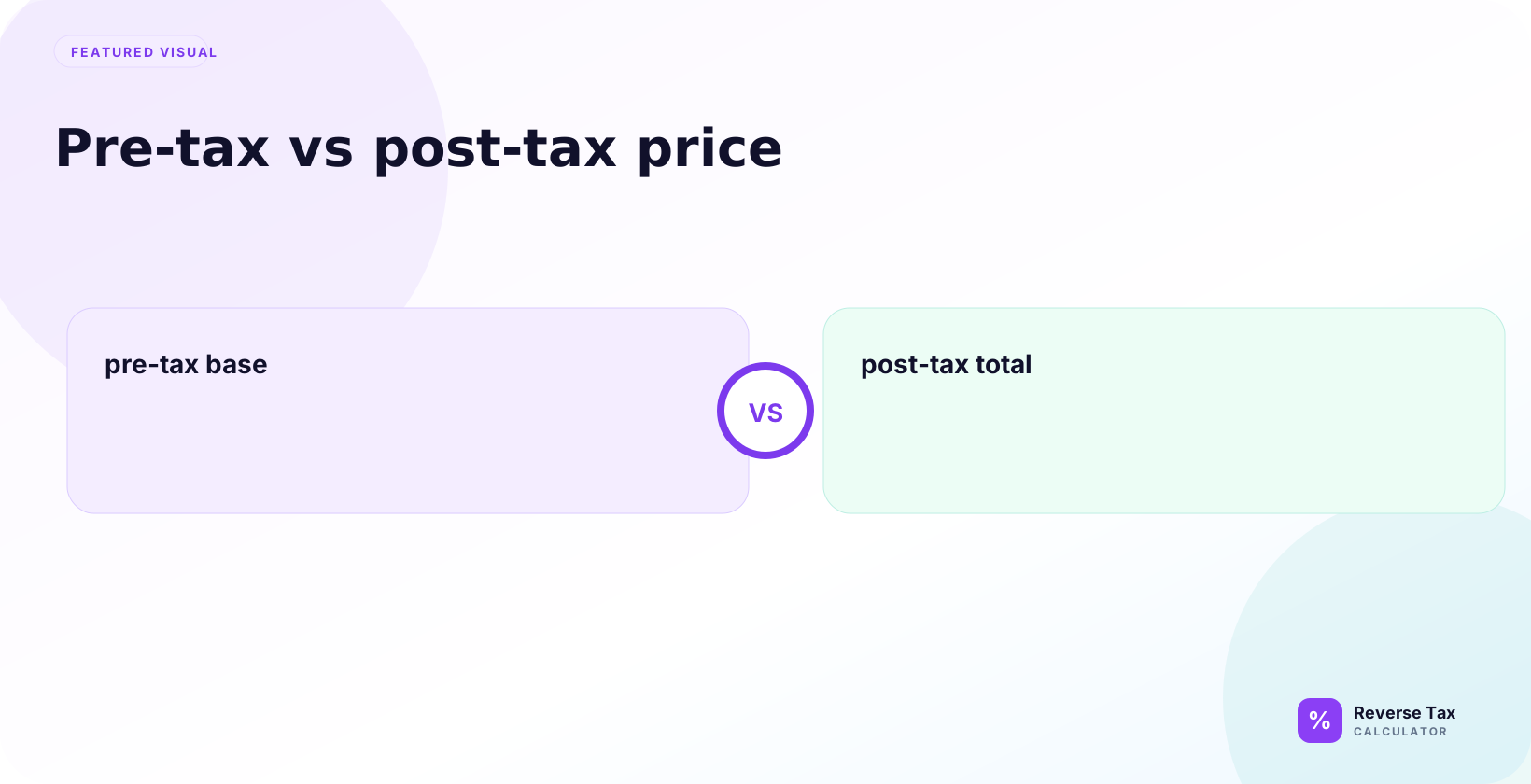
Pre-tax price is the amount before tax is added, while post-tax price is the final amount after tax is included. Reverse tax starts with the post-tax price and divides it by the tax multiplier to recover the pre-tax price and included tax. The comparison matters for receipts, invoices, refunds, and pricing checks because using the wrong price type reverses the calculation direction. Tax-inclusive labels identify the post-tax amount.
The difference matters because sales tax, VAT, GST, HST, PST, QST, and similar taxes are usually calculated from a tax base. If you confuse the price before tax with the price after tax, you can calculate the wrong tax amount, use the wrong base, or misread a receipt.
What Is the Difference Between Pre-Tax and Post-Tax Price?
The difference is tax inclusion.
Pre-tax price excludes the tax added to a transaction. Post-tax price includes tax and is often the amount paid by the customer.
| Term | Includes tax? | Typical use |
|---|---|---|
| Pre-tax price | No | Base price, subtotal before tax, net selling price |
| Post-tax price | Yes | Final price, receipt total, tax-inclusive total |
This distinction is simple, but it affects every reverse tax calculation. The tax rate is applied to the pre-tax price, while the post-tax price contains both the pre-tax amount and the tax.
What Is a Pre-Tax Price?
A pre-tax price is the amount before tax is added. It is the taxable base used to calculate sales tax, VAT, GST, HST, or another transaction tax. Depending on the document, it may be called net price, subtotal, tax-exclusive price, or amount before tax. Reverse tax often tries to recover this value from a tax-inclusive total.
A pre-tax price is the amount before tax is added.
It is the tax base for a simple percentage-based tax calculation. If an item costs 100.00 before tax and the tax rate is 10 percent, the tax is calculated from 100.00, not from the final total.
What Does Pre-Tax Mean on a Receipt or Invoice?
On a receipt or invoice, pre-tax may appear as subtotal, net amount, amount before tax, taxable amount, or price before tax.
These labels are not always identical in every system, so context matters. A subtotal may be before tax on one receipt, but another receipt may use subtotal differently. For the specific subtotal question, see Subtotal, Tax, and Total Explained.
Why Pre-Tax Price Is the Base for Tax
Pre-tax price matters because the tax percentage is normally applied to this amount.
If the tax rate is 10 percent and the pre-tax price is 100.00, the tax is 10.00. The post-tax price becomes 110.00.
The mistake happens when someone applies 10 percent to the 110.00 post-tax total instead. That uses the wrong base.
What Is a Post-Tax Price?
A post-tax price is the amount after tax has been added or included. It may be called gross price, total, tax-inclusive price, or amount including tax. In reverse tax, post-tax price is often the starting number. The formula divides it by 1 plus the rate to recover the pre-tax price.
A post-tax price is the amount after tax is included.
It may be the final checkout total, receipt total, invoice total, or tax-inclusive price shown to a customer.
Why Post-Tax Price Is Usually the Final Price
Post-tax price is usually the final price because it includes the pre-tax amount plus tax.
For example, if a pre-tax item price is 100.00 and the tax is 10.00, the post-tax price is 110.00.
What Does Post-Tax Mean in Reverse Tax?
In reverse tax, post-tax price is the starting number.
The user usually has the final total and wants to know what amount existed before tax was added. This is why reverse tax is sometimes described as finding the price before tax from the total.
How Do Pre-Tax and Post-Tax Prices Relate?
Pre-tax and post-tax prices relate through the tax multiplier. Post-tax price equals pre-tax price multiplied by 1 plus the tax rate. Reverse tax divides post-tax price by the same multiplier to recover pre-tax price. The tax amount is the difference between the two. This relationship works when the base and rate are clean.
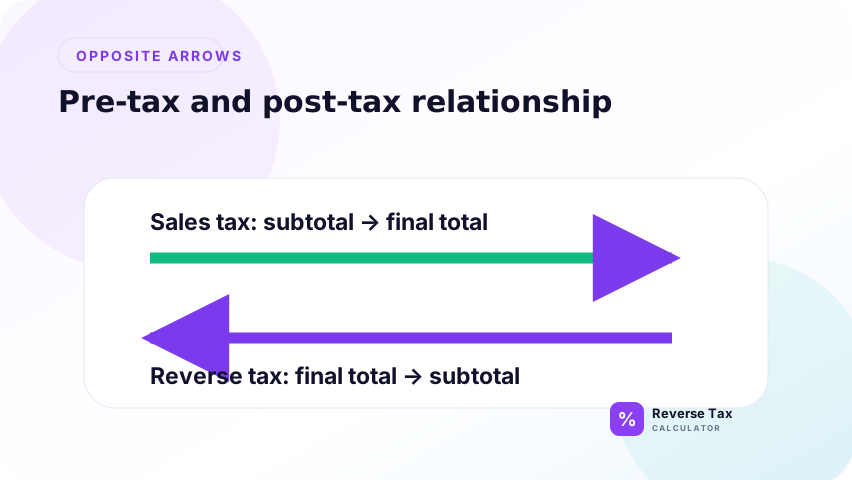
Pre-tax and post-tax prices are two sides of the same transaction.
The pre-tax price is the base. The tax amount is added to that base. The post-tax price is the result.
Pre-Tax Price Plus Tax Equals Post-Tax Price
In a forward tax calculation:
Pre-tax price plus tax amount equals post-tax price.
Example:
| Component | Amount |
|---|---|
| Pre-tax price | 100.00 |
| Tax at 10 percent | 10.00 |
| Post-tax price | 110.00 |
Post-Tax Price Minus Included Tax Equals Pre-Tax Price
In a reverse tax calculation, the direction changes.
You begin with the post-tax price and separate the included tax to recover the pre-tax price.
That is why reverse tax needs the post-tax total and the tax rate.
Why Does This Difference Matter for Reverse Tax?
Reverse tax exists because post-tax totals often hide the pre-tax price.
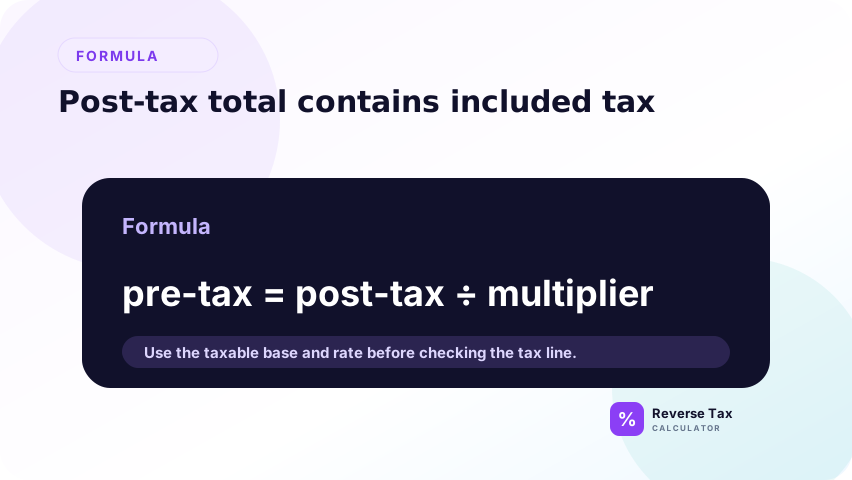
If a receipt or invoice already includes tax, you cannot simply subtract the tax percentage from the final total. The final total is not the tax base. The pre-tax price is the tax base.
This is also why the article How Does Reverse Tax Work? explains the tax multiplier. The multiplier connects the pre-tax amount to the post-tax total.
How Do You Identify Pre-Tax and Post-Tax Prices on Real Documents?
Identify pre-tax and post-tax prices by reading labels such as subtotal, taxable subtotal, net, tax, total, gross, VAT included, GST inclusive, or amount due. The last number on a document is not always the post-tax sale because it may include payments, deposits, tips, fees, or outstanding balance. Use labels and line structure before calculating.
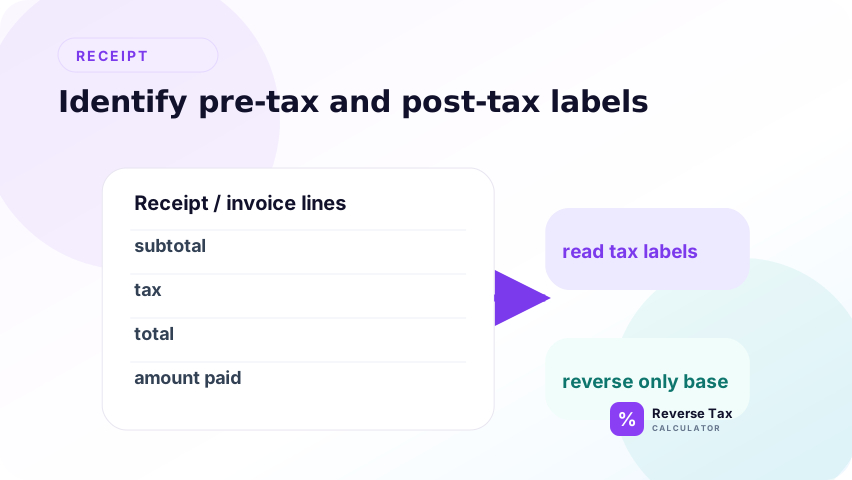
You identify pre-tax and post-tax prices by reading the labels around the number.
A receipt, invoice, checkout page, or quote may use different wording for the same relationship. The safest approach is to locate the tax line first, then decide whether the number appears before or after that line.
What Labels Usually Mean Pre-Tax?
These labels usually point to a pre-tax number:
- Subtotal before tax
- Amount before tax
- Taxable amount
- Net amount
- Price excluding tax
- Tax-exclusive price
The word "usually" matters. Some receipts use subtotal differently, especially when discounts, service charges, tips, or delivery fees appear before tax.
What Labels Usually Mean Post-Tax?
These labels usually point to a post-tax number:
- Total
- Total paid
- Amount due
- Tax-inclusive price
- Price including tax
- Gross amount
If the total includes other fees besides tax, reverse tax may separate only the tax portion if the taxable base and rate are known.
What If the Receipt Does Not Say Whether Tax Is Included?
If a receipt does not clearly say whether tax is included, check whether it has a separate tax line.
If the tax line is added after the subtotal, the subtotal is normally pre-tax and the final total is post-tax. If the receipt says the total includes tax but does not show a separate tax amount, reverse tax may estimate the split when the rate is known.
How Do Official Tax Systems Show This Distinction?
Official tax systems often care whether tax is included in the displayed price, added separately, or shown clearly on invoices.
In the United Kingdom, GOV.UK lists VAT rates including the standard VAT rate of 20 percent, a reduced rate of 5 percent for some goods and services, and a zero rate of 0 percent for zero-rated goods and services. Those figures matter because a post-tax price at 20 percent does not reverse to the same pre-tax price as a post-tax price at 5 percent.
In Canada, the CRA says the rate to charge depends on the place of supply. Its examples include 13 percent HST for Ontario, 14 percent HST for Nova Scotia after the 2025 decrease, and Manitoba treatment where GST is 5 percent and PST is 7 percent in the example. That reinforces why the rate must be known before a post-tax price can be reversed accurately.
> Trust note: this page explains price terms and arithmetic relationships. Tax rates and tax treatment depend on jurisdiction, place of supply, item type, and official rules. For calculation standards, see the methodology.
Pre-Tax vs Post-Tax Decision Matrix
Use this matrix to decide which number you have.
| If the number... | It is probably | What to do |
|---|---|---|
| Appears before a tax line | Pre-tax price | Add tax if you need the final total |
| Appears as the final receipt amount | Post-tax price | Reverse tax if you need the pre-tax price |
| Is called subtotal | Usually pre-tax, but verify | Check whether tax is listed after it |
| Is called total paid | Usually post-tax | Reverse tax if the rate is known |
| Includes VAT, GST, or sales tax in the label | Post-tax or tax-inclusive | Reverse tax if you need the base |
| Excludes tax in the label | Pre-tax or tax-exclusive | Add tax, not reverse tax |
Operational Table: Which Price Should You Enter?
Use this operational table when you are using a calculator or spreadsheet.
| Task | Number to enter first | Rate needed? | Result you should expect |
|---|---|---|---|
| Find price before tax | Post-tax total | Yes | Pre-tax price and included tax |
| Add tax to a listed price | Pre-tax price | Yes | Post-tax total |
| Check a receipt total | Post-tax total | Yes | Estimated base and tax split |
| Verify a subtotal | Pre-tax subtotal | Yes | Expected tax and total |
| Compare two sellers | Use the same price basis for both | Maybe | Fair pre-tax or post-tax comparison |
This table prevents a common operational mistake: entering a pre-tax price into a reverse calculator or entering a post-tax price into a forward calculator.
What Data Can Change the Pre-Tax and Post-Tax Relationship?
Discounts, fees, exempt items, multiple rates, refunds, shipping, tips, and rounding can change how pre-tax and post-tax prices relate. A simple total may divide cleanly by one rate, but a mixed receipt needs group-level calculation. The relationship is still arithmetic, but the correct input must be isolated first.
The relationship is simple when one tax rate applies to one total. It becomes more complex when the transaction contains special conditions.
Different Tax Rates
Different tax rates produce different post-tax totals from the same pre-tax price.
A 100.00 pre-tax price becomes 105.00 at 5 percent, 110.00 at 10 percent, and 120.00 at 20 percent.
Tax-Exempt or Zero-Rated Items
If some items are exempt or zero-rated, the whole total may not be taxable at one rate.
In that case, the taxable and non-taxable parts should not be reversed together as one simple number.
Discounts and Coupons
Discounts can change the taxable base.
Whether the tax applies before or after a discount depends on transaction rules. That detail belongs in How Discounts and Coupons Affect Reverse Tax.
Shipping, Tips, and Fees
Shipping, delivery, tips, and service fees may or may not be taxable depending on the jurisdiction and transaction.
That means a post-tax total may include more than the item price and tax.
Why Official Rates Are Useful but Not Enough
Official tax rates are necessary, but they do not always complete the calculation by themselves.
GOV.UK lists the UK standard VAT rate as 20 percent, but it also lists reduced and zero rates. CRA guidance shows that Canadian GST/HST treatment can depend on place of supply and type of supply. These examples show why a user must know both the rate and the taxable base.
What a Rate Can Tell You
A rate can tell you how the tax relates to the taxable amount.
For example, a 20 percent rate means the tax is 20 percent of the pre-tax price. It does not mean the tax is 20 percent of the post-tax total.
What a Rate Cannot Tell You
A rate cannot tell you whether the item was taxable, exempt, zero-rated, discounted before tax, or mixed with other charges.
That is why a reverse tax result should be treated as a calculation result, not a full tax determination.
What This Page Does Not Cover
This page compares pre-tax and post-tax price. It does not fully explain every nearby topic.
| Topic | Better page |
|---|---|
| Exact reverse tax equation | Reverse Tax Formula |
| How to calculate tax backward | How to Calculate Tax Backwards |
| Subtotal, tax, and total labels | Subtotal, Tax, and Total Explained |
| Net and gross wording | Net Price vs Gross Price |
| Tax-inclusive versus tax-exclusive pricing | Tax-Inclusive vs Tax-Exclusive Pricing |
Frequently Asked Questions
Is pre-tax price the same as subtotal?
Often, yes, but not always. Many receipts use subtotal for the amount before tax, but some documents use subtotal differently. Check whether tax is added after the subtotal.
Is post-tax price the same as total?
Usually, yes. If the total includes tax, it is a post-tax price. If the document says tax is excluded, the total may not be post-tax yet.
Do I use pre-tax or post-tax price for reverse tax?
Use the post-tax price as the starting number. Reverse tax works backward from the tax-inclusive total to the pre-tax price.
Why is the pre-tax price not found by subtracting the tax rate?
Because the tax rate was applied to the pre-tax price, not to the post-tax total. Subtracting the percentage from the total usually uses the wrong base.
Can the same price be pre-tax in one country and post-tax in another?
Yes. Price display rules and business practices differ. Some prices are shown tax-inclusive, while others add tax at checkout. Always check whether tax is included.
Sources
The formulas on this page come from the arithmetic relationship between pre-tax price, tax rate, tax amount, and post-tax price. Use official tax authority guidance for taxability, rate selection, exemptions, and filing-sensitive decisions. Use this page to interpret document labels and choose the right calculation direction.
- GOV.UK, VAT rates
- Canada Revenue Agency, Charge and collect the GST/HST