
Reverse charge and reverse tax solve different tax problems. Reverse charge shifts VAT reporting responsibility from seller to buyer, while reverse tax removes included tax from a gross total to find the before-tax price and tax amount. The reverse charge affects compliance and invoice wording; reverse tax affects arithmetic, receipt checks, pricing, refunds, and bookkeeping splits. The correct term depends on whether the user is asking about tax liability or tax-inclusive calculation.
What Is Reverse Tax Calculation?
Reverse tax calculation is arithmetic that removes tax from a tax-inclusive amount or finds the tax portion inside a total. It is not the same as reverse charge. Reverse tax calculation answers "what was the pre-tax amount?" or "how much tax is included?" It can be used for VAT, GST, sales tax, refunds, receipts, and invoices when the rate and base are known.
Reverse tax calculation works backward from a tax-inclusive amount.
Formula:
Pre-tax amount = Total / (1 + rate / 100)
Then:
Included tax = Total - pre-tax amount
Example:
120.00 / 1.20 = 100.00
120.00 - 100.00 = 20.00
This is arithmetic. It does not decide who must report the tax.
What Is Reverse Charge?
Reverse charge is a tax accounting mechanism. In a reverse charge transaction, the seller may not charge VAT in the usual way. Instead, the buyer accounts for the VAT under the applicable rule.
GOV.UK explains reverse charge in several VAT contexts, including domestic reverse charge rules for certain supplies and services. The exact rule depends on the country, supply type, customer status, and transaction conditions.
Reverse charge is not a calculator formula. It is a compliance treatment.
Reverse Charge vs Reverse Tax Table
| Feature | Reverse tax calculation | Reverse charge |
|---|---|---|
| Main meaning | Remove tax from total | Buyer accounts for tax |
| Type | Math method | Tax rule or accounting mechanism |
| Input | Tax-inclusive total and rate | Transaction facts and law |
| Output | Pre-tax amount and tax amount | Accounting treatment |
| Used by | Shoppers, bookkeepers, sellers | VAT-registered businesses |
| Can calculator decide it? | Yes for math | No |
Example of Reverse Tax Calculation
Suppose a VAT-inclusive total is 240.00 and the VAT rate is 20 percent.

240.00 / 1.20 = 200.00
240.00 - 200.00 = 40.00
The reverse tax result is:
| Component | Amount |
|---|---|
| Net amount | 200.00 |
| VAT included | 40.00 |
| Gross total | 240.00 |
Example of Reverse Charge
Suppose a VAT-registered supplier provides a service covered by a domestic reverse charge rule to a VAT-registered customer. The supplier may issue an invoice that does not charge VAT in the normal way and states that reverse charge applies. The customer accounts for VAT according to the relevant rule.
The key point is that the invoice treatment is determined by the reverse charge rule, not by dividing a gross total by a tax rate.
| Reverse charge field | Meaning |
|---|---|
| Supplier | May not charge VAT normally |
| Customer | Accounts for VAT |
| Invoice note | May state reverse charge applies |
| Tax authority rule | Determines treatment |
| Calculator role | None for deciding rule |
When to Use Each Term
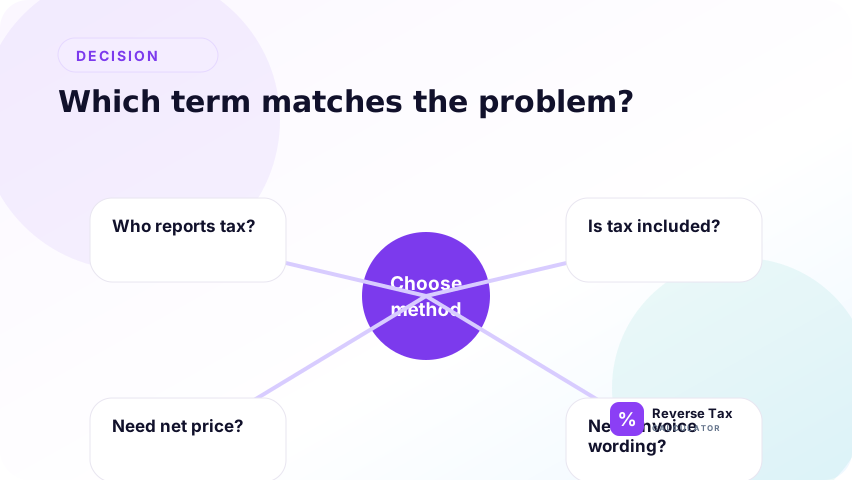
Use reverse tax calculation when asking:
- how do I remove tax from a total;
- how do I find price before tax;
- how much VAT is included;
- how do I calculate tax backwards.
Use reverse charge when asking:
- who accounts for VAT;
- should VAT be charged on this invoice;
- does domestic reverse charge apply;
- how should a VAT-registered customer record the transaction.
Decision Matrix
| Situation | Correct concept |
|---|---|
| Total includes tax and you need pre-tax amount | Reverse tax calculation |
| Invoice says reverse charge applies | Reverse charge |
| Seller charged VAT and you want net amount | Reverse tax calculation |
| Buyer must account for VAT | Reverse charge |
| You need arithmetic split | Reverse tax calculation |
| You need compliance treatment | Reverse charge |
Can Reverse Charge Still Need Math?
Yes, reverse charge accounting can involve calculating VAT for records. But the decision that reverse charge applies is separate from the math.
| Step | Type |
|---|---|
| Decide whether reverse charge applies | Legal or accounting rule |
| Determine taxable value | Invoice or contract analysis |
| Calculate VAT amount for accounting | Math |
| Report transaction | Compliance process |
This is why a reverse tax calculator may help with arithmetic but cannot determine reverse charge status.
Reverse Charge Invoice Clues
A reverse charge invoice may include wording that tells the customer to account for VAT. Exact wording requirements depend on the jurisdiction and rule.
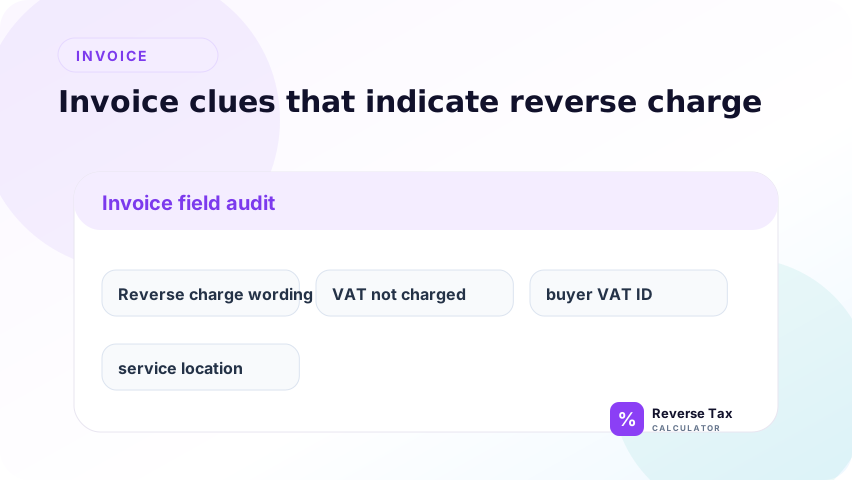
Look for clues such as:
| Invoice clue | Meaning |
|---|---|
| Reverse charge statement | Customer may account for VAT |
| VAT not charged in normal way | Supplier may not add VAT |
| Customer VAT number | Customer status may matter |
| Supply category | Rule may apply only to certain goods or services |
| Taxable value | Amount used for accounting |
These clues are not enough by themselves. The rule still has to apply to the transaction.
Reverse Tax Invoice Clues
A reverse tax calculation usually starts from a different kind of clue:
| Invoice clue | Calculation use |
|---|---|
| VAT included | Reverse from gross total |
| Tax rate shown | Use rate multiplier |
| Gross total | Main input |
| Net amount missing | Reverse tax can reconstruct it |
| Tax amount shown | Verify by subtraction |
If the invoice says reverse charge, do not assume it is tax-inclusive.
Example: Same Word, Different Problem
Two users can search “reverse VAT” and mean different things.
| User question | Likely meaning |
|---|---|
| How do I reverse VAT from 120? | Reverse tax calculation |
| What is VAT reverse charge? | Tax accounting mechanism |
| Why does invoice say reverse charge? | Compliance question |
| How do I find VAT included in price? | Reverse VAT calculation |
This is why a comparison page is necessary. It prevents the calculator page from ranking for a compliance query it should not answer as math.
Common Mistakes
Common mistakes include confusing reverse charge with reverse tax calculation, treating a reverse-charge invoice as if tax was included in the price, using a calculator to decide VAT reporting obligations, and ignoring invoice wording. The fix is to identify whether the question is legal responsibility for VAT or arithmetic removal of included tax.
The easiest test is to ask what the user is trying to find. If they need to know who accounts for VAT, the topic is reverse charge and official VAT guidance applies. If they need to remove VAT, GST, or sales tax from a gross total, the topic is reverse tax calculation. The words sound similar, but the tasks are different.
Thinking Reverse Charge Means Remove VAT from a Total
Reverse charge is not the same as reverse VAT calculation.
Using a Calculator to Decide Reverse Charge
A calculator cannot determine customer status, supply type, or legal conditions.
Treating Every Business Invoice as Reverse Charge
Reverse charge applies only when the relevant rule applies.
Ignoring Invoice Wording
Reverse charge invoices often need specific wording or treatment.
Confusing Gross and Net Amounts
Reverse tax calculation starts with a tax-inclusive total. Reverse charge invoices may not include VAT in the same way.
Entity Map
| Entity | Reverse tax role | Reverse charge role |
|---|---|---|
| Total | Math input | May be taxable value |
| Tax rate | Math input | Accounting rate |
| Seller | Usually charged tax | May not charge tax normally |
| Buyer | Pays tax-inclusive total | Accounts for tax |
| Invoice | Shows total and tax | May state reverse charge |
| Tax authority rule | Confirms rate | Determines mechanism |
Operational Workflow
Use this workflow to avoid mixing the concepts:

- Read the invoice wording.
- Decide whether the problem is arithmetic or compliance.
- If the price includes tax, use reverse tax calculation.
- If the invoice says reverse charge, check official reverse charge guidance.
- If both math and reverse charge accounting are needed, separate the steps.
- Keep evidence of the tax authority rule and invoice wording.
What a Calculator Can and Cannot Do
| Calculator can do | Calculator cannot do |
|---|---|
| Divide a gross amount by a tax multiplier | Decide whether reverse charge applies |
| Find tax included in a total | Confirm customer VAT status |
| Check invoice arithmetic | Interpret legal wording |
| Show tax effect at a rate | Replace accountant or tax authority guidance |
Accounting Risk Comparison
| Risk | Reverse tax calculation | Reverse charge |
|---|---|---|
| Wrong rate | Wrong arithmetic split | Wrong accounting amount |
| Wrong transaction type | Usually calculation mismatch | Rule may not apply |
| Wrong customer status | Usually not relevant | Can be decisive |
| Missing invoice wording | Usually not relevant | Can affect compliance |
| Mixed tax rates | Split by rate | Check rule and taxable value |
Reverse charge has higher compliance risk because it depends on facts outside the price itself.
Example: Reverse Tax and Reverse Charge Together
A business may need both concepts in a workflow:
- Read the invoice.
- Determine whether reverse charge applies under the official rule.
- Identify the taxable value.
- Calculate the VAT amount for accounting records.
- Record the transaction according to the reverse charge rule.
Only step 4 is a calculator-style math step. The other steps require tax-rule interpretation.
Why Search Intent Matters
Search engines can see “reverse tax” and “reverse charge” as related entities, but the user intent is different.
| Query | Intent |
|---|---|
| reverse tax calculator | Math tool |
| reverse VAT calculator | Remove VAT from gross price |
| VAT reverse charge | Tax accounting rule |
| reverse charge invoice | Invoice compliance |
| reverse charge vs VAT | Concept comparison |
Reverse charge belongs on a separate explanation page because it changes tax reporting responsibility, not the arithmetic used to remove tax from a gross total.
What This Page Does Not Cover
| Topic | Better page |
|---|---|
| Reverse VAT formula | How to Reverse VAT from a Total |
| UK VAT removal | How to Remove UK VAT from a Price |
| GST reverse calculation | How to Reverse GST from a Total |
| Bookkeeping | How to Separate Sales Tax for Bookkeeping |
Frequently Asked Questions
Is reverse charge the same as reverse tax?
No. Reverse tax is a calculation. Reverse charge is a VAT or GST accounting mechanism.
Can a reverse tax calculator handle reverse charge?
It can help with arithmetic, but it cannot decide whether reverse charge rules apply.
What does reverse charge mean on an invoice?
It usually means the customer accounts for VAT under the applicable reverse charge rule.
What does reverse tax mean?
It means calculating backward from a tax-inclusive total to find the pre-tax amount and tax included.
Should VAT be included on a reverse charge invoice?
That depends on the specific reverse charge rule and jurisdiction. Check official tax authority guidance or an accountant.
Sources
These sources support the distinction between tax mechanism and calculation method. Reverse charge is a VAT compliance concept, while reverse tax calculation is an arithmetic operation. Use official tax authority guidance for reverse-charge obligations and use this page for understanding when a reverse calculator is or is not relevant.
- GOV.UK, VAT reverse charge technical guidance
- GOV.UK, VAT domestic reverse charge for building and construction services